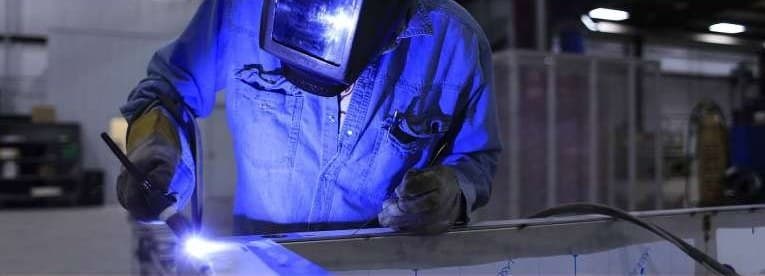
A welding job is won at the weld test, not on paper. A shop gives you a coupon, a position and a process, and then bends or x-rays what you produce. The American Welding Society's own Certified Welder programme works the same way: it is a performance test with no written exam, and AWS state plainly that there are no educational prerequisites and no minimum experience requirement.
What the weld test actually is
A pre-employment test is a short, specific task. You are given a joint - usually plate or pipe, prepared with a bevel - a process, a position, and a code to weld to. You get a set time, and the result is destroyed to see inside it: bent in a jig until the face and root either hold or tear, or radiographed.
The positions a test will name
| Code | What it means |
|---|---|
| 1G / 1F | Flat. The easiest, and the one nobody tests you on |
| 2G / 2F | Horizontal |
| 3G / 3F | Vertical. The common structural test, usually uphill |
| 4G / 4F | Overhead |
| 5G | Pipe fixed horizontal - you weld around it, through every position |
| 6G | Pipe fixed at 45 degrees. The hardest, and the one that qualifies you for most others |
G is a groove weld, F a fillet. A shop that asks for 3G and 4G with stick is testing structural work; 6G with TIG root and stick fill is a pipe test, and a different career. If the test is stick, the thing to practise is holding a short arc out of position, and the rod will almost certainly be 7018 - which is the one that has to be dry.
Certification: what AWS actually requires
This is the part most career pages get wrong by making it sound harder than it is. AWS run the Certified Welder programme as a performance test only - no written examination - taken at an AWS Accredited Test Facility, to the QC47 specification, covering procedures used in structural steel, sheet metal, petroleum pipelines, pressure vessels and chemical refinery construction.
That matters for two reasons. A career changer with no welding history can sit the test as soon as they can pass it. And a certificate from four years ago, with no continuity behind it, is not what the employer thinks they are reading. How certification works goes through it in more detail.
Where the jobs are
The Bureau of Labor Statistics counted 421,730 welders, cutters, solderers and brazers in May 2023, earning a median of $48,940 a year. The largest employers are fabricated metal product and machinery manufacturing.
Welders in the United States, May 2023
| Figure | |
|---|---|
| People employed | 421,730 |
| Median annual wage | $48,940 |
| Mean annual wage | $52,640 |
| 10th percentile | $36,830 |
| 90th percentile | $72,970 |
| State with most welders | Texas, 52,820 |
| State with the highest mean wage | Wyoming, $65,730 |
Wyoming paying more than Texas is the useful part of that table. The high-wage states are not the ones with the most welders - they are the ones where the work is remote, industrial and short of people. The same pattern shows up within specialisms and, at the extreme, in commercial diving.
The three routes in
How people actually start
None of these is better than the others; they suit different situations.
- Registered apprenticeship
- paid from day one, and the US Department of Labor lists welding among its registered apprenticeship occupations. Slowest to start, because you have to find an employer taking apprentices, and the best of the three if you do
- Community college or trade school
- six months to two years, you pay, and you come out with booth time and a test to sit. Check the programme's placement rate before the brochure
- Hired as a helper
- turn up at a fabrication shop, take the worst job in it, and learn from the welders. Cheapest and slowest, and still how a lot of shops fill positions
- Self-taught, then test
- legitimate, because the certification has no prerequisites. It requires a machine, a lot of steel and the honesty to know when you are not ready
The resume, in the form a shop reads
A welding resume is not a career story. It is a list of what you are qualified to do, and a hiring foreman reads four things before anything else.
- Processes, by their proper names: SMAW, GMAW, FCAW, GTAW. Writing stick, MIG, flux-core and TIG is fine too; writing only that you can weld is not
- Positions you have been tested in, by code: 3G, 4G, 6G. Not good at vertical
- Codes you have welded to: AWS D1.1 for structural steel, ASME Section IX for pressure work, API 1104 for pipelines
- Materials and thickness: carbon steel to 1 inch, 304 and 316 stainless, aluminium 6061
- Certifications with dates and continuity, because a lapsed one is a different claim from a current one
Put those in the first third of a single page. Everything else - the jobs, the dates, the references - is what the foreman reads after deciding you are worth testing.
What gets people rejected
- Failing the bend test on the root, which is almost always incomplete penetration rather than a bad cap
- Turning up without their own hood, gloves and leathers. Some shops supply them; arriving assuming so reads as not serious
- Grinding the test coupon. Many tests forbid it, and doing it anyway ends the test
- Not asking what the test will be. Calling ahead to ask process, position, material and code is not cheek - it is what a professional does
- A certification with no continuity behind it, presented as current
Frequently asked questions
Do I need to be certified to get a welding job?
Not always to be hired, but almost always to keep the job on anything structural or pressure-bearing. Many shops test you themselves and certify you in-house to the code they work to. AWS certification is portable, which is its advantage - it goes with you when you leave.
How long does it take to become employable as a welder?
Six months of serious booth time is a common answer for basic structural work, because the AWS Certified Welder programme has no minimum experience requirement - you can sit the test whenever you can pass it. Pipe work to 6G takes considerably longer, which is part of why it pays more.
What is the hardest welding test position?
6G: pipe fixed at 45 degrees, so you weld uphill, overhead and flat in one pass around the joint without moving the pipe. It is the standard pipe test precisely because passing it qualifies you for most other positions.
Can I get a welding job with no experience?
Yes, by two routes. A registered apprenticeship pays you from the start and trains you, and welding is listed among the US Department of Labor's registered apprenticeship occupations. Or you start as a shop helper. What you cannot do is pass a weld test without having welded.
What should I bring to a weld test?
Your own hood, gloves, leathers, safety glasses and boots, a grinder if the test allows one, and your certification paperwork. Call ahead and ask what the test is - process, position, material, thickness and code - and practise that exact joint before you go.
Sources
- American Welding Society - Certified Welder Program: performance test only, no prerequisites, six-monthly continuity
- US Bureau of Labor Statistics - Occupational Employment and Wages, May 2023: Welders, Cutters, Solderers and Brazers
- BLS Occupational Outlook Handbook - Welders, Cutters, Solderers and Brazers
- Apprenticeship.gov - registered apprenticeship listings for welders, cutters, solderers and brazers
- AWS - Accredited Test Facilities
- WeldTube - testing day at the welding lab
In short
Find out what the test is, practise that exact joint until you can pass it cold, and put the processes, positions and codes in the first third of one page. The certification has no prerequisites and no minimum experience, so the only real barrier is whether the weld holds when they bend it - which is a fairer hiring process than most trades offer, and the reason a career change into welding is genuinely possible at any age.