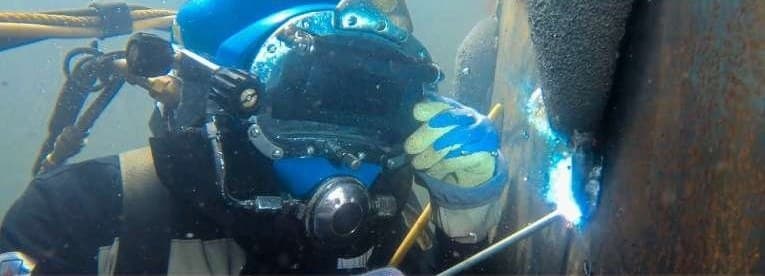
To become an underwater welder you become a commercial diver first and a welder second. The route is a welding ticket on land, then commercial diving school - 625 documented hours of instruction for an entry-level ADCI certification - then years of field days before you dive as a diver at all, and only then a welding qualification tested in the water rather than in a booth.
The ladder, with the numbers ADCI actually publishes
The Association of Diving Contractors International certifies divers in the United States and publishes what each level requires. It is worth reading before anything else, because it shows how long this takes in a way no career article does.
ADCI diver classifications and what each requires
| Classification | What it takes to get there |
|---|---|
| Entry level | At least 625 documented hours of formal instruction to the ANSI/ACDE-01-2015 standard |
| Air diver | 100 field days and 30 working dives as an air diver on surface-supplied equipment |
| Air diving supervisor | An examination, 200 field days as an air diver, 50 working dives, and 30 days as an assistant supervisor |
| Mixed-gas diver | 100 air and 50 mixed-gas field days, plus 50 air and 10 mixed-gas working dives |
| Bell or saturation diver | 200 field days, 100 air or mixed-gas working dives, 10 bell runs, and 30 days supporting bell and saturation operations |
A field day is a day on a job, not a day of training. Getting from entry level to air diver means a hundred of them, and the saturation work that produces the famous pay figures sits two more rungs above that - what the pay actually is makes more sense once this ladder is in front of you.
Step 1: be a welder before you are a diver
Welding underwater is harder than welding in air in every respect, and nothing about the water teaches you to weld. Arrive able to run a sound bead on land, in position, with stick - because wet welding is a stick process, so stick welding is the skill to have before you spend anything on diving. A land certification first is the cheapest step on this whole path: how to become a certified welder covers it, and getting a welding job on land pays for the diving school.
Step 2: commercial diving school
This is the expensive step and the one with no shortcut. Schools run five to seven months full time and cost five figures before equipment. What you are buying is the 625 hours ADCI require, taught to the ANSI/ACDE-01-2015 standard, plus the dive medical, the paperwork and a first employer who takes their graduates.
- Check the school's programme is accredited to ANSI/ACDE-01-2015, because that is what the ADCI entry-level certification is measured against
- Ask what proportion of graduates are placed, and with whom. A school with no contractor relationships is selling you a certificate, not a career
- Budget for the dive medical separately, and take it before you enrol rather than after
- Expect the course to include underwater cutting and rigging as well as welding. Those are what you will actually be paid for
Step 3: the years as a tender
A new graduate does not dive. They tend: dressing the diver, tending the umbilical, handling compressors and gear, and learning the job from the deck. It is physical, it is long-houred, it pays poorly, and it is where most people who leave the industry leave it.
It is also not wasted time. The field days a tender accumulates are what ADCI counts toward the next classification, and the supervisors deciding when you go in the water are watching how you handle the gear. The work itself - wet and dry welding and the equipment involved - is easier to understand from the deck than from a page.
Step 4: the welding qualification, tested wet
An underwater welding qualification is separate from anything you hold on land, and it is tested in the water. The governing document is AWS D3.6M:2017, the Underwater Welding Code, now in its sixth edition, which covers welding in both dry and wet environments.
AWS D3.6M weld classes
| Class | What it means |
|---|---|
| Class A | Comparable to above-water welding |
| Class B | For less critical applications |
| Class O | Meets the requirements of some other designated code or specification |
A qualification is always to a class, and the class is what an employer asks for. Note that the C class quoted by older articles is not in the current edition - if a page still lists Class C, it has not been checked since at least 2017.
What will actually stop you
Four things, in the order they stop people.
- The medical. You need to equalise your ears reliably, and a history of certain ear, sinus, lung or heart conditions ends the conversation. Take the dive medical before you pay a school
- The money and the time. Five to seven months with no income, a five-figure course fee, then a tender's wage for a year or more before the numbers improve
- The life. Contract work, weeks away, weather stand-downs, and gaps between jobs. It is not a job you go home from every evening
- The risk, which is real. NIOSH recorded 39 fatal occupational injuries among commercial divers in the United States between 2011 and 2017, and 460 injuries serious enough to lose days from work - in an occupation the Bureau of Labor Statistics counted at 2,790 people. The hazards that kill are differential pressure, entrapment and equipment failure, not the welding
Frequently asked questions
How long does it take to become an underwater welder?
Commercial diving school is typically five to seven months full time, and ADCI's entry-level certification needs at least 625 documented hours of instruction. After that you tend rather than dive: ADCI's air diver classification requires 100 field days and 30 working dives. Two to three years from starting school to working as a diver is a realistic expectation, not a pessimistic one.
Do I need to be a welder before diving school?
It is not always a formal requirement, but arrive as one. Wet welding is a stick process done blind, cold and in current; the water teaches you nothing about running a bead. Every hour you spend learning to weld on land is an hour you are not paying dive-school rates to learn it.
What certification does an underwater welder need?
Two separate things. A diving certification - ADCI's, in the United States, built on the ANSI/ACDE-01-2015 training standard - and a welding qualification to a class under AWS D3.6M, tested in the water. A land welding certificate does not transfer, and a diving certification alone does not let you weld.
Can you become an underwater welder without diving school?
In practice, no. The hours requirement behind the entry-level certification is set at 625 hours of formal instruction, and commercial diving operations in the United States are regulated under OSHA 29 CFR 1910 Subpart T, which sets requirements for the dive team. Contractors hire against those, not against enthusiasm.
Is it worth becoming an underwater welder?
It is a real career with real pay - commercial divers had a median wage of $61,300 in May 2023 against $48,940 for welders - but the gap is smaller than the internet suggests and the cost is high: months of training, years of tending, contract work, and an injury and fatality record that is not a footnote. People who last do it because they want the work.
Sources
- Association of Diving Contractors International - diver classification requirements
- ADCI - commercial diver certification programme
- OSHA 29 CFR 1910 Subpart T - Commercial Diving Operations
- AWS D3.6M:2017, Underwater Welding Code - weld classes A, B and O (preview PDF)
- NIOSH - commercial diving injuries and fatalities, 2011-2017
- US Bureau of Labor Statistics - Commercial Divers, May 2023
- Simply Scuba - things to consider before going into commercial diving
In short
Learn to weld on land. Take the dive medical before you spend anything else. Go to an accredited commercial diving school and get the 625 hours. Then tend for a year or two while the field days accumulate, dive as a diver, and add the AWS D3.6M qualification when an employer needs it. That order is not advice about being patient - it is the order the certifications are actually built in.