It's Saturday afternoon.
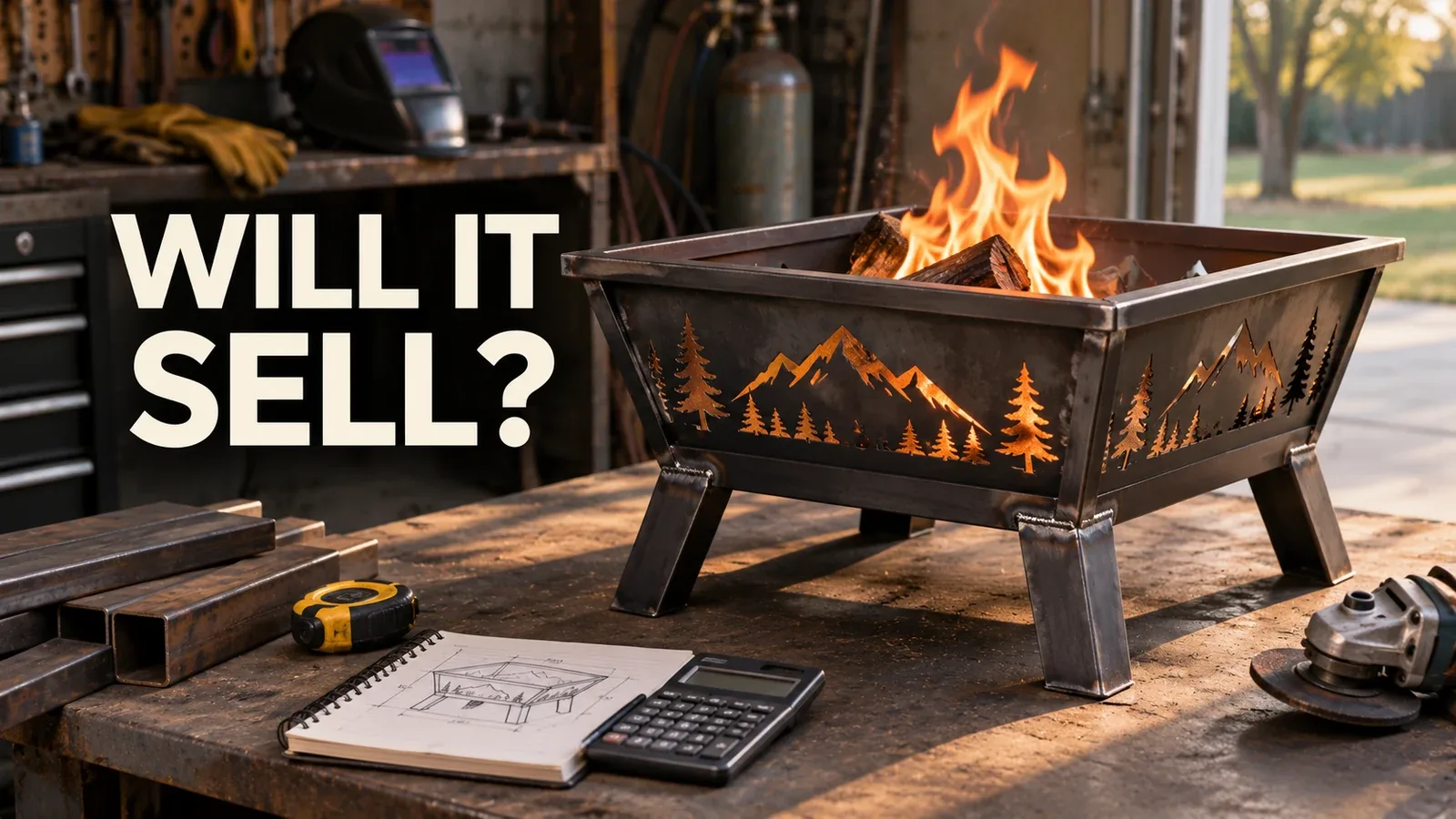
You've got a pile of steel offcuts, a welder, and an idea for a fire pit.
A few hours later, it looks pretty good.
Your friends love it. Someone says you should start selling these.
But there's a question nobody has asked yet.
How much did it actually cost you to make, and would a stranger pay enough for you to build another one?
That's where welding projects stop being a hobby and start becoming a business decision.
The trick isn't finding fifty things you could weld. It's finding something people want, that you can build safely, price properly, and make again without losing your weekend.
Everyone Loves Your Work. That Doesn't Mean They'll Buy It.
Imagine building a beautiful steel fire pit.
You clean every edge. Grind the welds. Give it a finish that looks good enough for somebody's backyard.
Then you post a picture online.
A few people comment. Somebody asks what it costs.
You give them a number.
Silence.
That's when you discover the difference between making something people admire and making something they're willing to buy.
A welded project can look impressive and still be difficult to sell. Maybe it's too heavy to ship. Maybe customers can buy something similar for less. Or maybe the hours you spent getting the finish right cost more than you expected.
None of that means the idea is bad. It means the project needs a business test, not just a welding test.
A good project to sell solves a problem, fits a buyer's budget, and leaves enough money after every real cost.
Let's see what that looks like.
Which Welding Projects Sell? Start With the Asking Prices
Before you cut more steel, it helps to know what people are listing for sale.
We looked at the first page of Etsy search results for nine types of welded work on November 23, 2026. The listings were viewed in US dollars from Etsy's Bangladesh storefront, and we kept the results whose titles named metal, steel, iron, welding or horseshoes.
Then we compared their asking prices. Not their sales. That's an important difference.
Which Welding Projects Sell? Start With the Asking Prices
| Welding project | Median asking price | Middle 50% of listings | Listings read |
|---|---|---|---|
| Horseshoe art | $50 | $36 to $74 | 58 |
| Metal yard art | $59 | $32 to $289 | 60 |
| Coat racks | $63 | $59 to $84 | 41 |
| Wine racks | $135 | $93 to $229 | 34 |
| Plant stands | $139 | $83 to $182 | 46 |
| Boot scrapers | $152 | $83 to $230 | 49 |
| Firewood racks | $180 | $135 to $245 | 54 |
| Fire pits | $200 | $126 to $358 | 39 |
| Steel table legs | $321 | $192 to $573 | 60 |
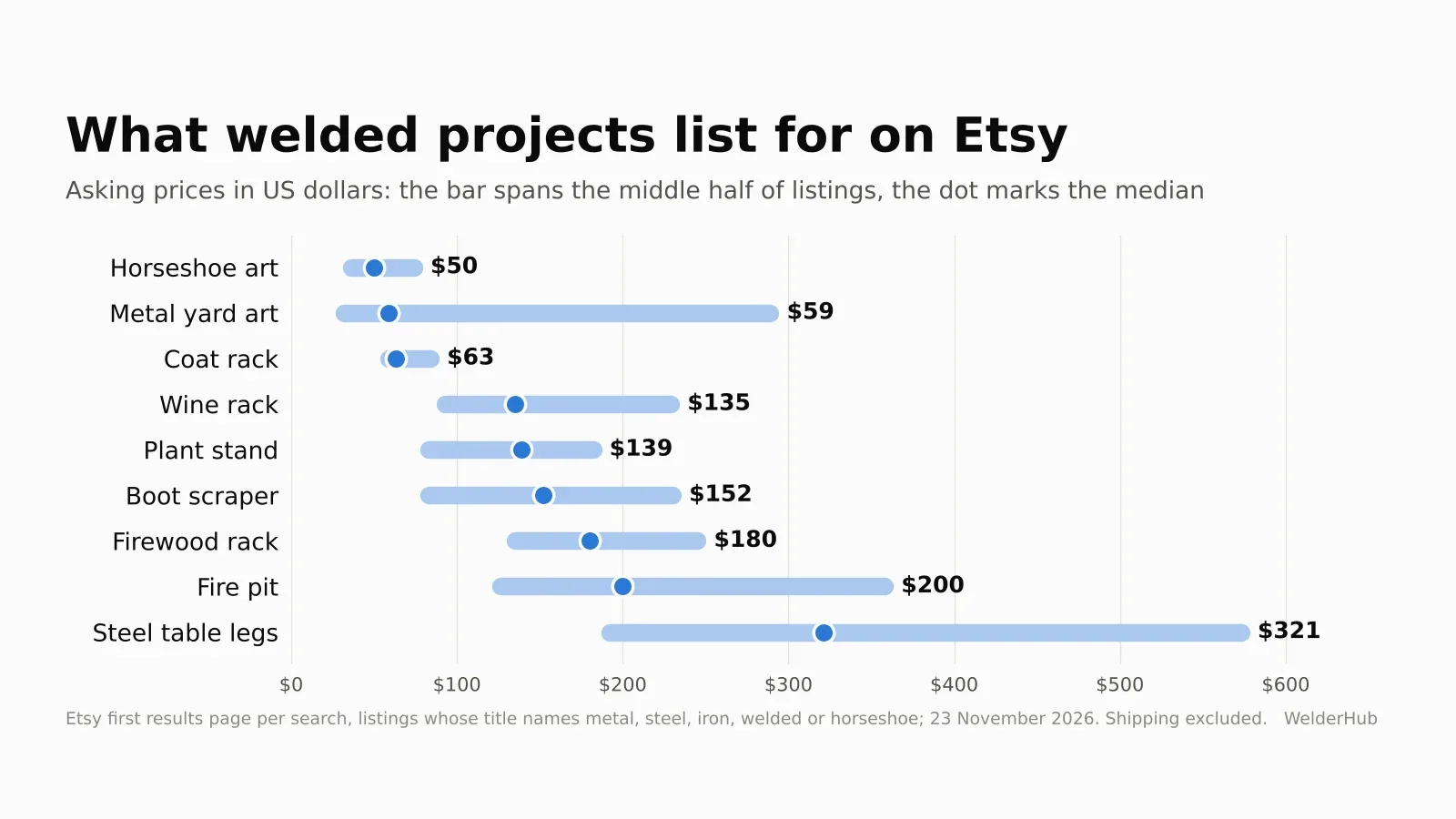
Research note: these are sampled asking prices, not verified sales, sales volume or profit. The middle-50% range shows how widely listings are priced, not what an individual seller can charge. Shipping is excluded. Sellers change prices constantly, so run the same searches before you set yours.
A few things stand out.
Everyday pieces sit in tight bands. Coat racks had the narrowest spread, $59 to $84 across the middle half, and buyers can compare them with shop-bought racks. You win on design, finish and a size the big stores don't stock, not on undercutting.
Art spreads out. Metal yard art ran from about $32 to $289, the widest range in the table. A simple scrap-metal bird and a commissioned sculpture share the same search. Art can earn the most per hour, but only once people are buying your style rather than "a metal bird".
Table legs list highest, and they're the least forgiving. A buyer bolts a slab of timber to them and expects it to sit flat and stay square. They may also need careful packaging and a buyer who wants your exact dimensions.
So don't jump to the conclusion that table legs are the better business. A $50 project you can repeat efficiently might serve you better than a $300 project that consumes two full days.
The selling price is only half the story. The other half is what it takes to earn it.
The Small Projects That Might Be Worth Your First Weekend
Suppose you've got a small garage workshop. You're comfortable welding mild steel, but you don't own a fabrication shop full of equipment. You want something you can make, photograph and offer for sale without betting your month's budget.
Start by comparing projects like these.
The Small Projects That Might Be Worth Your First Weekend
| Project | Why someone might buy it | What makes it difficult |
|---|---|---|
| Coat rack | Useful home accessory with room to personalize | Smooth edges, finish quality, wall mounting |
| Plant stand | Decorative and easy to size for different spaces | Stability, corrosion protection, repeatable dimensions |
| Firewood rack | Simple purpose and a straightforward shape | Size, weight, finish, delivery |
| Boot scraper | Practical for muddy boots on farms and rural homes | Durability, sharp-edge prevention, slip resistance |
| Horseshoe art | Gift appeal and endless design variety | Narrow customer tastes, finishing time |
| Steel table legs | Buyers want custom heights and widths | Accurate alignment, square fit-up, shipping |
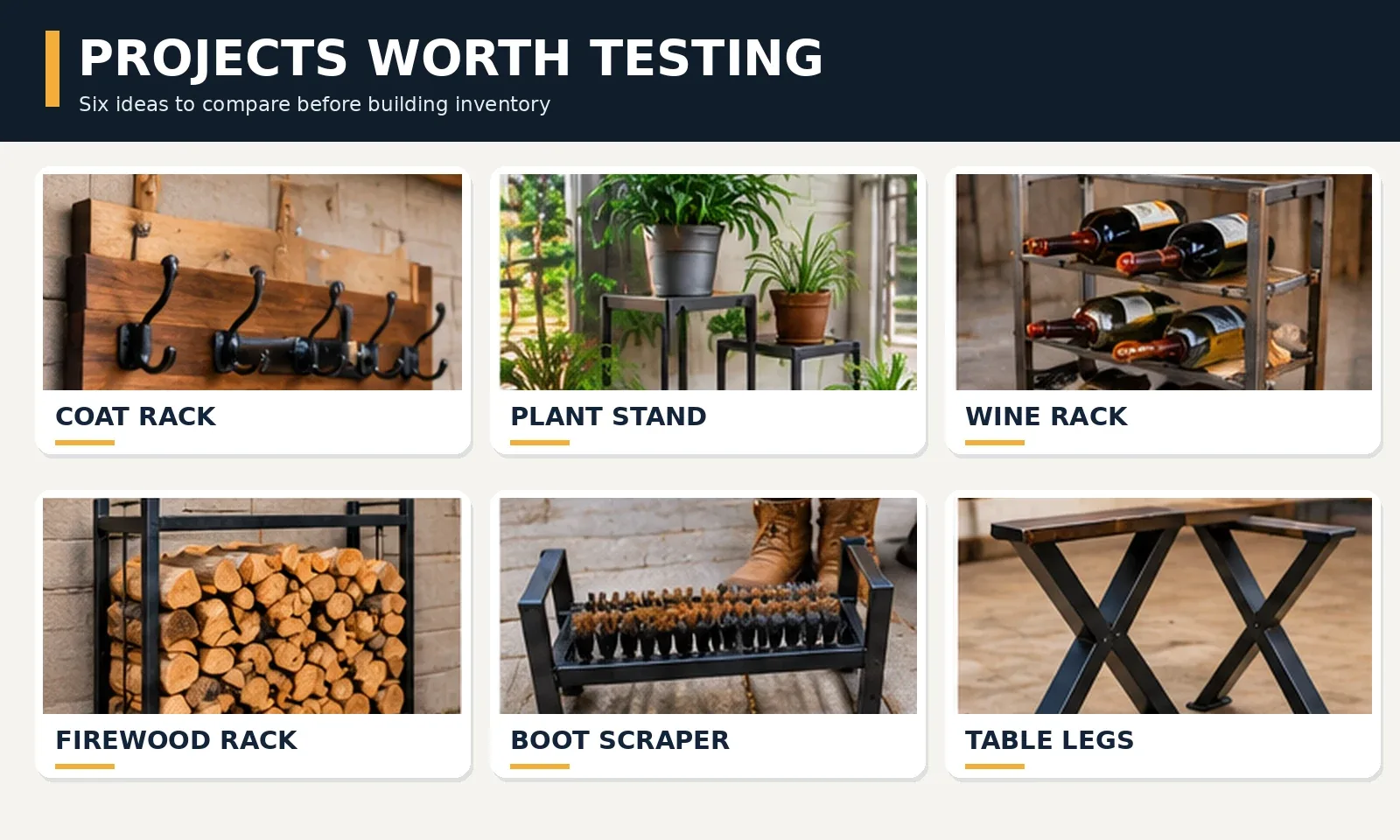
There's no universal winner. But there is a useful question.
Could you make the same product three times without redesigning it every time?
That matters because every new design has a hidden cost. You measure again. You adjust the cutting list. You build another jig. You spend longer checking angles.
A repeatable design lets you improve the process instead of starting from zero with every order.
Take a simple plant stand. The first one might take an afternoon because you're working out the dimensions. By the third, you may know exactly how to cut, clamp, weld and finish it.
That's where a small workshop finds its efficiency. Not necessarily in a more expensive welder. Sometimes just in a better jig.
That $200 Fire Pit Isn't $200 in Your Pocket
Here's where many weekend projects stop looking so profitable.
You finish something and decide to ask $200. It sounds reasonable.
Then you remember the steel. And the cutting discs. And the paint. And the hours you spent grinding those corners until they looked right.
Suddenly, $200 starts looking smaller.
Let's price a firewood rack properly instead of guessing. A simple 48-inch rack has two U-shaped ends, 36 inches tall and 14 inches deep, joined by two 48-inch bottom rails. That's about 22 feet of 1-inch square tube, so one 24-foot length covers it with room for saw kerf.
Start with the steel, and buy full lengths. On November 23, 2026, Metals Depot listed 1-inch × 1-inch × 14-gauge (0.083-inch wall) A513 square tube at $41.72 for 8 feet and $77.28 for 24 feet. That's $5.22 a foot against $3.22 a foot, about 38% less per foot for the longer length, before delivery.
We'll charge the whole 24-foot length to this rack, even though another design might leave a reusable offcut. The other numbers are deliberately simple.
That $200 Fire Pit Isn't $200 in Your Pocket
| Cost | Amount | Basis |
|---|---|---|
| Steel, one 24 ft length of 1" × 1" × 14 ga tube | $77.28 | Metals Depot, Nov 23, 2026 |
| Wire, discs, primer and paint | $25.00 | Assumption |
| Labor, 4 hours × $25.84 | $103.36 | Build time assumed; rate from BLS |
| Subtotal before selling fees | $205.64 |
Why $25.84 an hour? That's the US Bureau of Labor Statistics' 2025 median pay for welders, cutters, solderers and brazers. It's a reference point for valuing your time, not a universal shop rate. If a piece doesn't pay you something near it, you're paying to make it.
Now look at that subtotal: $205.64.
And it still leaves things out. No packaging. No delivery. No marketing. No share of your rent or electricity. No profit.
So the rack isn't ready to sell profitably at $206 just because the steel and the labor add up to that. We still need to think about where it's sold.
Etsy Takes a Share Too
Picture uploading the rack to Etsy.
You've taken the photographs, written the listing and entered your price. A customer buys it. Great.
But what the customer pays isn't what reaches your business.
A US seller pays Etsy a $0.20 listing fee, a 6.5% transaction fee on the item price plus any shipping you charge, and Etsy Payments processing of 3% plus $0.25. Other charges can apply.
To cover your costs after percentage fees, divide by what's left:
Price = (materials + consumables + hours × hourly rate + fixed fees) ÷ (1 − percentage fees)
For the rack, ignoring shipping, taxes and advertising:
($205.64 + $0.45) ÷ (1 − 0.095) = $227.72
Round that to $228.
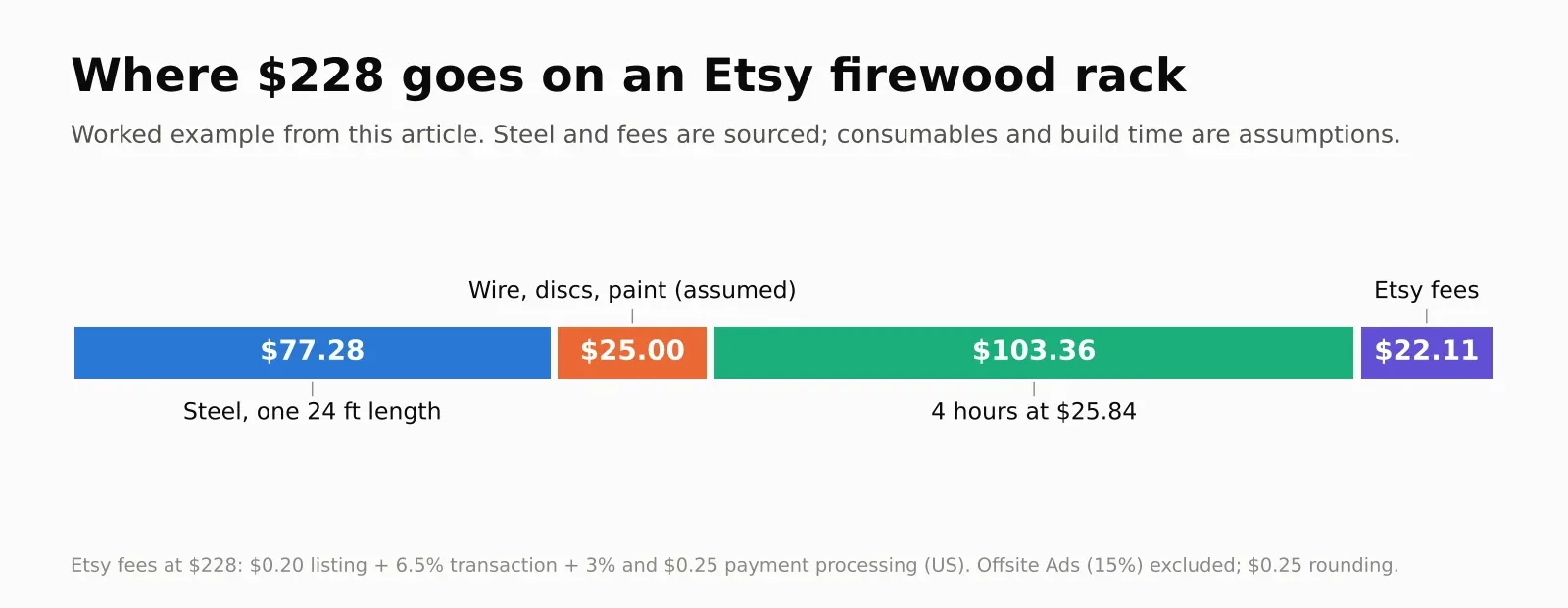
Here's the catch. At $228, about $205.89 is left after those Etsy fees. That's just 25 cents above the materials, consumables and labor subtotal.
So $228 isn't a profit target. It's roughly a break-even floor, under a deliberately incomplete set of assumptions.
If the sale came through one of Etsy's Offsite Ads, a 15% fee applies and the same floor rises to about $273, before shipping, overhead or profit. Shops with under $10,000 in yearly sales can opt out of Offsite Ads.
And if the job takes three hours instead of four? The floor drops to about $199.
Saving an hour can matter more than adding another $10 to the listing price.
Now set that against the market. Firewood racks had a median asking price of $180, with the middle half between $135 and $245. At four hours, this rack only pays the benchmark wage in the upper part of that range. A cutting list and a jig, or a feature such as a kindling shelf or a log-carrier hook, is how it moves into a better position.
Don't mistake this for a universal firewood-rack price. Steel costs, local wages, fees, shipping, production time and demand all vary. The point isn't to sell every rack for $228. It's to know why that number would or wouldn't work for you.
Before You Set a Price, Ask Where the Buyer Lives
A coat rack and a fire pit might both come out of your garage. Selling them isn't the same experience.
A compact wall-mounted coat rack can be practical to package and ship if you allow for its weight, the protruding hooks and protecting the finish. A large fire pit may need bulky packaging or local delivery. Even our firewood rack weighs about 23 pounds before paint.
So before you build an oversized project, imagine the customer has already bought it. How are you getting it to them? Will it fit in a normal parcel? Does it need a truck? Will the finish survive the trip? Are you charging separately for delivery?
Before You Set a Price, Ask Where the Buyer Lives
| Where you sell | What it costs you | Best for |
|---|---|---|
| Etsy | $0.20 listing, 6.5% transaction, 3% + $0.25 processing in the US; 15% Offsite Ads if a sale comes from Etsy's ads | Light pieces that ship easily: horseshoe art, coat racks, wine racks, small yard art |
| Local sale (word of mouth, community boards, local marketplace listings) | No platform fee on a cash sale; your time meeting buyers | Heavy pieces: firewood racks, fire pits, table legs, large yard art |
| Craft fairs and farmers' markets | A stall fee and a day of your time | Gifts and art, where people want to pick the piece up |
| Commissions | Time spent quoting and designing | Gates, railings and custom furniture. Take a deposit before you buy steel |
Sometimes the best first customers aren't hundreds of miles away. They might be local homeowners, interior designers, landscapers, or people who need a custom piece no nearby store carries. Sold for cash to a neighbor, our rack has no platform fee to cover, so its floor is the $205.64 subtotal itself.
Neither channel automatically produces more profit. Compare your actual costs.
Etsy collects and pays sales tax for you on orders to most US states. When you sell locally, collecting and reporting it is usually your job. The rules vary by state, so check before you sell regularly.
Your First Sale Should Be a Test, Not a Business Expansion
Let's say you've settled on a coat rack.
Don't make ten. Make one.
Build a clean, repeatable design. Photograph it well. Record the steel you used, the consumables, the welding time and the finishing time.
Then put a realistic price on it. Not a price chosen because it sounds affordable. One that covers your costs and leaves room for a return.
Now see what happens. Do people ask for dimensions? Do they want another color? Do they ask whether you can customize it? More importantly, does anyone agree to buy it at a price that works?
An inquiry is not an order. A favorite on Etsy isn't a sale. Even a promising conversation may never turn into payment.
But every real buyer question gives you information. Maybe people want a narrower version. Maybe your design is too heavy. Maybe the customer likes it but needs it delivered.
You can learn those things from one prototype. You don't need a garage full of unsold stock to find out.
The Welding Projects You Shouldn't Try to Sell
Not every object you can weld belongs on a beginner's sales list.
A decorative yard ornament is one thing. Car ramps, jack stands, a trailer or trailer hitch, a lifting attachment, a child's play structure or a loaded gym rack are another. Each holds a vehicle or a person under load, and a failed weld, material or fastener can hurt someone badly. Commercial versions are sold with a rated capacity and a manufacturer's testing behind them. A shop-welded copy has neither. Build them for yourself if you understand the loads, but don't sell them.
Anything made for children aged 12 or under carries paperwork. In the US, the Consumer Product Safety Commission requires children's products covered by its safety rules to be tested by an accepted third-party laboratory and certified in a written Children's Product Certificate. Registered small-batch makers can qualify for limited relief from testing, but they still issue the certificate. That's not the kind of responsibility you want to discover after your first sale.
There's a simpler way to start: make products whose design, material, use and failure consequences you can realistically understand. Decorative, non-safety-critical pieces are the easier starting point. Even then, check that the finished piece is stable, free of sharp edges and fit for the way it will be used.
A beautiful weld doesn't excuse a dangerous product.
Don't Let Cheap Scrap Create an Expensive Problem
You spot some old steel behind the workshop. Free material. Perfect for a small project, right?
Maybe. But look carefully. Is it painted? Rusty? Covered in an unknown coating? Galvanized?
Scrap can cut your material cost, but unknown coatings bring hazards. The American Galvanizers Association says the zinc should be removed at least 1 to 4 inches from either side of the weld, on both sides of the part, with grinding the preferred method, and that the work should be done somewhere well ventilated. Breathing zinc fume can cause metal fume fever, with chills, nausea and fever starting a few hours after exposure.
Drums and tanks are worse, because you can't see what they held. Our 50 welding project ideas explain why a used container must be prepared before any hot work. A barrel grill isn't worth a guess.
And for a product you're going to sell, consistency matters. A repeatable material specification can be worth more than a random pile of free offcuts.
The Machine You Have Is Probably Enough to Test an Idea
There's a temptation to buy new equipment before your first sale. A bigger welder. A cutting table. A better grinder.
But the machine isn't the business. The customer is.
Almost everything in the tables above is mild steel in tube, flat bar or rod. For pieces like these, a suitable MIG or flux-core setup is usually enough to build a prototype, provided the material thickness and weld quality suit the job.
- Flux-core needs no gas bottle and copes with a breeze and rusty stock, which suits a garage door left open or a job outside. It leaves spatter and slag to clean before paint, so allow time for finishing. If you don't own a welder yet, our best flux-core welders guide compares 120 V machines by duty cycle and the wire each one runs.
- MIG with shielding gas gives cleaner beads on visible decorative work, with less cleanup.
- TIG suits fine art, thin stainless and aluminum, where a neat bead is part of the look. It's slower, which matters when you price by the hour.
- Stick handles thick, rusty farm steel, such as boot scrapers made from old implement parts, but it's harder on thin tube.
No process makes an unsafe design safe. Before buying another machine, ask whether the one you already own can make something a stranger genuinely wants. If it can, you're ready to test the idea.
Frequently Asked Questions
What welding projects sell the most?
There's no verified ranking of sales. In our Etsy sample, small useful pieces such as coat racks, plant stands, firewood racks, boot scrapers, wine racks and horseshoe art had median asking prices between about $50 and $180, and they're practical to test. Real demand depends on your market, quality, price and delivery costs.
What is the most profitable welding project?
A high price doesn't prove a high profit. The better question is which project leaves the most after materials, labor, fees, finishing, delivery, overhead and the odd return. Steel table legs had the highest median asking price in our searches ($321), but they need accurate, square fit-up. A coat rack earns less per piece but can be cut and welded quickly in batches.
Can you make money welding at home?
Potentially, yes. Start with a repeatable product, add up every cost, test whether buyers will pay a price that works, and avoid building stock before you've proved demand. Many home welders sell locally first, because heavy steel is expensive to ship.
How much should I charge for a welded project?
Add materials and consumables, value your labor, add overhead and delivery, allow for platform fees, and include a deliberate profit margin. As a benchmark, the 2025 US median pay for welders was $25.84 an hour. Then compare the result with real listings before you accept an order.
Is it worth selling welded items on Etsy?
It can suit handmade decorative metalwork that photographs well and ships efficiently, such as horseshoe art, coat racks and wine racks. For heavy pieces, shipping and Etsy's fees on both the price and the shipping charge often make a local sale the better deal. Listing prices alone don't prove sales.
The Difference Between a Hobby and a Business
Remember that fire pit from Saturday afternoon? The one everybody loved?
It's still a good project. Maybe it's even a good product.
But those aren't the same thing.
You can enjoy making something without ever selling it. And you can sell something without earning enough to justify making another one.
The real opportunity sits in the middle. A design people want. A process you can repeat. A price that respects your time. And a customer willing to pay it.
The best welding project to sell isn't necessarily the most impressive thing you can build.
It's the thing you can make well, sell at a workable price, and feel good about building again next weekend.
Sources and Research Notes
The Etsy figures are asking prices from the first results page of each search, viewed in US dollars on November 23, 2026. They are not completed sales or profit measurements. The firewood rack's consumables and build time are WelderHub assumptions. Fees and steel prices were checked on November 23, 2026.
- U.S. Bureau of Labor Statistics: Welders, Cutters, Solderers, and Brazers, 2025 median pay of $25.84 an hour.
- Etsy: Fees & Payments Policy, for the listing fee, the 6.5% transaction fee, Offsite Ads and US sales tax collection.
- Etsy: Etsy Payments Policy, for the US payment processing fee of 3% plus $0.25.
- Metals Depot: Steel Square Tube, for 1" × 1" × 14 ga A513 tube in 8 ft and 24 ft lengths. Prices are a November 23, 2026 snapshot, not a current quote.
- U.S. Consumer Product Safety Commission: Children's Product Certificate, for third-party testing and certification of children's products.
- American Galvanizers Association: Welding Galvanized Steel, for weld-zone coating removal and ventilation.
- American Galvanizers Association: Can You Weld Galvanized Steel?, for metal fume fever.