WelderHub is reader-supported. When you buy through links on our site, we may earn an affiliate commission. As an Amazon Associate, we earn from qualifying purchases.
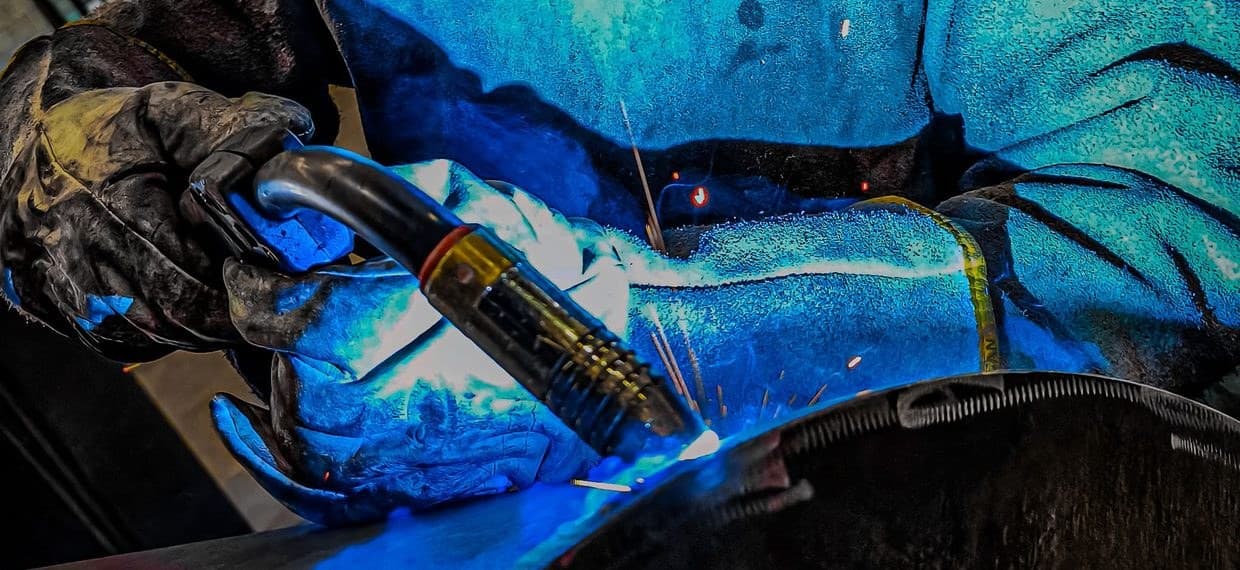
Flux-cored arc welding with self-shielded wire is the process that goes outside. The flux is inside the wire, so it makes its own shielding gas as it burns and there is no bottle, no regulator and no gas shield for the wind to strip away. That is the whole appeal, and it is a real one.
It is also the corner of the market where the numbers on the box agree with each other least. This guide compares four machines that are current models, every figure taken from the maker’s own page, and then does the thing the listings do not: reads the machine’s claims against the specification of the wire it is sold to run. If you have not struck an arc yet, how the four arc processes differ is the better place to start; this page is about choosing the machine.
The Thickness Claim, and the Wire That Settles It
Every one of these machines advertises a maximum material thickness. They do not agree, and the disagreement does not run the way you would expect — the cheapest machine on this page publishes the most conservative number, and the two most respected brands publish the boldest.
What each maker claims, in its own words
| Machine | Sold as | Rated output | Thickness claim | Says “single pass”? |
|---|---|---|---|---|
| Lincoln Weld-Pak 90i FC | 120 A | 90 A at 30% | 1/4 in. | no |
| Lincoln Weld-Pak 90i MIG | 120 A | 90 A at 30% | 1/4 in. flux-core, 3/16 in. MIG | no |
| Forney Easy Weld 141 FC-i | 140 A | 90 A at 30% | 24 ga – 1/4 in. | yes |
| Hobart Handler 140EZ | 140 A | not published on the listing | 3/16 in. | no |
| YESWELDER FLUX-135PRO | 135 A | 60% at 135 A (claimed) | 3/16 in. | no |
Two machines sold as 120 A and 140 A are rated at the identical 90 amps and a 30% duty cycle — three minutes of welding in every ten. Of the five, only Forney prints the words that make a thickness claim mean anything: its own page says the machine will weld 24 gauge through a quarter inch “in a single pass”.
That phrase is the key to the whole disagreement, because the thickness a gasless machine can handle is decided by the wire at least as much as by the welder — and not one of these product pages mentions which wire the claim assumes.
The two gasless wires, and what their own makers say
| Wire | AWS class | What the maker says | Polarity |
|---|---|---|---|
| E71T-GS | AWS A5.20 E71T-GS | “designed for single pass welding of thin-gauge carbon steel”, recommended 3/16 in. down to 22 gauge (Pinnacle Alloys). Washington Alloy: “single pass all-position welds on mild steels” | DCEN |
| E71T-11 | AWS A5.20 E71T-11 | “Light structural [under 3/4 in. (19 mm) thick]”, general fabrication (Hobart Brothers, Fabshield 21B). Lincoln’s own NR-211-MP is this class — the MP stands for multi-pass | DCEN |
E71T-GS is the wire these machines ship with. YESWELDER’s listing says so in as many words: the box includes “extra E71T-GS .030'' &.035'' flux core wires”. Its maker recommends stopping at 3/16 in. — which is exactly the number Hobart and YESWELDER print, and exactly what Lincoln and Forney exceed.
Duty Cycle: Where the Same Brands Swap Places
Duty cycle is the share of a ten-minute period a machine can weld at a stated current before it has to stop and cool. It is a thermal measurement, so it is a function of mass and cooling, and it is the number that separates a machine that will lay a long bead from one that will not.
On thickness, the budget machine is the conservative one. On duty cycle, it is the other way round. Lincoln and Forney both publish 90 amps at 30% — a modest claim, stated plainly, on machines sold as 120 and 140 amps. YESWELDER publishes 60% at 135 amps, which would mean a small 110-volt inverter holding its full rated output for six minutes in every ten.
That is the useful lesson of this whole shelf: neither the expensive brands nor the cheap ones are reliably honest. They overstate in different places. Read both numbers from both, and treat a duty cycle quoted at the machine’s own maximum with the same suspicion as a thickness claim with no wire attached to it.
Electrode Negative, and the Two-Minute Fix
Both wire datasheets say the same thing about polarity: DCEN, direct current electrode negative. That is the opposite of gas MIG, which runs electrode positive. On a machine sold as “MIG and flux-core 2-in-1” or “3-in-1”, the leads inside the case have to be swapped when you change process — and on most of these machines that is a labelled pair of terminals behind the wire-spool door.
What Flux-Core Is Good At, and What It Is Not
Self-shielded flux core makes its own shielding as the flux burns, so wind does not matter. That one property decides most of the buying: it is the process for gates, trailers, fencing, farm repairs and anything that cannot be carried into a shop — the same ground a stick welder covers, with a wire feeder instead of a rod to change every twelve inches. It also burns through mill scale, rust and paint better than gas MIG, which is why it survives on machinery that has been outside for twenty years.
What it is not good at is thin metal, tidy beads and anything that has to look right. It runs hot, it spatters, and every bead leaves slag that has to be chipped and wire-brushed off. For car body panels and anything under about 16 gauge, gas MIG is the better tool — and for stainless, aluminium or a weld that has to be presentable, TIG is. The honest way to read a 3-in-1 machine is as a flux-core welder that can do a bit of the other two, not as three welders in a box.
What to Look For in a Flux-Core Welder
There is no certification on this shelf the way there is for welding clothing. What you have is arithmetic and a wire specification, so every check here is one or the other.
- A duty cycle quoted at a named current
- “30% at 90 A” is a specification. “60% duty cycle” with the machine’s own maximum attached to it is a claim.
- The thickness claim, read against the wire
- if the maker does not say which wire the figure assumes, assume E71T-GS and 3/16 in.
- Whether it says “single pass”
- Forney does. It is the difference between a capability and a joint that will hold.
- Polarity terminals you can reach
- on a MIG-capable machine you will be swapping them. A labelled pair behind the spool door is worth more than a feature list.
- Wire diameters it takes
- .030 in. and .035 in. covers everything these machines can do. A machine that only takes one size limits you on thin metal.
- Spool size
- 4 in. spools are what fits most of these. An 8 in. spool is cheaper per pound, and only some machines take one.
- The input current, not just the output
- a 135 A machine on 110 V draws far more than a 15 A circuit supplies at full output. Plan to run it below maximum on a domestic socket.
- A warranty you can find
- Forney publishes one year. Several makers here publish nothing at all.
Four Flux-Core Welders
Four machines, all current models on their makers’ own sites, all still in their makers' current ranges. The price spread across them is wide, and the comparison is more useful than usual because every figure below is the maker’s own.
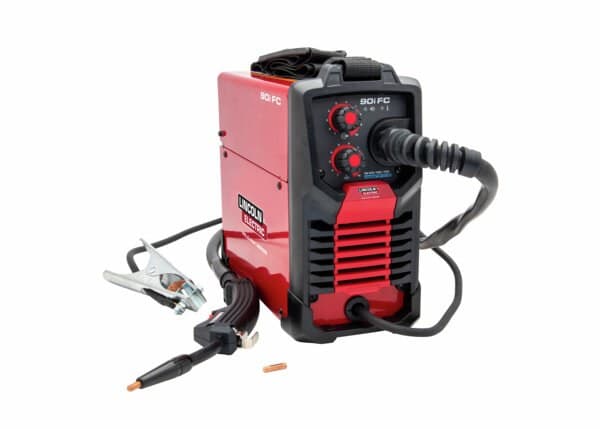
Lincoln Electric Weld-Pak 90i FC
The best-supported machine on this shelf, and the one to buy if you want a name with a dealer behind it. Flux-core only, 15 lb, and honest about its duty cycle.
Technical info
- Process: self-shielded flux-cored (FCAW-S) only — no gas, ever
- Input: 120 V, single phase
- Output: 20–120 A
- Rated output: 90 A / 21 V / 30% duty cycle
- Thickness: Lincoln claims a maximum of 1/4 in.
- Control: two knobs, wire speed and voltage, infinitely adjustable
- Weight: 15 lb, metal case and shoulder strap
- Part number: K5255-1 (Lincoln MSRP $346)
- By far the most owner experience of any established brand here
- 90 A at 30% published on the product page rather than buried in a PDF
- 15 lb in a metal case with a strap: it goes to the job rather than living on a bench
- Infinite voltage instead of tapped settings, so the arc can actually be tuned
- Flux-core only. If you ever want a gas bottle, this is the wrong one of the two
- The 1/4 in. claim says nothing about the wire, and E71T-GS is rated to 3/16 in.
- Two knobs and no display — you set it from the chart inside the door
- No warranty term published on the product page
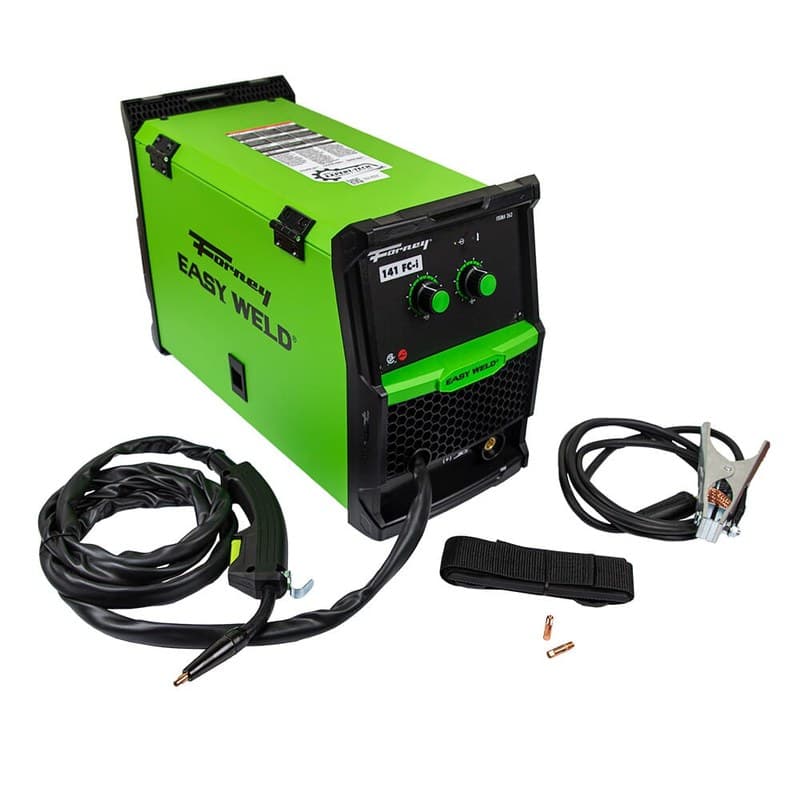
Forney Easy Weld 262 141 FC-i
The only machine here whose maker prints the words that make a thickness claim mean something. Takes 8 in. wire spools, draws the least current, and says what its warranty is.
Technical info
- Process: gasless flux-cored (FCAW)
- Input: 120 VAC, 50–60 Hz, single phase; input current 13.4 A
- Output: up to 140 A
- Rated output: 30% duty cycle at up to 90 A
- Thickness, in Forney’s own words: “Single-pass plate thickness range: 24 ga–1/4 in. mild steel”
- Wire: 0.030–0.035 in.; takes 4 in. and 8 in. spools
- Case: full side door on two latches — which is what lets the 8 in. spool fit
- In the box: gun, work clamp, contact tips and a shoulder strap
- Weight: 18.6 lb
- Warranty: 1 year. CSA certified
- The only maker on this page to say “single pass” against its thickness range
- Takes 8 in. spools as well as 4 in. — wire is much cheaper by the larger spool
- 13.4 A input, the lowest here and the friendliest to a household circuit
- A stated one-year warranty and CSA certification, both on the product page
- A shoulder strap in the box, which neither Lincoln lists
- Seven reviews. It is a new model that replaced the 261, not an unpopular one — but there is almost no owner experience of it yet
- 140 A is the peak; the rating is the same 90 A at 30% as the Lincoln
- Flux-core only — no gas MIG, no stick, no TIG
- 18.6 lb against the Lincoln’s 15, for the same rated output
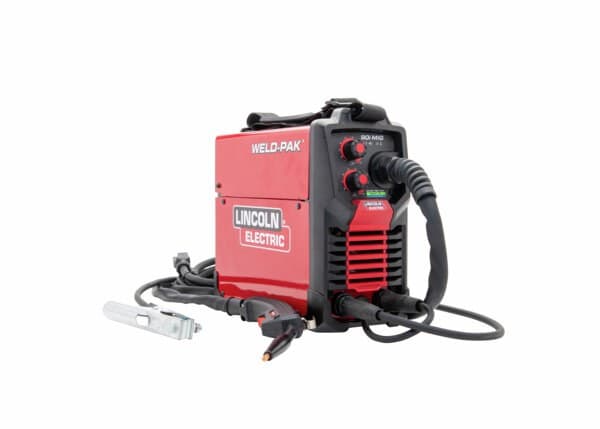
Lincoln Electric Weld-Pak 90i MIG
The same machine with a gas valve. Buy it only if you already know you want a bottle — the extra money buys a second process, not more output.
Technical info
- Processes: self-shielded flux-cored and gas MIG
- Input: 120 V, single phase
- Rated output: 90 A / 21 V / 30% duty cycle — identical to the flux-only version
- Thickness, in Lincoln’s own words: “Flux-cored welding with a maximum thickness of 1/4 in., MIG weld up to maximum thickness of 3/16 in.”
- Control: two knobs, wire speed and voltage
- Weight: metal case and shoulder strap
- Part number: K5256-1
- Takes a gas bottle when you want tidier welds on thinner metal
- The same published 90 A at 30% rating as its flux-only sibling
- An upgrade path that does not mean buying a second machine
- Dearer than the flux-only version — and Lincoln’s own product photograph shows the machine with no bottle, regulator or hose, because none of them is included
- Lincoln’s own page gives it less thickness on MIG than on flux-core: 3/16 in. against 1/4
- Same 90 A at 30%: the money buys a process, not power
- A gas bottle is a rental and a delivery, which is the thing flux-core exists to avoid
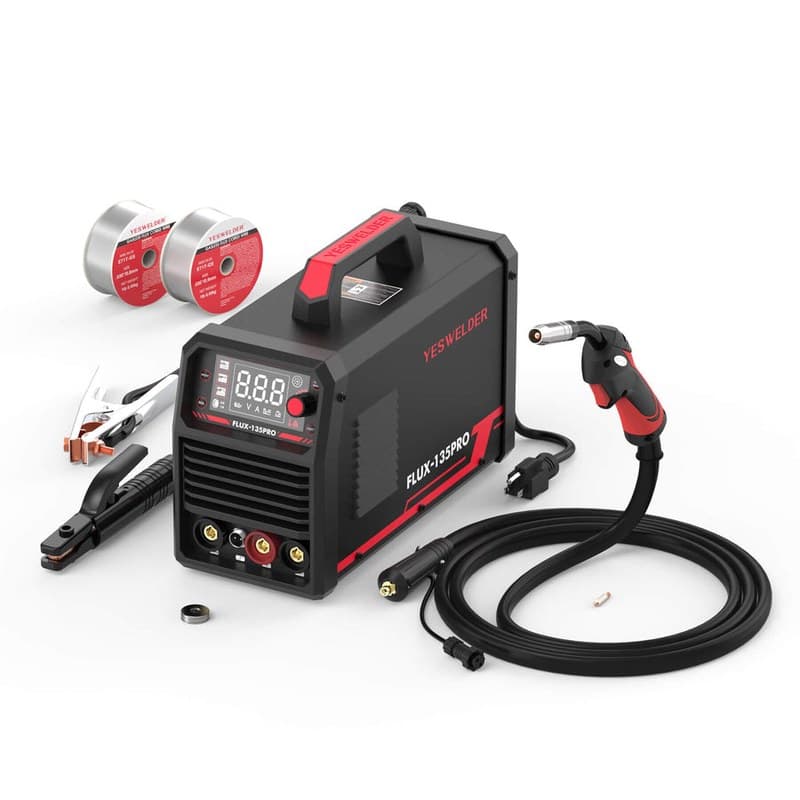
YESWELDER FLUX-135PRO
A third of the price of the Lincoln, nearly three thousand reviews, and the only maker here that publishes a thickness figure matching the wire. Its duty-cycle claim is the one to doubt.
Technical info
- Processes: flux-cored, lift TIG and stick
- Input: 110 V ±10%, 50/60 Hz
- Output: flux-cored 35–135 A; TIG 15–135 A; stick 20–135 A
- Duty cycle as published: flux-cored 60% at 135 A
- Recommended thickness, in YESWELDER’s own words: flux-cored ≤ 3/16 in. (5 mm) at 110 V
- Wire: E71T, .030 in. and .035 in. No spool gun support
- Included: E71T-GS wire in .030 in. and .035 in.
- Control: synergic — voltage follows wire speed, with ±3 V trim
- The machine most people on this shelf own, by a wide margin
- Publishes a recommended thickness of 3/16 in., the figure that agrees with the wire’s own maker
- Synergic control genuinely helps a beginner: set the wire speed and the voltage follows
- Stick and lift TIG included, which the two Lincolns and the Forney do not offer at all
- 60% at 135 A is a duty-cycle claim neither Lincoln nor Forney makes at two-thirds the current
- No gas MIG and no spool gun: flux-core is the only wire process it does
- At its full 135 A on a 110 V supply the input current is well beyond a household circuit — expect to run it below maximum
- The extra processes need extra kit: lift TIG needs a torch, stick needs an electrode holder
The four compared
| Machine | Price | Output | Rated duty cycle | Thickness claim | Other processes |
|---|---|---|---|---|---|
| Lincoln Weld-Pak 90i FC | 20–120 A | 90 A at 30% | 1/4 in. | none | |
| Forney Easy Weld 141 FC-i | up to 140 A | 90 A at 30% | 24 ga–1/4 in., single pass | none | |
| Lincoln Weld-Pak 90i MIG | 20–120 A | 90 A at 30% | 1/4 in. flux, 3/16 in. MIG | gas MIG | |
| YESWELDER FLUX-135PRO | 35–135 A | claimed 60% at 135 A | 3/16 in. | lift TIG, stick |
Three of the four are rated at the same 90 amps and 30%, which means the price difference between the cheapest and the dearest of them buys build, support, spool size and a gas valve — not welding. The fourth costs a fraction of any of them, claims twice the duty cycle at higher current, and is the only one whose published thickness matches the wire. Read that as two different kinds of optimism rather than one trustworthy brand and one that is not.
What an Amazon Search for a Flux-Core Welder Shows You
Search Amazon for “flux core welder” and count the first twenty results. When we ran it in September 2026: four were YESWELDER, two were Lincoln Electric, two were BESTMIG, and the remaining twelve were SEESII, AWT, FEMEROL, DURATECH, ANDELI, ACEWELDER, MIGVAN, WELDPRO, BILT HARD and three listings with no brand in the title at all. Hobart, Forney, ESAB and Miller did not appear once.
Two of twenty from a maker you would find in a welding supply shop, both of them Lincoln. And one brand — YESWELDER — held four of the twenty places and, between them, both of the retailer’s own recommendation badges. That is not a verdict on the machines. It is a reminder that such badges measure sales and returns, not specification, and that the shelf you are shown is not the market.
Frequently Asked Questions
How thick can a 140-amp flux-core welder actually weld?
Three-sixteenths of an inch is the number to plan on, and a quarter inch is the number on the box. The difference is the wire: the E71T-GS that these machines ship with is classified for single-pass welding and its makers recommend it from 22 gauge up to 3/16 in. Lincoln and Forney both claim a quarter inch, and Forney adds the words that explain it — “in a single pass”. For a quarter-inch joint that has to hold, bevel it and use E71T-11 wire, which is rated for multiple passes.
What is the difference between E71T-GS and E71T-11 wire?
Both are self-shielded flux-cored wires that run on direct current electrode negative, and both are AWS A5.20 classifications. E71T-GS is for single-pass welding of thin material — its makers recommend 22 gauge to about 3/16 in. E71T-11 is rated for multiple passes and light structural work under 3/4 in.; Lincoln's own NR-211-MP is this class, and the MP stands for multi-pass. E71T-GS is what comes in the box; E71T-11 is what you buy when the job is thicker.
Which polarity for flux-core welding?
Electrode negative — DCEN, sometimes called straight polarity. Both wire datasheets say so, and it is the opposite of gas MIG, which runs electrode positive. If your machine does both, the leads have to be swapped inside the case when you change process. A wandering arc, heavy spatter and slag that will not chip off are the symptoms of getting it wrong, and they look exactly like bad technique.
Do I need gas for a flux-core welder?
Not for self-shielded flux-cored wire — the flux inside the wire makes its own shielding as it burns, which is the whole point of the process and why it works outdoors in wind. Gas-shielded flux-cored wire exists and does need a bottle, but it is not what these machines are sold for. If you want a bottle for tidier welds on thin metal, buy a machine that does gas MIG as well, like the Lincoln Weld-Pak 90i MIG.
Can you run a flux-core welder on a normal household socket?
Yes, below maximum. Every machine here plugs into 120 V, and Forney publishes an input current of 13.4 A, which a 15 A circuit supplies. But a machine rated 135 A of output draws far more than that at full dial, and no 110 V household circuit will feed it there. Plan to work below maximum, and treat any listing advertising 200 amps or more on 110 V as describing a peak rather than a setting you can use.
Is flux-core welding strong enough for structural work?
The process is — self-shielded flux core is used on structural steel every day. The question is the machine and the wire. A 90 A machine at a 30% duty cycle with single-pass E71T-GS wire is not a structural welder; the same process with E71T-11 wire on a properly prepared joint is a different proposition. Anything load-bearing or life-safety should be welded to a procedure by someone qualified, whatever the machine.
Why does my flux-core weld have so much spatter?
Check the polarity first — electrode negative for self-shielded wire. After that, the usual causes are voltage too high for the wire speed, too long a stick-out, or a dirty contact tip. Self-shielded flux core spatters more than gas MIG even when everything is right; it is the trade for being able to weld outside, and it is why every bead needs chipping and brushing.
Sources
Every figure above comes from the maker’s own product page, specification sheet or datasheet. Prices and availability change constantly, so this page does not quote them - follow a link for the current figure.
- Lincoln Electric Weld-Pak 90i FC (K5255-1) — 20–120 A output, the 90 A / 21 V / 30% rating, and the 1/4 in. thickness claim
- Lincoln Electric Weld-Pak 90i MIG (K5256-1) — the same 90 A / 30% rating, and the line giving 1/4 in. on flux-core against 3/16 in. on MIG
- Forney Easy Weld 141 FC-i — “30% duty cycle at up to 90 A”, “single-pass plate thickness range: 24 ga–1/4 in. mild steel”, 13.4 A input, 18.6 lb, one-year warranty
- YESWELDER FLUX-135PRO — 35–135 A, the 60% at 135 A duty-cycle claim, and the recommended thickness of ≤ 3/16 in.
- Pinnacle Alloys E71T-GS datasheet — “designed for single pass welding of thin-gauge carbon steel”, 3/16 in. to 22 gauge, DCEN
- Washington Alloy E71T-GS — AWS A5.20 Class E71T-GS, “single pass all-position welds on mild steels”
- Hobart Brothers Fabshield 21B datasheet — AWS A5.20 E71T-11, DCEN, light structural under 3/4 in.
- Lincoln Electric Innershield NR-211-MP — the E71T-11 multi-pass wire these machines can also run
The Short Answer
Buy the Lincoln Weld-Pak 90i FC if you want an established name with a dealer behind it and the most owner experience on the shelf. Buy the Forney 141 FC-i if the 8 in. spool and the stated warranty matter more than the review count, and accept that the model is new. Buy the Lincoln 90i MIG only if you already know you want a gas bottle. And the YESWELDER FLUX-135PRO is a third of the price and the machine most people here actually own — just read its two numbers the right way round: its thickness figure is the honest one on this page, and its duty-cycle figure is the one nobody else is willing to match.