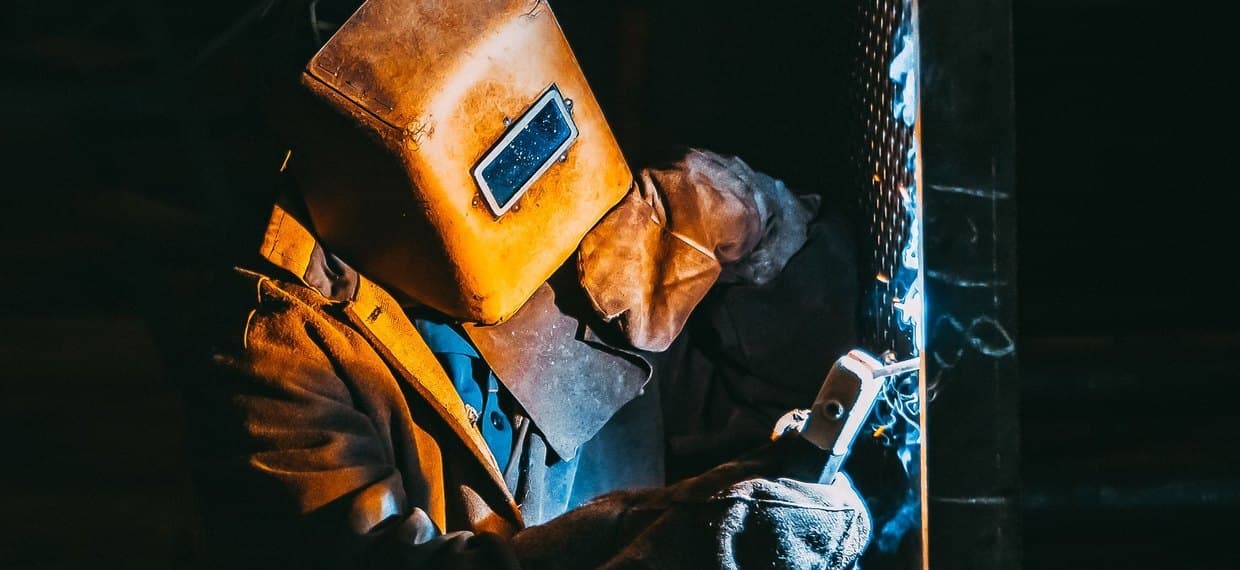
WelderHub is reader-supported. When you buy through links on our site, we may earn an affiliate commission. As an Amazon Associate, we earn from qualifying purchases.
The best welding jacket for most people is the Black Stallion FRB9-30C: a 9 oz flame-resistant cotton body with split cowhide sleeves, which puts the leather where the spatter lands and keeps cotton where you need to breathe. If you only weld occasionally, the all-cotton FN9-30C from the same maker does the same job for less.
At a glance
| Jacket | Material | Length | Standard named by the maker |
|---|---|---|---|
| Black Stallion FN9-30C | 9 oz FR cotton | 30 in | None |
| YESWELDER ZRF02 | 11 oz FR cotton | 29.5-31.4 in by size | "Complies with NFPA 2112", no certifier named |
| Miller Classic Cloth | Pre-shrunk 9 oz FR cotton | Not published | None |
| Black Stallion FRB9-30C | 9 oz FR cotton body, split cowhide sleeves | 30 in | None |
| Black Stallion JL1030 | Split cowhide | Not published | None |
| Lincoln Electric K2989 | Split cowhide chest and sleeves, 9 oz FR cotton back | 30-35 in by size | None on the product page; "ASTM D6413 compliant" on the Amazon listing |
Apparel is priced size by size, so what you see when you follow a link depends on the size you pick. Worth knowing before you compare two jackets on price alone.
The standard written for welding clothing, and why it is not on any of these labels
There is a standard for this. ISO 11611, Protective clothing for use in welding and allied processes, is the only one written for the hazard a welding jacket exists to stop: molten metal spatter, brief flame contact, the radiant heat of an arc, and accidental contact with a live conductor up to about 100 V DC. It grades garments into two classes.
ISO 11611 Class 1 and Class 2
| Class 1 | Class 2 | |
|---|---|---|
| Molten metal spatter | Withstands at least 15 drops | Withstands at least 25 drops |
| Radiant heat (RHTI 24) | At least 7 seconds | At least 16 seconds |
| Intended for | Gas welding, bench work, machine cutting, TIG, low-current MIG, MMA with rutile electrodes | MMA with basic or cellulose electrodes, MAG, high-current MIG, plasma cutting, overhead and confined work |
Two things about those numbers. The first is that they come from EN ISO 11611:2015 as the protective-clothing industry publishes it, because the standard itself is paywalled. The second is that ISO withdrew the 2015 edition on 18 June 2024 and replaced it with ISO 11611:2024, a third edition that also grades protection against harmful artificial optical radiation - UV-A, UV-B and UV-C - across three risk levels. Most of the explainers you will find, including the fabric makers' own, still describe the withdrawn edition.
And none of that reaches the shelf. Not one of the six jackets on this page names ISO 11611. Neither do the makers behind them: Revco, who make Black Stallion, name no standard on any of their three product pages; Miller names none on its product page or in its own welding-jacket spec sheet; Lincoln names none on the product page for its heavy-duty leather jacket; Tillman names none. Two claims are made anywhere in this comparison, and neither is ISO 11611. Lincoln's Amazon listing says the cotton back of the K2989 is "ASTM D6413 compliant". YESWELDER says its jacket complies with NFPA 2112. Those are two different kinds of claim, and neither is what it first looks like.
NFPA 2112 is a flash-fire standard, and "complies with" is not "certified"
NFPA 2112 is a real and demanding standard. It is also not about welding. It covers short-duration thermal exposure from industrial fire - vapour cloud fires, jet flames, liquid and solid fires - and its central test is ASTM F1930, in which a finished garment is put on an instrumented manikin and engulfed in flame for three seconds at 2 cal/cm2. To pass, total predicted second and third degree burn must come in under 50%. The fabric must also survive ASTM D6413, the vertical flame test, after 25 launderings, with no melting or dripping, under two seconds of afterflame and no more than four inches of char.
Nothing in that programme measures a drop of molten steel landing on your forearm, which is the thing a welding jacket is for. A garment can pass NFPA 2112 and still be the wrong jacket for stick welding overhead, and a heavy split-cowhide jacket that would shrug off spatter all day carries no NFPA 2112 label at all.
The second half matters more. NFPA 2112 does not let a manufacturer decide for itself. Tyndale, quoting the standard, puts it plainly: every garment labelled as compliant with NFPA 2112 "shall be UL certified", and "the UL certification organization's label, symbol, or identifying mark shall be attached to the product label". Arcwear, an accredited arc and flame testing laboratory, says the same from the testing side: an accredited laboratory and a third-party certification body must both be used, and "testing alone is not sufficient to label compliance with NFPA 2112".
So the wording is the test. The YESWELDER jacket is sold on Amazon as "NFPA2112-certified". On YESWELDER's own product page the claim is that the jacket complies with NFPA 2112 - no certification organisation named, no certificate number, no arc rating, nothing to look up. That is not the same claim, and the difference is exactly the one NFPA 2112 was written to prevent. It does not prove the jacket fails; the label on the garment may carry a mark that the website does not show. It does mean the claim cannot be checked before you buy.
Lincoln's claim is a different animal again. The Amazon listing for the K2989 says its flame-resistant cotton back is "ASTM D6413 compliant". ASTM D6413 is the vertical flame test: a strip of fabric is held in a flame and measured for afterflame, char length and whether it melts or drips. It is a real test, and it is one of the seventeen test methods inside NFPA 2112 - not an alternative to it, and not a garment standard. A fabric that passes D6413 has passed a flame held to a swatch. A garment certified to NFPA 2112 has passed that same test after 25 launderings and then been put on a manikin and set on fire.
Four things people treat as one standard
| Standard | Written for | Central test | Named by any jacket here |
|---|---|---|---|
| ISO 11611:2024 | Welding and allied processes | Molten metal spatter drops, radiant heat transfer, and from 2024 optical radiation | No |
| NFPA 2112 | Industrial flash fire | ASTM F1930 manikin, 3 s at 2 cal/cm2, under 50% body burn | Claimed by one, without a certifier |
| ASTM F1506 | Electric arc hazards, for electrical workers | Arc rating (ATPV or Ebt) with an arc thermal performance value | No |
| ASTM D6413 | Nothing on its own - it is a test method | Vertical flame test on a strip of fabric: afterflame, char length, melting or dripping | Claimed by Lincoln, on the listing rather than the product page |
Leather, FR cotton, or both
With no standard to sort by, the decision comes down to material, and it is a genuine trade-off rather than a ladder.
What each material is good and bad at
| FR cotton | Split cowhide leather | Hybrid | |
|---|---|---|---|
| Spatter | Resists ignition; heavy spatter still burns pinholes | Shrugs off spatter and slag; the only honest choice for overhead stick | Leather on the sleeves and shoulders, cotton on the back |
| Heat in summer | Breathes | Does not | Breathes where it can |
| Weight | 9-11 oz of cloth | Two to three times heavier | Between |
| Mobility | Full | Stiff until broken in | Full in the body |
| Washing | Machine washable, but never with fabric softener or bleach | Wipe only | Wash the body, wipe the sleeves |
| Life | The FR treatment is rated in launderings | Years, if kept dry | Body wears out first |
The reason the hybrid pattern exists is that spatter is not evenly distributed. It lands on your forearms, your shoulders and your chest, and almost never on your back. Putting cowhide there and cotton everywhere else is not a compromise between the two materials; it is the answer to where the hazard actually is. The same logic runs through the rest of the kit - see our guides to FR welding shirts and welding trousers.
One thing FR cotton is not: ordinary cotton. Untreated cotton is not arc-rated and is not flame-resistant, whatever a workwear listing implies. The flame resistance in these jackets is a chemical treatment, and it is rated for a number of launderings - which is why how you wash the jacket changes how well it protects you.
What AWS Z49.1 says about what a welder wears
The American welding safety standard is more specific about clothing than most people expect. ANSI Z49.1:2021, Safety in Welding, Cutting, and Allied Processes, clause 4.3.1 requires that clothing "provide sufficient coverage, and be made of suitable materials, to minimize skin burns". Clause 4.3.2 requires flame-resistant gloves for all welders and cutters. Clause 4.3.5 requires cape sleeves or shoulder covers with bibs, of leather or other flame-resistant material, for overhead work. Choosing the auto-darkening welding helmet that goes over it is a separate decision.
The explanatory material at E4.3 is where the buying advice is. It prefers "heavier materials such as leather or Flame-Resistant Clothing (FRC)". It asks that sleeves and collars be kept buttoned. It says pockets should be eliminated from the front, that trousers should have no cuffs, and that frayed clothing should not be worn because it ignites easily. And it says plainly that synthetic materials which can melt and cause severe burns should not be worn for welding or cutting.
Read the six against that list, with the product photographs open. The YESWELDER has a chest pocket, but it is a covered one with a flap over it - which is what the standard is actually asking for. An open patch pocket on the chest is a place for slag to sit against your sternum; a flapped one is not. Lincoln puts its only pocket inside the jacket and a lined flap behind the snap front, which is where spatter gets through a snapped jacket. The two cotton-bodied Black Stallion jackets put their scribe pockets on the sleeve. The leather JL1030 is the exception: Revco's specification lists a sleeve pocket and an inside pocket, and the photograph shows an open patch pocket on the lower front as well.
The six welding jackets, compared
Black Stallion FRB9-30C Hybrid
The one to buy. Split cowhide on the sleeves where the spatter lands, 9 oz flame-resistant cotton everywhere else, and a full 30 inches of it. It costs half what a full leather jacket costs and is far cooler to work in.
Technical info
- Body: 9 oz flame-resistant cotton
- Sleeves: split cowhide leather
- Length: 30 in
- Collar: stand-up welder's collar
- Closure: snap front, snap wrists
- Pockets: dual scribe pockets, one on each sleeve
- Sizes: S to 5XL
- Standard named by Revco: none
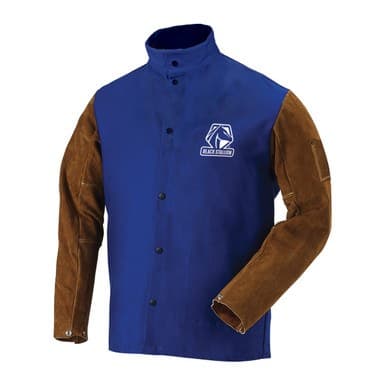
- Leather exactly where spatter lands, cotton exactly where it does not
- 30 in covers the hips, so kneeling does not expose your lower back
- Scribe pocket on each sleeve rather than on the chest, which is what AWS E4.3 asks for
- Snap wrists close the gap at the glove, the most common place to catch a spark
- Half the price of the full leather jackets here
- Revco names no standard, published arc rating or spatter rating for it
- The cotton body still burns pinholes under heavy overhead spatter
- The leather sleeves cannot go in a washing machine, so the jacket is wipe-and-spot-clean
- Royal blue and brown is not a discreet jacket
Black Stallion FN9-30C
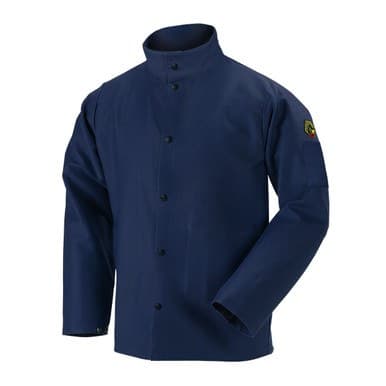
The value pick: nine ounces of flame-resistant cotton, 30 inches long, with leather reinforcement on every snap.
Technical info
- Fabric: 9 oz flame-resistant treated cotton
- Length: 30 in
- Collar: welder's collar
- Closure: 6 snaps including a collar snap, leather reinforcement on all snaps
- Pockets: scribe pocket, inside pocket
- Sizes: S to 5XL
- Standard named by Revco: none
- A full 30 in jacket from an established welding-PPE maker rather than a marketplace brand
- Leather reinforcement on the snaps, which is where a cotton jacket usually fails first
- Breathes, which matters more than anything else in a hot shop
- Sizes to 5XL
- All cotton: heavy spatter will burn pinholes in it
- No standard, arc rating or spatter rating published
- The FR finish is a treatment with a laundering life, not a property of the fibre
- Scribe pocket only - there is nowhere to put anything substantial
Miller Classic Cloth Jacket
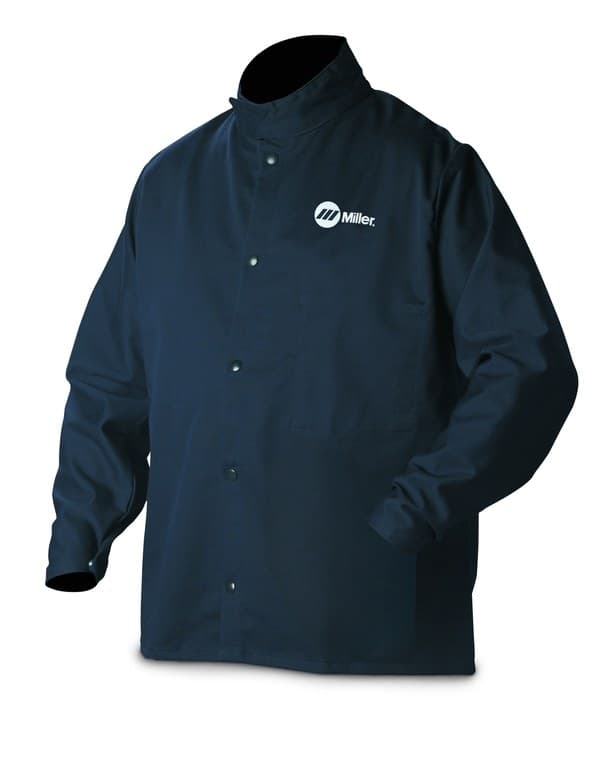
The same nine-ounce cotton idea from a company with a service network, at twelve dollars more. Pre-shrunk fabric, a Barracuda stand-up collar, five front snaps and fold-in sleeve snaps.
Technical info
- Fabric: pre-shrunk 9 oz flame-resistant navy cotton
- Collar: Barracuda stand-up collar
- Closure: five front snaps, fold-in sleeve snaps
- Pockets: inside pocket
- Construction: finished hems, reinforced stitching
- Miller part number: 244752 (XL)
- Standard named by Miller: none, on the product page or in spec sheet AY/47.5
- Pre-shrunk, which is why it still fits after the first wash
- Fold-in sleeve snaps close the cuff without a separate strap
- Inside pocket only - nothing on the front for slag to sit in
- Miller's line is organised by material, so the cloth, combo, leather and WeldX jackets are easy to step between
- Miller does not publish the length anywhere we could find
- No standard named on the product page or in Miller's own welding-jacket spec sheet
- Priced above the Black Stallion for a comparable 9 oz cotton jacket
- All cotton, so the same pinhole problem under heavy spatter
YESWELDER ZRF02
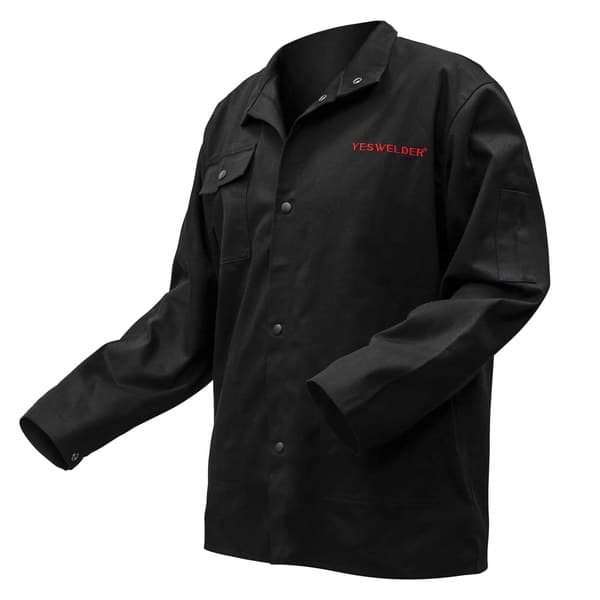
The heaviest cotton here at 11 oz, and the only jacket on this page that claims a safety standard. Read how that claim is worded before you rely on it.
Technical info
- Fabric: 11 oz (310 g) FR cotton
- Length: 29.5 in (M) to 31.4 in (3XL)
- Collar: described as a stand collar; the photograph shows a fold-down collar with a snap-up throat tab
- Closure: YESWELDER's page says buttons; the product photograph shows metal snaps at the front, collar and cuffs
- Pockets: covered chest pocket, sleeve pocket
- Sizes: M to 3XL
- Standard claimed: Amazon says NFPA 2112 certified; YESWELDER's own page says it complies with NFPA 2112, naming no certification organisation, certificate number or arc rating
- 11 oz is two ounces heavier than everything else in cotton here
- The chest pocket is covered by a flap, which is the design AWS E4.3 asks for
- Adjustable cuffs on a cotton jacket, which is rarer than it should be
- Publishes its length size by size, which none of the established brands does
- The NFPA 2112 wording is "complies with" on YESWELDER's own page, and NFPA 2112 requires UL certification and a certification mark on the product label
- YESWELDER's own page says button closure and its own photograph shows snaps - a small thing, but it is the second spec on that page that does not survive checking
- Sizes start at M, so there is nothing for a small frame, and the collar folds down rather than standing up like a welder's collar
Black Stallion JL1030 Color Block
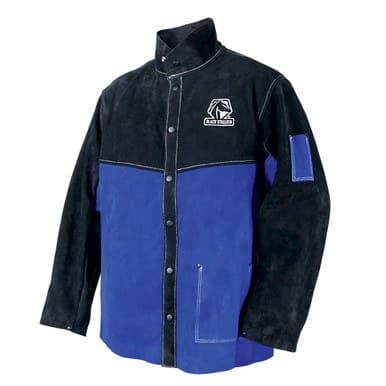
Full split cowhide with the details that separate a welding jacket from a leather coat: a stand-up welder's collar with two snap positions, satin-lined shoulders so it goes on over a shirt, and gusseted underarms so you can still reach.
Technical info
- Material: split cowhide, black and royal blue
- Collar: stand-up welder's collar with two snap options
- Closure: front snaps, adjustable waist snaps
- Lining: satin-lined shoulders
- Underarms: gusseted for range of movement
- Pockets: Revco lists a scribe pocket on the left sleeve and an inside pocket; the product photograph also shows an open patch pocket on the lower front
- Sizes: S to 4XL
- Standard named by Revco: none
- Full leather: the only material on this page that genuinely stops slag
- Gusseted underarms, which is what stops a leather jacket pinning your arms down
- Satin-lined shoulders, so it slides on rather than dragging on your sleeves
- Adjustable waist snaps keep the hem from flapping open when you crouch
- Leather carries a premium over every cotton jacket on this page
- Leather is hot, and in a summer shop you will feel every ounce
- Revco publishes neither the leather weight nor the jacket length
- No standard, arc rating or spatter rating named
- The Amazon listing is a size-variant page, so pick the size before checking the price
- The photograph shows a front patch pocket that Revco's specification does not list, and AWS E4.3 asks for front pockets to be eliminated
Lincoln Electric Heavy Duty Leather Jacket (K2989)
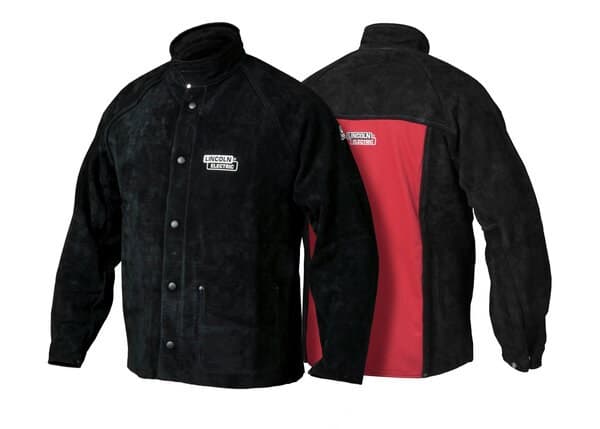
The heavy-duty answer, and the only jacket here whose maker tells you what it is for: Lincoln sells it for stick welding and out-of-position work. Split cowhide on the chest and sleeves, 9 oz flame-resistant cotton across the back so you are not carrying leather where no spatter lands.
Technical info
- Chest and sleeves: heavy-duty split cowhide leather
- Back: 9 oz flame-resistant cotton
- Length: Lincoln's product page gives both "31, 32, 33, 33, 34, 35" by size and "30 to 34 inches" - the two figures do not agree
- Collar: flip-up Velcro collar
- Closure: snaps, with an extra lined flap behind them
- Pockets: large inside left pocket
- Sizes: M to 3XL
- Lincoln MSRP: $210.97
- Standard named by Lincoln: none on its product page; the Amazon listing says the FR cotton back is "ASTM D6413 compliant"
- The only jacket here whose maker states what it is for - stick welding and out-of-position work
- Leather on the chest and sleeves, FR cotton on the back: the same logic as the hybrid, taken further
- Flip-up Velcro collar, so the neck closes without a snap to find one-handed
- A lined flap behind the snaps, which is where spatter gets through a snap front
- Lincoln has a dealer network behind it
- Several times the price of the Black Stallion cotton jacket
- Lincoln's own page contradicts itself on the length
- ASTM D6413 is a vertical flame test, one of the test methods inside NFPA 2112, not a garment standard in its own right
- Heavy, and in a hot shop you will know it
- Lincoln names no standard at all on its own product page
Washing an FR jacket without destroying it
The flame resistance in every cotton jacket on this page is a chemical treatment, and four ordinary laundry habits strip it. Fabric softener leaves a flammable film on the fibres. Chlorine bleach attacks the treatment directly. Hydrogen peroxide bleach does the same more slowly. And hard-water minerals build up in the cloth and carry a flame across it.
So: warm water, ordinary detergent, no softener, no bleach, no dryer sheets. Wash FR garments separately from ordinary clothes, because lint from a cotton T-shirt is not flame-resistant and it ends up on your jacket. Leather sleeves do not go in a machine at all - wipe them, and let them dry away from heat so the hide does not go hard. We go through this in more detail in how to maintain welding clothes at home.
None of this applies to a jacket with an oil or grease stain on it. Oil is fuel, and it will burn on flame-resistant cloth as happily as on anything else. A jacket you cannot get the oil out of is finished.
What to check before you buy, in order
In the order that eliminates the most jackets fastest.
- The heaviest work you will do in it. Overhead stick or flux-cored means leather sleeves, and nothing else will do. Bench TIG and light MIG do not
- Length. Thirty inches covers the hips when you crouch; a 24 in jacket leaves your lower back out when you kneel to a weld
- Sleeve cuffs and collar. Snap cuffs close the gap at the glove; a stand-up welder's collar closes the gap at the neck. Both are where sparks get in
- Pockets, and where they are. AWS Z49.1's explanatory material asks for front pockets to be eliminated. A covered pocket with a flap is acceptable; an open patch pocket on the chest is a slag trap
- Snaps rather than buttons. A snap gives way if the jacket catches on something; a button does not
- Whether the maker publishes anything at all - a standard, an arc rating, a spatter rating, even a length. Most publish none of it, and the ones that publish the most are not the expensive ones
- Fabric weight, once everything else is settled. Nine ounces is the industry default; eleven is warmer in both senses
- Sizing. Buy it big enough to go over a hooded sweatshirt in January, because you will
Frequently asked questions
Is a leather welding jacket better than FR cotton?
For heavy spatter, yes, and for nothing else. Split cowhide stops slag that would burn a pinhole through nine-ounce cotton, which is why overhead stick and flux-cored welders wear leather sleeves. It is also two to three times heavier, does not breathe, and cannot be machine washed. For bench TIG and light MIG, cotton is more comfortable and just as safe. The hybrid pattern - leather sleeves, cotton body - exists because spatter lands on your arms and shoulders, not your back.
What does ISO 11611 mean on a welding jacket?
ISO 11611 is the international standard written specifically for welding clothing. It grades a garment Class 1 or Class 2 by how many drops of molten metal it withstands (at least 15 or at least 25) and how long it holds off radiant heat (at least 7 seconds or at least 16). Class 1 is for gas welding, bench work and low-current TIG or MIG; Class 2 is for MMA with basic electrodes, MAG, high-current MIG and overhead work. The current edition is ISO 11611:2024, which replaced the 2015 edition in June 2024. You will rarely see it on a jacket sold in the United States.
Is NFPA 2112 the right standard for a welding jacket?
Not really. NFPA 2112 is a flash-fire standard: a finished garment is engulfed in flame for three seconds at 2 cal/cm2 on an instrumented manikin, and must keep predicted body burn under 50%. Nothing in it measures molten metal spatter. It is a genuine and demanding certification, and a jacket that carries it is a well-made garment - but it is answering a different question from the one a welder is asking.
What is the difference between "NFPA 2112 certified" and "complies with NFPA 2112"?
Certification. NFPA 2112 requires that garments labelled compliant be UL certified and that the certification organisation's mark be attached to the product label. An accredited laboratory and a third-party certification body must both be involved; testing alone is not enough to label compliance. So "certified", with a mark you can look up, is a claim someone else stands behind. "Complies with", on its own, is the manufacturer's own word.
How long does a flame-resistant cotton jacket last?
The garment outlasts the treatment. FR cotton is rated in launderings rather than years, and four things shorten that: fabric softener, chlorine bleach, peroxide bleach and hard-water mineral build-up. Wash it in warm water with ordinary detergent, separately from non-FR clothes, and retire it when the fabric thins or when an oil stain will not come out - oil burns whatever it is sitting on.
What length welding jacket should I buy?
Thirty inches for most work. It covers the hips, which is what matters when you crouch or kneel to a weld and a shorter jacket rides up and leaves your lower back exposed. A 24 inch jacket is cooler and fine at a bench. Four of the six jackets here are 30 inches; two makers do not publish a length at all.
Sources
- ISO - ISO 11611:2024, Protective clothing for use in welding and allied processes
- ISO - ISO 11611:2015, withdrawn 18 June 2024
- TenCate - EN ISO 11611 Class 1 and Class 2 requirements explained
- BP - EN ISO 11611 class selection by welding process
- Tyndale - what NFPA 2112 tests, and the UL certification and marking requirement
- Arcwear - why testing alone is not enough to label NFPA 2112 compliance
- AWS - ANSI Z49.1:2021, clause 4.3 and E4.3 on protective clothing (free PDF)
- Black Stallion - FN9-30C specifications
- Black Stallion - FRB9-30C/BS hybrid specifications
- Black Stallion - JL1030-BB specifications
- Miller - Classic Cloth Jacket specifications
- Miller - welding jackets spec sheet AY/47.5 (PDF)
- YESWELDER - ZRF02 product page
- Lincoln Electric - Heavy Duty Leather Welding Jacket K2989 specifications
- Tillman - 3830 split cowhide jacket, for comparison
Which one
Buy the Black Stallion FRB9-30C. Leather sleeves where the spatter lands, breathable cotton everywhere else, 30 inches of coverage and snap wrists - the only jacket here whose design matches where the hazard actually is. If you weld a few times a month and never overhead, the FN9-30C from the same maker is the same jacket without the leather, and it costs less. If you weld stick out of position for a living, the Lincoln K2989 earns its premium: leather on the chest and sleeves, cotton across the back, and a maker willing to say what the jacket is for. Skip the YESWELDER not because it is a bad jacket - 11 oz is the heaviest cotton here - but because the one safety claim it makes is the one you cannot check.