WelderHub is reader-supported. When you buy through links on our site, we may earn an affiliate commission. As an Amazon Associate, we earn from qualifying purchases.
Stick is the process that does not care. It welds through rust, paint and mill scale, it works outdoors in wind that would strip the gas shield off a MIG weld, and the whole consumable is a rod in a box. The machines are correspondingly simple — which is exactly why the marketing around them has so much room to move.
This guide explains the three numbers that decide whether a stick welder is any good, then compares four machines that are current models. Every specification comes from the maker’s own product page, spec sheet or manual, and where those disagree with each other — which on this shelf they do, at three different manufacturers — both figures are printed. If you have not struck an arc yet, read how to use a stick welder first; this page is about choosing the machine, not running it.
The Three Numbers That Decide It
Almost every stick welder sold today is an inverter: a switching power supply that weighs a tenth of what the old transformer machines weighed and costs a fraction of what they cost. The differences between them are not in the case. They are in three figures, and two of the three are routinely left off the listing.
What each number on a stick welder actually tells you
| The number | What it means | What it decides |
|---|---|---|
| Amperage range | The lowest and highest current the machine will set, at a given input voltage | Which rod diameters you can run. 1/8 in. 7018 wants roughly 110–140 A; 3/32 in. wants 70–95 |
| Duty cycle | The share of any ten-minute period the machine can weld at a stated current before it must cool | Whether you can lay a long bead or have to stop. 30% at 225 A means three minutes welding, seven minutes idle |
| Open-circuit voltage (OCV) | The voltage across the leads before the arc is struck | How easily the arc starts and whether cellulosic rods such as E6010 will run at all |
| Input voltage | 120 V, 240 V, or both | Where you can plug it in — and, on every dual-voltage machine here, the 120 V figures are much lower than the headline |
Why a 250-Amp Welder on a 110-Volt Plug Is Not 250 Amps
Search Amazon for a stick welder and the first page is mostly unfamiliar brands advertising 200 to 250 amps on 110 volts. Work it through. At 250 A and a typical 30 V arc, the machine is putting out 7.5 kW. Allowing for conversion losses the input is close to 9 kW, and at 120 V that is about 73 amps. A household circuit is 15 or 20 amps. The current simply cannot get in.
What those numbers describe, at best, is a momentary peak on 240 V with the dial at maximum, held for as long as the machine can stand it. That is not a lie in the way a false certification is a lie, but it is not a number you can weld with either. The machines that publish honest figures make the gap visible: they give the amperage range separately for each input voltage, and they quote the duty cycle at a current well below the maximum.
Duty Cycle Is Where the Price Difference Shows
Duty cycle is the single most useful number for telling a cheap machine from a good one, because it is a thermal measurement and heat is a function of mass and cooling. It is quoted as a percentage of a ten-minute period at a stated current, and a machine rated 160 A at 15% can weld for ninety seconds at 160 A before it has to sit for eight and a half minutes.
Two machines on this page make the point better than any argument. ESAB’s HandyArc rates 160 A at 15% duty cycle on 240 V. YESWELDER’s ARC-205DS PRO costs a fraction as much and publishes 205 A at 60%. If that were true, a 3.8 kg box would be holding more current for longer than an 8.25 kg ESAB Rogue rated 129 A at 60%. Both figures are printed on this page as the makers’ own claims, next to each other, and you can draw the conclusion.
Open-Circuit Voltage, and Why the Numbers Do Not Compare
Open-circuit voltage is the voltage sitting across the electrode holder and the work clamp before the rod touches anything. It is what pushes the arc into existence and what keeps it alive when the arc gets long. High OCV means easy starts and a forgiving arc; low OCV means a rod that sticks. Every stick machine worth buying is somewhere between 70 and 90 volts.
Except that some of them publish a much smaller number, and it is not a worse machine. Modern inverters can be fitted with a VRD — a voltage reduction device — which holds the idle voltage down near ten volts until the electrode touches the work, then raises it. It is a shock-safety feature, required on site in several countries, and it is invisible in use. But a spec sheet that lists the VRD figure instead of the welding figure produces a number that cannot be compared with anything — and two of the four machines on this page have a VRD indicator on the front panel that their specification tables never mention.
Published open-circuit voltage, and what it is measuring
| Machine | Published OCV | VRD fitted? | What the number is |
|---|---|---|---|
| Lincoln Weld-Pak 225i DV | 82 V | none visible on the panel | the welding OCV |
| ESAB HandyArc 1/8 | 80.5 V | none visible on the panel | the welding OCV |
| ESAB Rogue ES 151iP PRO | 78 V | yes — there is a VRD indicator on the front panel, which the specification does not mention | presumably the VRD-off figure |
| Lincoln AC-225 (transformer) | 79 V | n/a | the welding OCV |
| Miller Thunderbolt 210 MV | 9.5 V | yes, stated in the manual | the VRD idle voltage, not the welding OCV |
| YESWELDER ARC-205DS PRO | not published | yes — a VRD indicator on the front panel | — |
Miller’s website goes further and rounds it: the product page for the Thunderbolt 210 MV lists “Max Open Circuit Voltage: 10 VDC”. You cannot strike an arc at ten volts. The spec sheet says 9.5 V, and only the owner’s manual explains that the machine has a VRD and gives the voltage both with and without it. The number is not wrong; it is answering a question the buyer did not ask.
What to Look For in a Stick Welder
Certification does not exist on this shelf the way it does for welding clothing. What you have instead is arithmetic, so the checks are all arithmetic.
- Dual voltage, and read the 120 V row
- every machine here drops sharply on a domestic socket. The Lincoln does 225 A on 230 V and 65 A on 120 V. Buy for the socket you actually have.
- A duty cycle quoted at a named current
- “30% at 225 A” is a specification. “60% duty cycle” with no current attached is marketing.
- A published open-circuit voltage
- if the maker will not print it, the machine is being sold on its maximum amperage alone, which is the number least worth trusting.
- Hot start, arc force and anti-stick
- hot start lifts the current for the first fraction of a second so the rod does not weld itself to the plate; arc force — sometimes called dig — raises it again when the arc shortens, which is what stops a 7018 freezing in the joint.
- Lift TIG, if you might ever want it
- several of these machines will run a TIG torch for the price of the torch. It is not a substitute for a real TIG welder, but it is close to free.
- An enclosure rating if it leaves the shop
- IP23S means it can take falling water at up to 60 degrees from vertical. Most machines do not state one at all.
- A stated generator requirement
- ESAB says 7 kW for the Rogue. A machine with no published figure on a 3 kW site generator is a guess.
- Weight, read as thermal mass rather than portability
- on this shelf the heavy machines are the ones with the honest duty cycles.
Four Stick Welders
Four machines, all current models on their makers’ own websites, all still in their makers’ current ranges. The price spread across them is wide, which makes the comparison unusually informative: every figure below comes from the maker, so the columns show what the money buys rather than what the marketing says it buys.
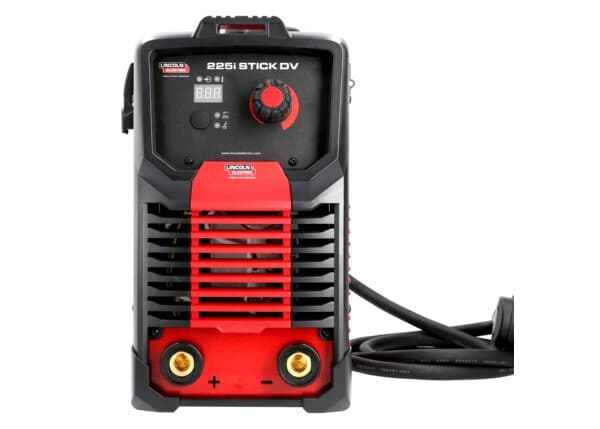
Lincoln Electric Weld-Pak 225i DV
The most usable output on this page and the only machine here that publishes a duty cycle worth having at its own maximum. The default answer for a home shop with a 230 V socket.
Technical info
- Processes: DC stick (SMAW) and DC lift TIG — Lincoln calls it Touch Start; the torch is extra
- Input: 120 V or 230 V, single phase, 60 Hz
- Output: 10–225 A DC
- Duty cycle, stick: 225 A at 30% on 230 V; 65 A at 50% on 120 V
- Duty cycle, TIG: 225 A at 40% on 230 V; 95 A at 50% on 120 V
- Open-circuit voltage: 82 V
- Electrodes: 5/64 in. to 5/32 in.; 12-gauge to 5/16 in. steel in a single pass
- Polarity: two Dinse sockets marked + and −, so you change polarity by swapping the leads
- Weight: 20 lb, 12 × 8 × 14 in., toolbox top and shoulder strap
- Part number: K5419-1
- 225 A at 30% duty cycle — by a wide margin the most welding per ten minutes here
- 82 V open-circuit voltage, published plainly on the spec sheet
- Lift TIG is in the machine; you only buy the torch
- Ships with 13 ft cables, a 230 V plug and a 120 V adapter, so it works out of the box
- 65 A at 50% on a domestic socket — the 225 is a 230 V number
- 20 lb, the heaviest of the four, which is exactly what the duty cycle costs
- Lincoln publishes no machine warranty term on the product page; the spec sheet’s warranty line covers the gun and cable for 90 days
- No enclosure rating and no generator requirement stated
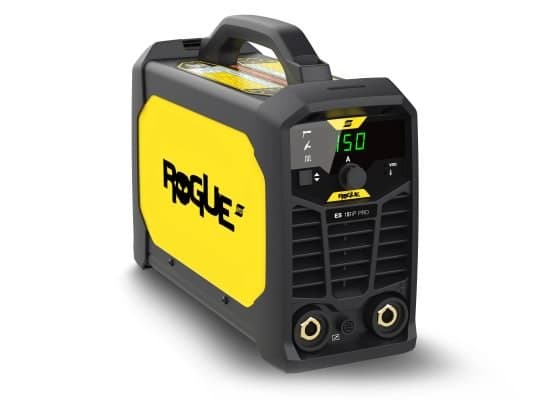
ESAB Rogue ES 151iP PRO
The one machine here that names a mode for 6010, with 78 V open-circuit and an IP23S case. Buy it if you run cellulosic rods or work outside; it costs four times the HandyArc and it is worth it only for those reasons.
Technical info
- Processes: stick (SMAW), pulse SMAW, lift TIG and pulsed TIG
- Input: 120–230 V ±15%, single phase, 50/60 Hz
- Output: ESAB lists 10–150 A at 120 V and 10–130 A at 230 V — see the cons
- Open-circuit voltage: 78 V
- VRD: the specification does not mention one, but the front panel carries a VRD indicator
- Enclosure: IP23S
- Electrodes: up to 1/8 in. (3.2 mm)
- Weight: 18.2 lb (8.25 kg), 15.8 × 6 × 10.4 in.
- Generator: 7 kW recommended
- Part number: 0705002021
- A named mode for stick 6010 — the only machine on this page that says it
- 78 V open-circuit, the figure a cellulosic rod needs
- IP23S, so it is rated to be rained on rather than merely carried outside
- Power factor correction rated for extension cable runs up to 300 ft of 12 AWG
- Pulse SMAW, which keeps heat down on thin material
- By a wide margin the most expensive machine here — several times the HandyArc and an order of magnitude above the YESWELDER
- ESAB’s own product page and its own store both give a higher current range on 120 V than on 230 V, which cannot be right; the panel in ESAB’s own photograph reads 150, so 150 A is almost certainly the 230 V figure and the rows are transposed
- The front panel has a VRD indicator that no ESAB specification page mentions — if the VRD is on, the open-circuit voltage is not 78 V
- A new model with very little owner experience behind it yet, rather than a proven one
- 1/8 in. electrodes maximum; the 201iP PRO takes 5/32 but is harder to find at retail
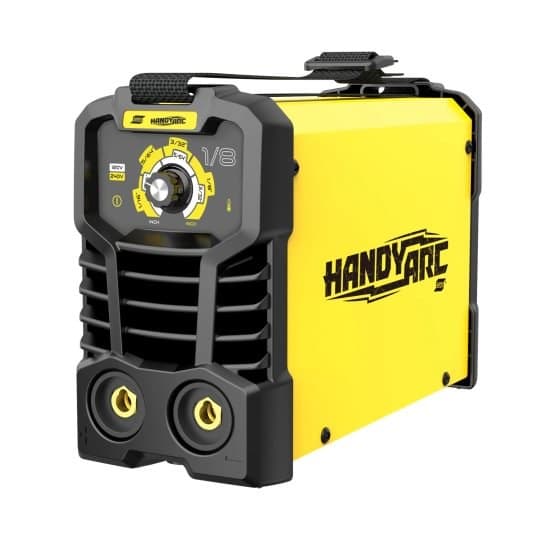
ESAB HandyArc 1/8
Six pounds, and honest numbers at both voltages. The right machine for occasional repairs — as long as you can live without setting an amperage.
Technical info
- Process: DC stick (SMAW)
- Input: 120 V ±10% or 240 V ±10%, single phase, 50/60 Hz
- Output: 15–70 A at 120 V; 15–160 A at 240 V
- Duty cycle: 70 A at 20% on 120 V; 160 A at 15% on 240 V
- Open-circuit voltage: 80.5 V DC
- Control: a single dial marked by electrode diameter — 1/16, 3/32, 1/8, 5/32 — with separate 120 V and 240 V bands, not an amperage scale
- Weight: 6.3 lb (2.9 kg), 4.5 × 10.3 × 7.1 in.
- Electrodes: ESAB names 6013 arc starts
- Part number: 0700734012
- 80.5 V open-circuit — the second highest here, and published plainly
- 6.3 lb: it lives in a toolbox rather than on a bench
- A manufacturer with a warranty channel behind it, at a hobby price
- Duty cycle stated separately and honestly for both input voltages
- You cannot set an amperage: the dial is marked in rod diameters, so the machine chooses the current for you. That is fine until a joint needs less heat than the rod chart assumes
- 160 A at 15% is ninety seconds of welding in every ten minutes
- 70 A at 120 V holds you to 3/32 in. rod on a domestic socket
- ESAB names 6013, not 6010 — do not buy this one for cellulosic rods
- No lift TIG, no enclosure rating, no generator figure
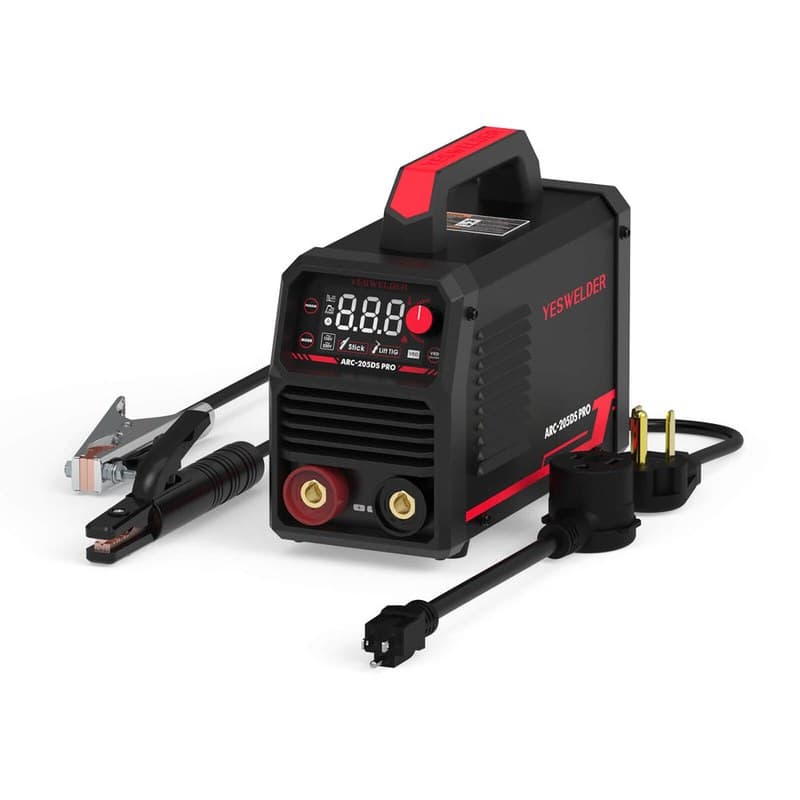
YESWELDER ARC-205DS PRO
The cheapest machine here by a wide margin, and the one most people on this shelf own. It is also the only machine on this page that publishes no open-circuit voltage and whose own two descriptions disagree about which rods it runs.
Technical info
- Processes: stick (SMAW) and lift TIG
- Input: 110 V / 220 V ±10%, 50/60 Hz
- Output: 20–145 A at 110 V; 20–205 A at 220 V
- Duty cycle as published: “Stick: 60% @ 205A”
- Open-circuit voltage: not published
- VRD: the front panel has a VRD indicator; no YESWELDER document we found mentions it
- Weight: 8.4 lb (3.8 kg), 11.6 × 5.3 × 7.7 in.
- Electrodes, per YESWELDER’s own spec table: E6011 / E6013 / E7018
- Warranty: 2 years
- The machine most people on this shelf actually buy
- Dual voltage with lift TIG included, at a price the branded machines cannot touch
- Adjustable hot start and arc force, both on the front panel
- A two-year warranty stated plainly, which is more than two of the makers here say at all
- No open-circuit voltage published anywhere — and the machine has a VRD indicator on its front panel, so there are two figures unpublished rather than one
- “60% at 205 A” from a 3.8 kg machine is a claim the 8.25 kg ESAB Rogue does not make at 129 A
- The spec table lists E6011 / E6013 / E7018 while the Amazon listing says 6010 — the maker’s own two descriptions disagree
- 145 A at 110 V is the honest figure for a domestic socket, not the 205 on the box
The four compared
| Machine | Price | Output at 240 V | Duty cycle | OCV | Lift TIG |
|---|---|---|---|---|---|
| Lincoln Weld-Pak 225i DV | 10–225 A | 225 A at 30% | 82 V | yes | |
| ESAB Rogue ES 151iP PRO | 10–130 A (as listed) | 150 A at 25% (as listed) | 78 V | yes, and pulsed | |
| ESAB HandyArc 1/8 | 15–160 A | 160 A at 15% | 80.5 V | no | |
| YESWELDER ARC-205DS PRO | 20–205 A | claimed 205 A at 60% | not published | yes |
Read the last three columns together. The Lincoln costs five times the YESWELDER and claims less maximum current, and it is still the machine that will weld for longer without stopping, because 30% of ten minutes at 225 A is a figure a 20 lb machine can actually make. The ESAB Rogue costs nearly twice the Lincoln and produces less current still; what the money buys there is the 6010 mode, the weather rating and the pulse functions, not output. Three of the four will also strike a TIG arc by lift start, which is a second process for the price of a torch rather than a reason to skip a proper TIG machine.
The 6010 Problem
E6010 is the cellulosic rod that pipeline and farm work runs on: a deep, digging arc that burns through rust and cuts into a root gap. It is also the rod most small inverters run badly or not at all, because it needs a high open-circuit voltage and an arc that will not go out when it gets long. Our guide to welding rods explains where each one belongs; the reason it matters here is that the machine decides whether you can use it.
Two things tell you whether a machine will run one. The first is the open-circuit voltage, which is why a maker that does not publish it has told you nothing. The second is whether the maker names 6010 at all. ESAB’s Rogue PRO series names “a special mode for stick 6010” in its own feature list; ESAB’s HandyArc names 6013 and stops there; Lincoln’s Weld-Pak spec sheet mentions no rod class; Miller’s Thunderbolt manual does not mention cellulosic electrodes anywhere.
What the Makers’ Own Pages Get Wrong
Three of the manufacturers on this page publish a figure on their own website that is wrong, or that contradicts something else they publish. None of them is a small operation, and none of these is hidden — they are on the product page, in the specification table, where a buyer comparing machines would read them.
Three manufacturers, three errors on their own specification pages
| Maker | What the page says | What is actually true |
|---|---|---|
| Miller | Thunderbolt 210 MV: “Max Open Circuit Voltage: 10 VDC” | 9.5 V on the spec sheet, and the manual shows it is the VRD idle voltage, not the welding OCV |
| ESAB | Rogue ES 151iP PRO: 10–150 A at 120 V, 10–130 A at 230 V | A machine does not make more current on the lower input voltage. Both esab.com and ESAB’s own store repeat it |
| YESWELDER | Spec table lists E6011 / E6013 / E7018; the Amazon listing says 6010, 6011, 6013 and 7018 | One of the two is wrong, and 6010 is the one that depends on a voltage YESWELDER does not publish |
A fourth thing is missing rather than wrong. Two of these machines — the ESAB Rogue and the YESWELDER — carry a VRD indicator on the front panel in the makers’ own product photographs, and neither maker’s specification mentions a VRD at all. That is the one feature that changes what the open-circuit voltage number means, and on the YESWELDER there is no open-circuit voltage published to change. The lesson is not that these are bad manufacturers — two of them are the best names in the trade. It is that the product page is marketing copy with a table attached, and the table is entered by hand. The spec sheet is better. The owner’s manual, which every one of these makers publishes as a free PDF, is better still, and it is the only place the Miller VRD question is answered at all. Download it before you buy, not after.
Plugs, Circuits and Generators
A stick welder is one of the few tools in a home shop that can out-draw the building. On 120 V every machine here is limited to roughly 65 to 145 A of output, which covers 3/32 in. rod and light repairs. On 230 V they open up, and a 230 V circuit for welding usually means a 50 A receptacle: the Lincoln ships with a 6-50P plug, which is the same three-pin welder outlet an old transformer machine used.
Two practical points. Extension cables drop voltage, and an inverter that loses input voltage loses output current; ESAB rates the Rogue’s power factor correction for runs up to 300 ft of 12 AWG, which is a specification nobody else here gives. And if the machine is going on a generator, look for a stated figure — ESAB asks for 7 kW. A 3 kW site generator will start a small inverter and then sag the moment you strike an arc at any useful current.
Frequently Asked Questions
What size stick welder do I need for home use?
For general repair work in a home shop, a dual-voltage machine that will give 140 to 160 amps on a 230 V socket covers almost everything: 1/8 in. 7018 runs at roughly 110–140 A, and that welds material up to about 1/4 in. in a single pass. If all you have is a 120 V socket you are limited to around 65 to 145 amps depending on the machine, which means 3/32 in. rod and thinner steel. Buy for the socket you have, not the one you might install.
Is a 250-amp stick welder on 110 volts real?
No, not as a usable number. At 250 amps and a typical 30 V arc the machine is producing 7.5 kW, so it is drawing roughly 9 kW at the wall — about 73 amps at 120 V. A household circuit supplies 15 or 20. What those listings describe is a peak on 240 V at full dial. The figures worth reading are the amperage range quoted separately for each input voltage, and the duty cycle quoted at a named current.
What is duty cycle on a welder?
The share of a ten-minute period the machine can weld at a stated current before it has to cool. A machine rated 160 A at 15% will weld for ninety seconds at 160 A and then needs eight and a half minutes off. A duty cycle with no current attached to it is meaningless, because every machine is 100% duty cycle at a low enough setting.
Why will my inverter not run 6010 rods?
E6010 is a cellulosic electrode that needs a high open-circuit voltage and an arc that stays lit when it gets long. Many small inverters run at a lower open-circuit voltage than the old transformer machines, and some fit a voltage reduction device that holds it lower still until the rod touches the work. Machines that will run 6010 usually say so: ESAB’s Rogue PRO series names a special mode for it. If yours will not, E6011 is the same chemistry reformulated to run on less voltage, and it is the usual substitute.
What does VRD mean on a welder?
Voltage reduction device. It holds the open-circuit voltage down near ten volts while the machine is idle and raises it when the electrode touches the work — a shock-safety feature, and mandatory on site in some countries. It is invisible in use, but it makes the published open-circuit voltage incomparable with a machine that does not have one. Miller’s Thunderbolt 210 MV lists 9.5 V for exactly this reason.
Can you TIG weld with a stick welder?
With lift TIG, yes, within limits. Several of these machines will strike a TIG arc by touching the tungsten to the work and lifting; you buy a torch and a gas regulator and you have DC TIG for steel and stainless. What you do not get is high-frequency start, AC for aluminium or a foot pedal on most of them. It is a genuine second process, not a substitute for a proper TIG machine.
Do I need an inverter or is a transformer welder fine?
An inverter, for almost everybody. A modern 20 lb inverter gives more usable output than a 109 lb transformer, adds hot start and arc force, runs on 120 V as well as 230 V, and costs less. The transformer machine's remaining advantages are that there is nothing electronic to fail and that it will run a 5/32 in. rod all day on AC. If you already own one, it is not worth replacing until it dies.
Sources
Every figure above comes from the maker’s own product page, specification sheet or owner’s manual. Prices and availability change constantly, so this page does not quote them - follow a link for the current figure.
- Lincoln Electric Weld-Pak 225i DV (K5419-1) — output range, duty cycle at both input voltages, 82 V open-circuit voltage and electrode sizes
- ESAB Rogue ES 151iP PRO (0705002021) — 78 V open-circuit voltage, IP23S, the 6010 mode, the 7 kW generator recommendation — and the current range that reads higher on 120 V than on 230 V
- ESAB Rogue ES 201iP PRO (0705002022) — the larger current model: 10–200 A at 230 V, 200 A at 25% / 129 A at 60% / 100 A at 100%, 78 V open-circuit
- ESAB HandyArc 1/8 (0700734012) — 15–160 A, 160 A at 15% duty cycle, 80.5 V open-circuit voltage, and the 6013 arc-start claim
- ESAB’s United States stick welder range — the five current models — the Rogue ES 180i and ES 130i are not among them
- Miller Thunderbolt 210 MV (907909) — the rated output at 60% and 100% duty cycle at each voltage, and the “Max Open Circuit Voltage: 10 VDC” line
- Miller Thunderbolt 210 MV specification sheet — 10–110 A at 120 V against 10–210 A at 240 V, 13 lb, and the three-year warranty with five years on the main rectifier
- Miller Thunderbolt 210 MV owner’s manual — the VRD, and the open-circuit voltage given both with and without it — the only document that explains the 9.5 V figure
- YESWELDER ARC-205DS PRO — 20–145 A at 110 V, 20–205 A at 220 V, the “Stick: 60% @ 205A” duty cycle, and the E6011 / E6013 / E7018 electrode line
- Lincoln Electric AC-225 (K1170) — 40–225 A AC, 225 A at 20% duty cycle, 79 V open-circuit voltage and 109 lb
The Short Answer
Buy the Lincoln Weld-Pak 225i DV if you have a 230 V socket and want one machine that will weld for longer than any of the others without stopping. Buy the ESAB Rogue ES 151iP PRO if you run 6010 or work outdoors, and accept that you are paying nearly twice as much for a mode, a weather rating and a pulse function rather than for output. Buy the ESAB HandyArc if the welding is occasional and you want a real manufacturer behind a six-pound box. The YESWELDER is a third of the HandyArc’s price and the machine most people here actually own — just understand that it publishes no open-circuit voltage, and that its duty-cycle claim is one no heavier machine on this page is willing to make.