WelderHub is reader-supported. When you buy through links on our site, we may earn an affiliate commission. As an Amazon Associate, we earn from qualifying purchases.
A TIG welder is bought for control, not speed. One question decides what you spend: if you weld aluminium you need an AC/DC machine, and if you only weld steel and stainless, a DC-only machine does the same work for a quarter of the money. Everything below comes from the manufacturer's own published specification.
At a glance
| Machine | AC for aluminium | Max TIG amps | Duty cycle as published | Maker's price |
|---|---|---|---|---|
| PrimeWeld TIG225X | Yes | 225 A at 240 V | 40% at max, 100% at 155 A | |
| Weldpro TIGACDC200GD | Yes | 200 A at 230 V | 40% at 200 A | |
| AHP AlphaTIG 225Xi | Yes | 225 A at 240 V | 35% at 225 A, 60% at 200 A | |
| YesWelder TIG-205P PRO | No, DC only | 200 A at 220 V | 60% at 200 A, 100% at 155 A |
Prices are the manufacturer's own, read on 15 September 2026. Amazon's price moves independently of every one of them, which is why this table does not quote one.
The four machines
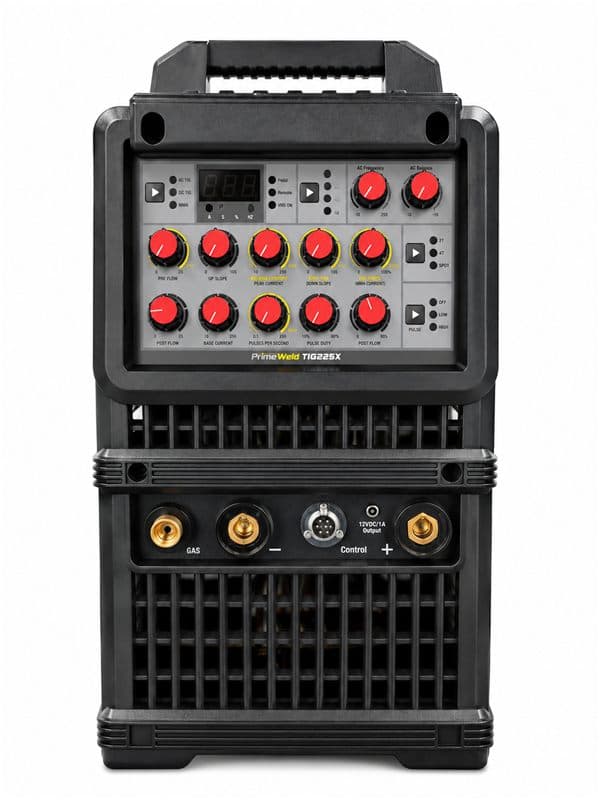
PrimeWeld TIG225X
The best specification here, and the one we would buy. It is the only machine on this page that ships with a CK Worldwide torch rather than a house-brand one, and the only one that publishes a 100% duty cycle figure at a useful amperage.
Technical info
- Process: AC/DC TIG and stick
- TIG amperage: 10-225 A at 240 V, 10-140 A at 120 V
- Stick amperage: 10-180 A
- Duty cycle, TIG: 40% at maximum output, 100% at 155 A on 240 V
- Duty cycle, stick: 40% at maximum, 100% at 139 A on 240 V
- Input: 120 V / 240 V single phase, 50/60 Hz
- AC frequency: 40-200 Hz
- AC balance: 10-90%
- Pulse: 0.5-200 Hz
- Torch: CK Worldwide, choice of CK17, CK20 or CK26
- Weight: 41 lb (18.5 kg)
- Warranty: 3 years
- Check on: PrimeWeld
- 100% duty cycle at 155 A, which is more continuous welding than most shop work asks for
- CK Worldwide torch, so consumables are the standard pattern and available anywhere
- Pulse and AC frequency both reach 200 Hz
- Three-year warranty from a company that answers its phone
- PrimeWeld sells it direct rather than through Amazon, so there is no Prime delivery on it
- 41 lb, and the cart is extra
- Publishes AC balance as a bare percentage without saying whether it means electrode positive or negative
Weldpro 200 A AC/DC TIG
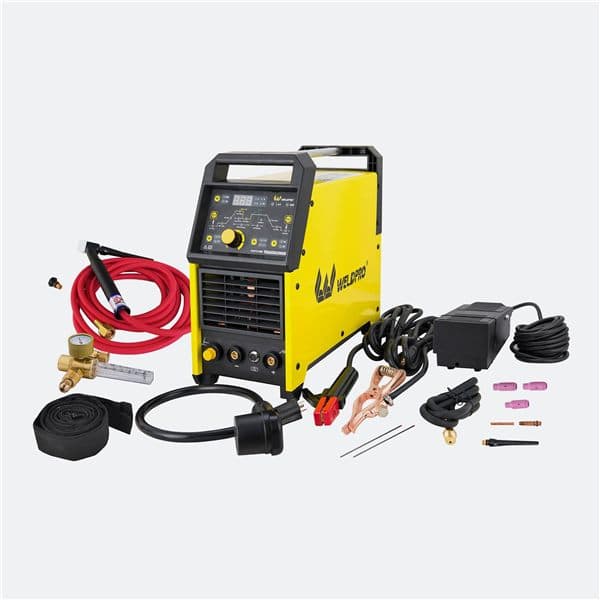
The AC/DC machine you can actually have delivered tomorrow, and the cheapest route to a CK17 torch. Weldpro publishes less about it than PrimeWeld does, which is the trade.
Technical info
- Process: AC/DC TIG and stick, with pulse
- TIG amperage: 5-200 A DC, 10-200 A AC
- Stick amperage: 20-180 A
- Duty cycle: 40% at 200 A on 230 V; 120 A at 40% on 115 V
- Input: 115-230 V single phase, 50/60 Hz
- AC frequency: not published
- AC balance: not published
- Pulse: not published
- Torch: CK17 superflex on Weldpro's own package
- Weight: 32.6 lb
- Warranty: 3 years on the power source
- Sold through the usual retail channel rather than direct only, which none of the other AC/DC machines here is
- Under 33 lb, the lightest AC/DC machine on this page by 8 lb
- Three-year power source warranty
- Weldpro's own package includes the CK17 superflex torch
- Does not publish its AC frequency, AC balance or pulse ranges anywhere we could find - on a machine sold for welding aluminium, those are the three numbers that matter
- Weldpro's spec sheet says the stick range starts at 20 A and its product page says 10 A; the maker disagrees with itself
- The Amazon listing is a different bundle from Weldpro's own, does not state a model number, and is sold by a third party rather than the Weldpro store
- Lower maximum output than the PrimeWeld and the AHP
AHP AlphaTIG 225Xi
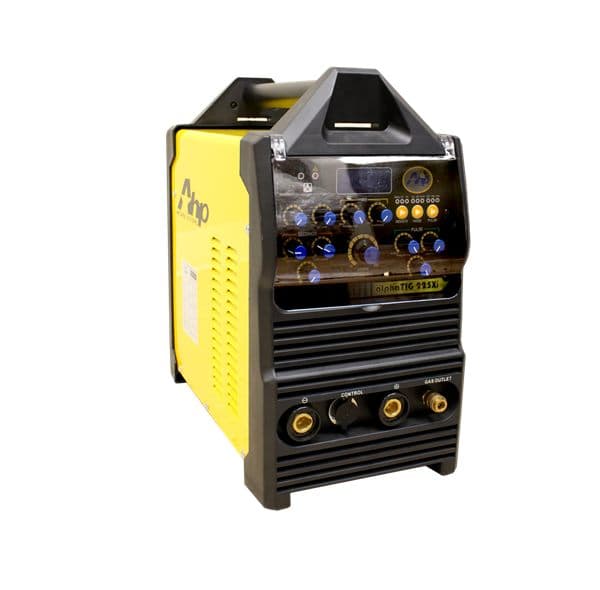
The most output per dollar anywhere on this page. Worth knowing before you read any other guide: AHP replaced the long-running AlphaTIG 200X and 201XD with the 203Xi and 225Xi, and most published reviews are still of the old machines.
Technical info
- Process: AC/DC TIG and stick
- TIG amperage: up to 225 A at 240 V, up to 150 A at 120 V
- Stick amperage: up to 185 A at 240 V, up to 125 A at 120 V
- Duty cycle, TIG: 35% at 225 A, 60% at 200 A on 240 V
- Input: 120 V / 240 V, 50/60 Hz
- AC frequency: 20-200 Hz
- AC balance: 10-90% electrode positive
- Pulse: 0.5-200 Hz, on AC or DC
- Torch: Nova 26, 12.5 ft, DINSE connector
- Weight: 50 lb
- Warranty: 3 years parts and labour
- Check on: AHP Welders
- 225 A and three years of warranty for under seven hundred dollars direct
- AC frequency down to 20 Hz, lower than anything else here, which widens the arc for thin aluminium
- States its AC balance in electrode positive, so the number on the dial means something
- Pulses on AC as well as DC
- The heaviest machine here at 50 lb
- The Nova 26 is a house-brand torch; CK consumables do not simply drop into it
- Sold mainly direct; the Amazon listings are bundles at different prices
- Publishes a duty cycle but not the ambient temperature it was measured at
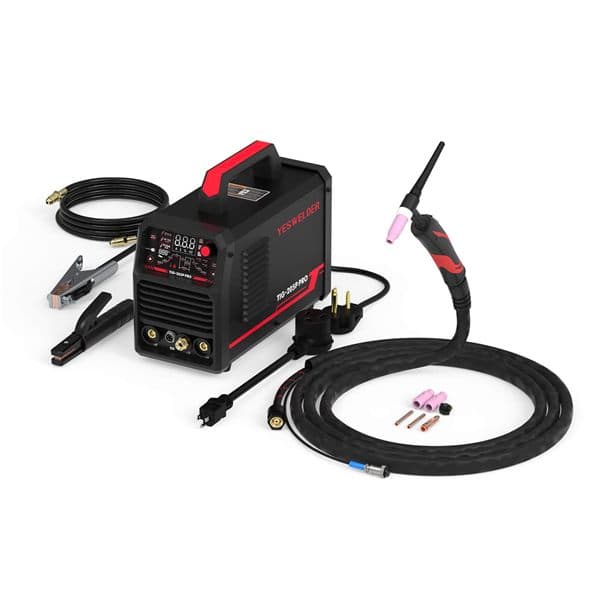
YesWelder TIG-205P PRO
Read the first line of the specification before anything else: this is a DC machine and it will not weld aluminium. If you weld steel and stainless it does everything the others do for a quarter of the money, and it weighs less than a bag of cement.
Technical info
- Process: DC TIG and stick, with pulse. No AC
- TIG amperage: 10-200 A at 220 V, 10-160 A at 110 V
- Stick amperage: 20-160 A at 220 V, 20-140 A at 110 V
- Duty cycle, TIG: 60% at 200 A, 100% at 155 A on 220 V
- Input: 110 V / 220 V, plus or minus 15%, 50/60 Hz
- Torch: WP-17, 13 ft
- Weight: 10.7 lb
- Warranty: 2 years
- Around a quarter of the price of the AC/DC machines
- 10.7 lb, so it goes to the work in one hand
- Publishes 100% duty cycle at 155 A, the same figure as the PrimeWeld
- WP-17 torch, the most common consumable pattern there is
- No AC, so no aluminium and no magnesium. That is the entire trade
- Two-year warranty against three on the others
- Several near-identical YesWelder listings exist; check the one you are buying says TIG-205P
One machine we left out on purpose: Lincoln's Square Wave TIG 200. It has a dealer network, parts you will still be able to buy in a decade and a full published spec sheet - but 25% duty cycle at 200 A against the PrimeWeld's 40%, pulse that stops at 20 pulses per second where the others reach 200 Hz, and a higher price. Buy it if what you want is a dealer rather than a specification. Once whichever machine you choose arrives, setting it up and striking the first arc is its own job.
Do you actually need AC?
Aluminium carries an oxide skin that melts at roughly three times the temperature of the metal underneath it. Direct current will not lift that skin. Alternating current does, because on the electrode-positive half of each cycle the arc strips the oxide off the surface. That is the whole reason AC/DC machines exist and cost three times as much. If you are still choosing between processes rather than machines, MIG against TIG and the wider list of welding processes come first.
So: steel, stainless, chrome-moly, titanium and copper are DC work. Aluminium and magnesium need AC. If your honest answer is that you might weld aluminium one day, buy the DC machine now and the AC/DC machine when that day comes. You will have spent less than one mediocre machine that does both badly.
The AC balance number does not mean the same thing on two machines
This is the most useful thing on this page and no product listing will tell you. AC balance sets how much of each cycle is spent cleaning oxide off the surface against melting the metal. Every AC/DC machine has the control. They do not all count it the same way.
The same control, three different numbers
| Machine | Published as | Range |
|---|---|---|
| AHP AlphaTIG 225Xi | % electrode positive | 10-90% |
| Lincoln Square Wave TIG 200 | % electrode negative | 60-90% |
| PrimeWeld TIG225X | a percentage, unstated which | 10-90% |
| Weldpro 200 A AC/DC | not published at all | not published |
Electrode positive and electrode negative are the two halves of one cycle, so 90% EP on the AHP is 10% EN, which is the opposite end of the dial from 90% EN on the Lincoln. Take a setting from a forum post, put it into the wrong machine, and you will either ball the tungsten off the end of the electrode or leave the oxide in the weld.
Frank Armao, who chairs the AWS D1 Aluminum Subcommittee, recommends running balance as low on the electrode-positive side as you can while still getting clean metal: around 35% EP on an older transformer machine, and as little as 15% EP on a modern inverter. In Lincoln's numbering that same setting is 85% electrode negative.
Duty cycle is only comparable when the conditions are published
Duty cycle is the share of a ten-minute period a machine can weld at a given output before it has to stop and cool. Read the table at the top again and something looks wrong: the budget YesWelder publishes 60% at 200 A and a Lincoln costing several times as much publishes 25% at 200 A.
Those figures are not lies, but they are not measured the same way either. Ambient temperature changes the answer and only some manufacturers say what theirs was - Everlast states 40 degrees C beside every figure on the PowerTIG 210EXT, and none of the four machines above does. Where the condition is missing, treat the headline number as the maker's best case and compare machines on the amperage at which they claim 100% instead. That figure is much harder to flatter.
What to look at on a spec sheet
In the order that matters when you are standing in front of two machines.
- AC, or not
- the only decision you cannot undo later. No AC means no aluminium, ever
- Amperage at your wall voltage
- every dual-voltage machine loses a third or more of its output on 120 V. The number on the box is the 240 V number
- The amperage at 100% duty cycle
- harder to flatter than the headline duty cycle, and closer to the welding you will actually do
- Whether the AC frequency, AC balance and pulse ranges are published at all
- if a maker will not print them, you are buying on trust
- Pulse frequency range
- low rates help you time filler rod by hand on thin material, high rates stiffen the arc. 0.5 to 200 Hz is the current normal
- AC frequency range
- lower widens the arc and the cleaned zone, higher narrows and focuses it. A 20 Hz floor is more useful than a 60 Hz one
- Torch pattern
- a CK or WP-17 style torch means consumables from any supplier. A house-brand torch means consumables from one
- Warranty length, and who honours it
- three years from a manufacturer is not three years from a marketplace seller
- Weight
- 10 lb goes anywhere in one hand. 50 lb needs a cart, and the cart is not included
Tungsten: what to buy, and the one to stop buying
The electrode is the cheapest part of the setup and the part most often bought wrong. Classifications and colour codes are set by AWS A5.12; the uses below are the ones CK Worldwide, who manufacture them, publish for each type.
Tungsten electrodes
| Type | AWS class | Colour | Use |
|---|---|---|---|
| 2% lanthanated | EWLa-2 | Blue | General purpose, AC and DC. The one to buy if you buy one |
| 1.5% lanthanated | EWLa-1.5 | Gold | DC. The non-radioactive substitute for thoriated |
| 2% ceriated | EWCe-2 | Grey | AC or DC, good at low-amperage starts |
| 2% thoriated | EWTh-2 | Red | DC. Contains thorium oxide and is radioactive |
| 0.8% zirconiated | EWZr-8 | White | AC, aluminium and magnesium |
| Pure | EWP | Green | AC only, non-critical work |
Thoriated is the red one every shop still has a tube of, and it is the one to stop buying. The thorium in it is radioactive. The exposure while welding is small, but grinding an electrode to a point makes a dust of it and you grind electrodes constantly. Two percent lanthanated does the same job on DC, works on AC as well, and is not radioactive at all.
What the machine does not come with
Budget for these before you decide which welder you can afford. None of the four includes any of them - and the clothing is not optional, because a TIG arc is a concentrated ultraviolet source held close to your hands and forearms. Our guides to flame-resistant welding shirts and welding trousers explain what the labels mean.
- Argon, and a regulator with a flowmeter. Pure argon for steel and for aluminium alike on TIG
- A cylinder, which you rent or buy locally and cannot order online
- Tungsten, in at least two diameters
- Filler rod matched to the parent metal: ER70S-2 for mild steel, ER308L for 304 stainless, ER4043 or ER5356 for aluminium
- A helmet that darkens at low amperage. Many auto-darkening helmets do not trigger reliably below about 20 A, which is exactly where TIG lives
- Flame-resistant clothing, and TIG gloves, which are thinner than MIG gloves so you can feel the rod
- A foot pedal, if the machine does not include one
Frequently asked questions
Can a TIG welder weld aluminium without AC?
No. Aluminium carries a surface oxide that melts far hotter than the aluminium under it, and only the electrode-positive half of an AC cycle strips it. A DC-only machine such as the YesWelder TIG-205P welds steel and stainless well and will not weld aluminium at all. That is why the AC/DC machines cost three times as much.
How many amps do I need?
Roughly one amp per thousandth of an inch of steel thickness, so about 125 A for 1/8 inch. Aluminium needs more because it carries the heat away faster. A 200 A machine covers everything a home workshop and most small shops will meet; what limits you in practice is the duty cycle at that amperage, not the maximum.
Will a 200 amp welder run on a normal household socket?
It will run, but not at 200 A. Every dual-voltage machine here loses a third or more of its output on 120 V: the PrimeWeld drops from 225 A to 140 A, the AHP from 225 A to 150 A. If you need full output you need a 240 V circuit, and that is an electrician, not an extension lead.
Is a cheap TIG welder worth buying?
For DC work, yes. A budget 200 A DC inverter does what a 200 A DC inverter does. The difference shows up when it breaks: how long the warranty runs, whether a person answers, and whether parts still exist in three years. That is most of what a premium price buys.
What is pulse for?
Pulsing switches the current between a high and a low value many times a second. At low rates it lets you time the filler rod to the peaks and keeps thin material from melting through; at high rates it stiffens and narrows the arc. Three of these machines pulse to 200 Hz; Lincoln's stops at 20 pulses per second.
Sources
- PrimeWeld - TIG225X specification
- Weldpro - TIGACDC200GD specification sheet (PDF)
- AHP Welders - AlphaTIG 225Xi specification
- YesWelder - TIG-205P PRO specification
- Lincoln Electric - Square Wave TIG 200 (K5126-1)
- Everlast - PowerTIG 210EXT, the one specification here that states its ambient temperature
- CK Worldwide - guide to AC/DC TIG welding, and their tungsten electrode chart
- Frank Armao, chair of the AWS D1 Aluminum Subcommittee - setting up an AC power supply for aluminium GTAW
Which one
If you weld aluminium and can wait for direct delivery, buy the PrimeWeld TIG225X: the highest continuous output here, a CK torch so consumables are ordinary, three years of warranty. If you want it this week, the Weldpro is the AC/DC machine on the shortest delivery, and you accept that it does not publish its AC settings. The AHP AlphaTIG 225Xi gives up the torch and gains an AC frequency floor of 20 Hz, which is genuinely useful on thin aluminium. And if you do not weld aluminium, do not pay for AC at all - the YesWelder does the other four-fifths of TIG work for a quarter of the money.