WelderHub is reader-supported. When you buy through links on our site, we may earn an affiliate commission. As an Amazon Associate, we earn from qualifying purchases.
A welding shirt is the layer that catches everything the hood does not. It is also the piece of kit where the labels are least honest — “flame resistant” is printed on garments that have passed very different things, and the difference is not obvious in a product listing.
This guide explains what the label claims mean, then covers three shirts. We have not worn them; every figure comes from the maker's own specification, and each one is linked at the foot of the page. The trousers side of the same problem is in our guide to the best welding pants.
Do You Need a Welding Shirt, or Will a Cotton Shirt Do?
For occasional light work, a heavy 100% cotton shirt is far better than anything synthetic, and plenty of people use one. It is not flame-resistant: cotton ignites and keeps burning once it catches. What it will not do is melt onto you, which is the thing that makes an ordinary polyester shirt genuinely dangerous near an arc.
ANSI/AWS Z49.1:2021 does not name a fabric. Clause 4.3 asks for clothing “made of suitable materials, to minimize skin burns caused by sparks, spatter, or radiation”, and its explanatory note E4.3 recommends heavier materials — leather or flame-resistant clothing — and says materials that melt should not be used. It also asks for sleeves and collars to be kept buttoned, and for pockets to be eliminated from the front of clothing, because sparks lodge in them.
OSHA has no rule naming FR clothing for welders. Its 2012 letter of interpretation says that where welders are exposed to flash fire or short-duration flame, employers are expected to provide flame-resistant clothing, and that where controls remove that exposure there is no requirement. If you weld for a living, you are in the first case.
“Flame Resistant” Is Not One Claim
Three different things get printed on FR shirts, and they are not interchangeable.
What each claim on the label actually means
| On the label | What it is | What it proves |
|---|---|---|
| ASTM D6413 | A single test method — a vertical flame held to a fabric strip | The fabric self-extinguishes and does not char past a limit. One test, on cloth |
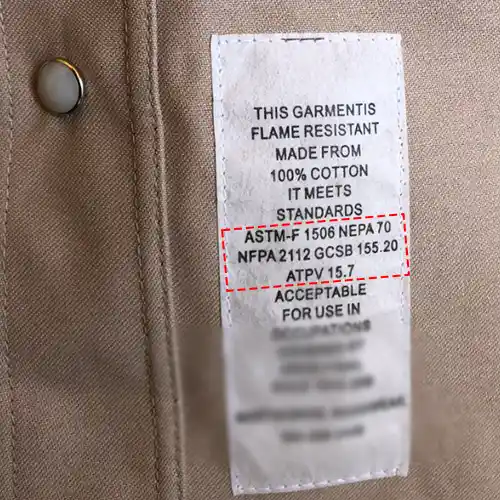
| NFPA 2112 | A garment certification built from 17 test methods | The fabric passed the flame test after 25 launderings, and a finished garment passed the ASTM F1930 manikin test — a three-second engulfment at 2 cal/cm² with under 50% predicted body burn |
| NFPA 70E / ASTM F1506 | Electrical safety and arc-rated clothing | The garment is arc-rated. That is an electric-arc measure, not a spatter one |
| ATPV, in cal/cm² | The arc rating itself | How much arc energy the fabric takes before a second-degree burn is predicted. CAT 1 needs 4 cal/cm², CAT 2 needs 8 |
The distinction that matters when you are comparing shirts: ASTM D6413 is one of the tests inside NFPA 2112, not an alternative to it. A shirt whose label claims only D6413 has passed the flame test on cloth. A shirt certified to NFPA 2112 has also been put on a manikin and set on fire.
None of it means fireproof. FR fabric resists ignition and stops burning when the flame goes away. It still passes heat through, and a bead of spatter sitting on it will still burn you — which is why weight matters.
What to Look For in a Welding Shirt
Certification first, then the shape of the garment. Most of what goes wrong is about the second.
- Fabric weight
- this is the single most useful number for spatter. 7 oz is the usual minimum in FR shirts; 9 oz puts noticeably more between a spark and your arm, at the cost of heat.
- Long sleeves with closable cuffs
- an open cuff is a funnel pointing at your forearm. Snap or button cuffs that actually close are worth more than any marketing feature.
- A collar you can turn up
- overhead and out-of-position work throws spatter at your neck, which nothing else covers.
- Nothing meltable
- untreated polyester, nylon, acetate and rayon melt onto skin. A certified FR blend is different — an 88/12 cotton-nylon fabric carrying NFPA 2112 was tested and certified as a finished fabric.
- Front pockets closed, or absent
- Z49.1 recommends eliminating pockets from the front of clothing because sparks lodge in them. Flaps that button are the compromise.
- Long enough to stay tucked
- a shirt that pulls out when you reach up exposes the one area a jacket would have covered.
Best Welding Shirts for Men
Ranked by what can be verified: certification first, then weight and welding-specific detail. All three are 100% cotton or a certified FR cotton blend, and all three were in stock when we checked. The Carhartt and the Bulwark are sold as men's cuts; the Lincoln comes in standard sizing. We have not tested a women's cut, so if that is what you need, this list will not help you.
Carhartt Men's FR Loose Fit Twill Long Sleeve Shirt
The most thoroughly certified of the three and the highest arc rating. The default choice if you want one shirt that covers both hazards.
Technical info
- Material: 88% cotton / 12% high-tenacity nylon FR twill
- Fabric weight: 7 oz
- Certification: UL Classified to NFPA 2112, meets NFPA 70E
- Arc rating: CAT 2, ATPV 8 cal/cm² as listed by the retailer
- Style: TW0160-FRM (FRS160)
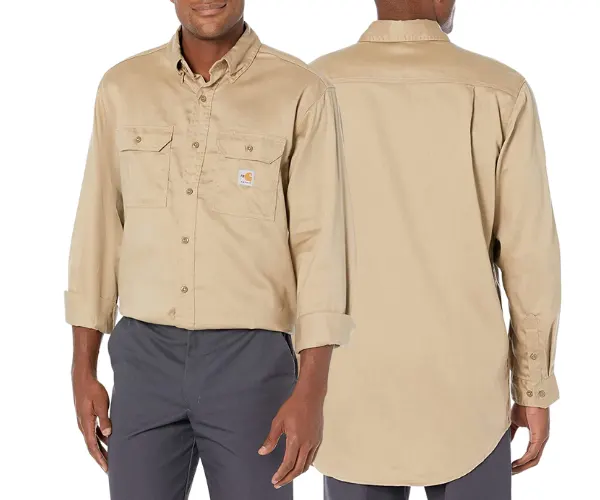
- UL Classified to NFPA 2112 — third-party certified, not self-declared
- CAT 2 is the higher of the two arc categories here
- Chest pockets with flaps, and a collar that turns up
- Widest size range of the three
- 7 oz — lighter than the Lincoln, so less mass against spatter
- The nylon content puts some people off; it is part of a certified FR fabric, not a surface layer
- Stock on individual sizes and colours moves quickly
Bulwark Men's Midweight Excel FR Work Shirt
All cotton, certified to the 2023 edition of NFPA 2112, from the largest FR apparel maker there is. The one to buy if you want no synthetic in the fabric at all.
Technical info
- Material: 100% cotton Excel FR
- Fabric weight: 7 oz
- Certification: NFPA 2112, 2023 edition
- Arc rating: ATPV 7.7 cal/cm², CAT 1
- Style: SEW2
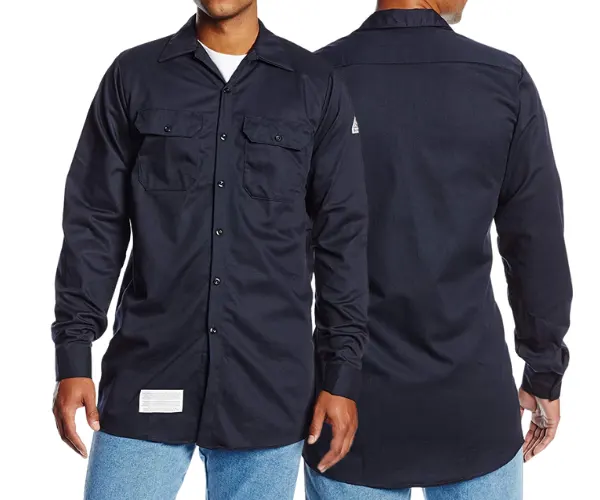
- 100% cotton — nothing in the fabric that can melt
- Certified to the current 2023 edition of NFPA 2112
- Made in a range of colours and sizes for industrial laundering
- ATPV 7.7 cal/cm² puts it in CAT 1, below the Carhartt
- 7 oz, so the same weight caveat applies
- Cotton shrinks; buy with that in mind
Lincoln Electric Black FR Welding Shirt (K3113)
The heaviest cloth here and the only one designed as welding kit rather than FR workwear — but the claim on it is narrower than the other two.
Technical info
- Material: 9 oz FR cotton
- Fabric weight: 9 oz
- Compliance: ASTM D6413 (Lincoln lists no NFPA 2112 certification and no arc rating)
- Detail: Two chest pockets with flaps, pencil slot, button collar
- Part numbers: K3113-M to K3113-3XL
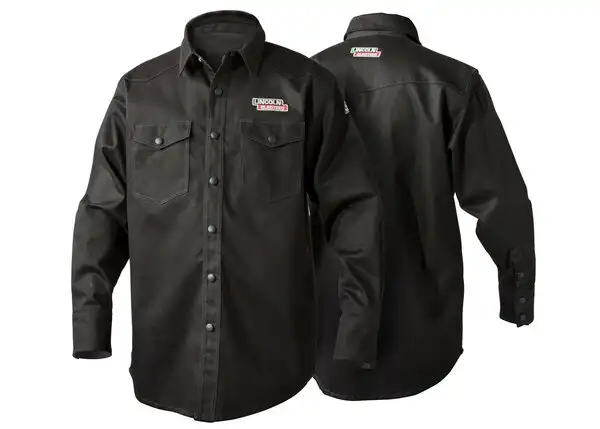
- 9 oz — the heaviest fabric of the three, which is what stops spatter
- Black, so it does not show the marks welding leaves
- Sold as welding kit, with the pockets and collar shaped for it
- Lincoln lists compliance with ASTM D6413 only — a flame test on cloth, not the NFPA 2112 garment certification the other two carry
- No published arc rating, so it cannot be selected against an arc-flash category
- 9 oz is hot in a warm shop
The three compared
| Shirt | Fabric | Weight | Certification | Arc rating |
|---|---|---|---|---|
| Carhartt FR Loose Fit Twill | 88/12 cotton-nylon | 7 oz | UL Classified NFPA 2112, NFPA 70E | CAT 2, ATPV 8 |
| Bulwark Midweight Excel FR | 100% cotton | 7 oz | NFPA 2112 (2023) | CAT 1, ATPV 7.7 |
| Lincoln Electric K3113 | FR cotton | 9 oz | ASTM D6413 flame test only | None published |
Keeping It Protective
Certified FR fabric does not simply wash out — NFPA 2112 requires the fabric to still pass the flame test after 25 launderings. What ruins it is what you put in the machine with it and what you get on it: fabric softener, chlorine bleach and starch all leave a flammable residue, and oil or grease soaked into the cloth burns whether or not the cloth does. Our guide to cleaning welding clothes has the washing rules, and how flame-resistant clothing works explains what the treatment does.
A shirt is also only half of it. The same reasoning about weight, cuffs and meltable fibres applies below the waist — see welding trousers, and how they compare with ordinary work trousers.
Frequently Asked Questions
Do you need a special welding shirt?
If you weld regularly, yes — a flame-resistant one. OSHA's 2012 letter of interpretation says employers are expected to provide FR clothing where welders are exposed to flash fire or short flame contact. For occasional light work a heavy 100% cotton shirt is a reasonable substitute; it is not flame-resistant, but it will not melt.
What does NFPA 2112 mean on a shirt label?
It is a garment certification, not a single test. The fabric must pass a vertical flame test after 25 launderings, and a finished garment must pass the ASTM F1930 manikin test — a three-second engulfment at 2 cal/cm² with under 50% predicted body burn. A label claiming only ASTM D6413 has passed one of those tests, not the certification.
What arc rating do I need for welding?
Arc rating measures electric-arc energy, not welding spatter, so for welding alone it is not the number to buy on — flame resistance and fabric weight are. It matters if you also work around energised electrical equipment, where NFPA 70E sets the category: CAT 1 needs at least 4 cal/cm², CAT 2 at least 8.
Can you weld in a flannel shirt?
A 100% cotton flannel is better than a synthetic one, but it is not flame-resistant and the raised nap catches sparks readily. Most flannel shirts sold today are cotton-polyester blends, and polyester melts. Check the composition label before wearing one anywhere near an arc.
Does the flame resistance wash out of an FR shirt?
Not from a certified garment used properly — NFPA 2112 requires the fabric to still pass the flame test after 25 launderings. It is lost to contamination and to the wrong laundry products: never fabric softener, chlorine bleach or starch, and wash FR clothing separately from oily work clothes.
Sources
Every figure above comes from the maker's own specification or from the body that publishes the standard.
- ANSI/AWS Z49.1:2021, Safety in Welding, Cutting, and Allied Processes — clause 4.3 and note E4.3 on clothing materials, buttoned collars and cuffs, and front pockets
- OSHA letter of interpretation, 12 January 2012 — flame-resistant clothing for welders
- NFPA 2112 test methods — the 17 tests, the 25-laundering flame-resistance requirement and the ASTM F1930 manikin test
- ASTM F1506-20a — flame resistant and electric arc rated clothing for workers exposed to flames and electric arcs
- Carhartt FR Loose Fit Twill Long Sleeve Shirt — fabric, weight and certification
- Bulwark Men's Midweight Excel FR Work Shirt (SEW2) — fabric, weight and arc rating
- Bulwark Men's FR Welding Work Shirt (SWW2SY) — the welding-specific alternative
- Lincoln Electric Black FR Welding Shirt — fabric, weight and the ASTM D6413 compliance listing
The Short Answer
Buy a long-sleeved FR shirt certified to NFPA 2112, wear it buttoned with the cuffs closed, and keep it clean of oil. The Carhartt is the most thoroughly certified and the easiest to size; the Bulwark is the all-cotton option; the Lincoln has the heaviest cloth and the most welding-shaped detailing, but its label claims a flame test rather than the full certification, and that is the trade you are making.