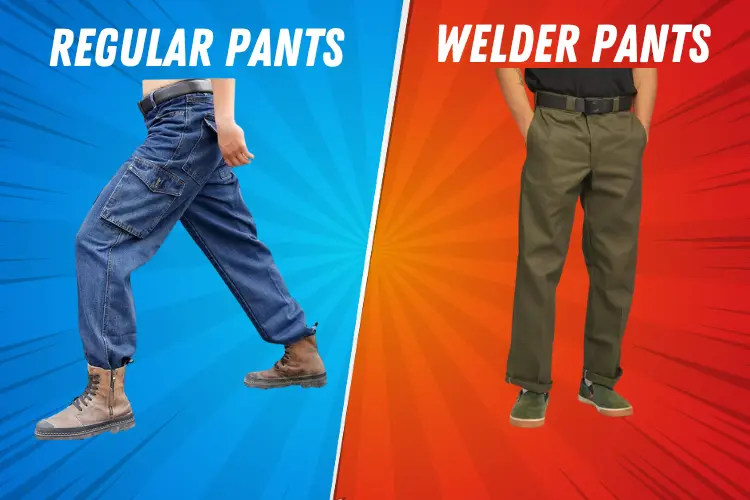
Almost every comparison of welding trousers and ordinary ones lists the same three words — protection, durability, comfort — and never says what actually happens to each fabric when a bead of spatter lands on it. That is the whole question, so start there.
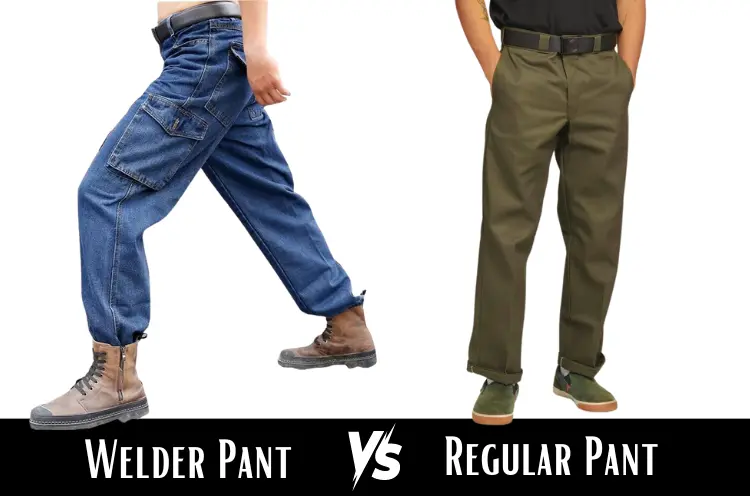
Can You Weld in Ordinary Jeans?
For light, occasional work, plenty of people do, and heavy 100% cotton denim is far from the worst thing to wear. It will not melt. Spatter tends to bounce off heavy denim rather than burn straight through it, and the fabric is thick enough to absorb the odd spark.
What it will not do is stop burning. Cotton ignites and keeps going once it catches, which is the difference flame-resistant fabric exists to remove. FR cloth chars and self-extinguishes as soon as the flame is gone.
Two things decide whether ordinary trousers are merely a compromise or actually dangerous: what they are made of, and how they are cut. Both are covered by ANSI/AWS Z49.1:2021, the welding safety standard.
The Four Differences That Matter
Welding trousers against ordinary work trousers
| Aspect | Flame-resistant trousers | Ordinary trousers |
|---|---|---|
| What happens when they catch | Char and self-extinguish once the flame is removed | 100% cotton ignites and keeps burning; poly-cotton and stretch blends melt |
| Certification | NFPA 2112, tested as a finished garment and after 25 launderings | None. No test, no claim |
| Cut | No cuffs, leg wide enough to sit over the boot | Often cuffed or tapered, which catches and funnels spatter |
| Fabric weight | Typically 9 to 15 oz | Varies; light summer trousers give almost nothing |
Only the first two are about the cloth. The other two are about shape, and they are where an ordinary pair fails most often — a turned-up cuff is a pocket facing upwards at exactly the height falling spatter arrives.
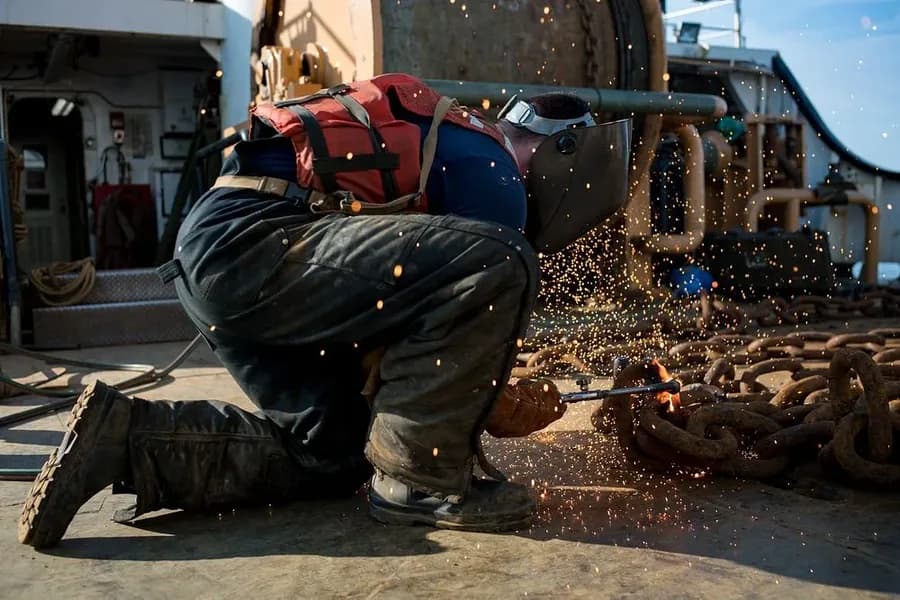
What Makes Ordinary Trousers Dangerous
Not all “regular pants” are the same risk, and lumping cotton in with polyester — as most comparisons do — hides the thing that actually hurts people.
Four things to check on any pair you weld in
If you are going to wear ordinary trousers near an arc, these are the ones that decide whether that is a reasonable compromise or a bad idea.
- Synthetic content
- polyester, nylon, acetate and polypropylene melt and stick to skin, which turns a burn into a much worse one. Most modern work trousers are a poly-cotton blend, and most stretch jeans contain elastane. Read the composition label, not the marketing.
- Cuffs and turn-ups
- Z49.1 says trousers should not have cuffs and should not be turned up on the outside. This costs nothing to fix and it is the single most common mistake.
- The leg over the boot
- the leg should overlap the boot top. Tucking trousers into boots funnels sparks straight in.
- Oil and grease
- contaminated fabric burns whether or not the fabric itself would. Z49.1 asks for clothing to be kept clean for this reason, and it applies to ordinary trousers just as much.

What Welding Trousers Cost You
It is not a free upgrade, and pretending otherwise is why people ignore the advice.
Certified FR trousers run several times the price of ordinary work trousers, they are heavier and hotter — the weight that stops spatter is weight you carry all day — and they need washing without fabric softener, chlorine bleach or starch, all of which leave a flammable residue behind. The flame resistance itself does not wash out: NFPA 2112 requires the fabric to still pass its flame test after 25 launderings before a garment can be certified at all.
When Ordinary Trousers Are Acceptable, and When They Are Not
OSHA has no rule that names FR trousers. Its 2012 letter of interpretation says employers are expected to provide flame-resistant clothing where welders are exposed to flash fire or short-duration flame, and that where controls remove that exposure there is no requirement. That is the line.
A rough rule
| Situation | What is reasonable |
|---|---|
| Occasional hobby work, light gauge, low current | Heavy 100% cotton, no cuffs, leg over the boot |
| Regular shop or site welding | Certified NFPA 2112 trousers |
| Overhead or out-of-position work | Certified trousers, and a jacket or apron as well — spatter falls on you rather than away |
| Anywhere near energised electrical work | Arc-rated to NFPA 70E as well as flame-resistant |
And whatever you wear on the outside, what is underneath matters: a polyester base layer melts even when the outer layer holds. Our guide to what flame-resistant clothing does and does not do covers that in full.
If you have decided to buy, we compared the certified options in our guide to the best welding pants, and the same reasoning applies to welding shirts. Once you own them, washing them correctly is what keeps them working.
Frequently Asked Questions
Can you weld in regular jeans?
For light, occasional work, heavy 100% cotton jeans are a common substitute and much better than anything synthetic. They are not flame-resistant: cotton ignites and keeps burning. They must have no cuffs, and the leg must cover the boot top. For regular welding, buy certified FR trousers.
What is the actual difference between welding pants and regular pants?
What the fabric does when it catches. Flame-resistant fabric chars and self-extinguishes; cotton keeps burning; polyester and elastane melt onto skin. Certification is the second difference — NFPA 2112 is tested on a finished garment, and ordinary trousers are tested against nothing.
Are denim jeans flame-resistant?
No. Denim is cotton, and untreated cotton is not flame-resistant — it ignites and continues to burn. Heavy denim is better than light or synthetic fabric because of its mass, not because of any fire performance. Flame-resistant denim exists, but it is a treated fabric and is sold as FR.
Why do welding trousers have no cuffs?
Because a cuff is a container facing upwards at the height falling spatter arrives. ANSI Z49.1 says trousers should not have cuffs and should not be turned up on the outside, and that the leg should overlap the shoe top so spatter cannot drop inside.
Are welding trousers worth the money?
If you weld regularly, yes — the failure they prevent is a burn that keeps going after the spark has stopped. If you weld a few times a year on light work, heavy cotton with the right cut is a defensible compromise, and the money is better spent on a hood and gloves first.
Sources
- ANSI/AWS Z49.1:2021, Safety in Welding, Cutting, and Allied Processes — clause 4.3 and note E4.3 on cuffs, pockets, meltable fabrics and keeping clothing clean
- OSHA letter of interpretation, 12 January 2012 — when employers are expected to provide flame-resistant clothing
- NFPA 2112 test methods — certification requires the flame test to pass after 25 launderings
- Bulwark, on non-FR undergarments — why meltable synthetics next to the skin make burns worse
The Short Answer
Welding trousers are not simply tougher trousers. They are trousers that stop burning when the flame goes away, cut so that spatter cannot lodge in them. Ordinary heavy cotton with no cuffs is a reasonable compromise for occasional work; a poly-cotton or stretch blend is not a compromise at all, because it melts. Read the composition label, lose the cuffs, and put the leg over the boot — those three cost nothing.