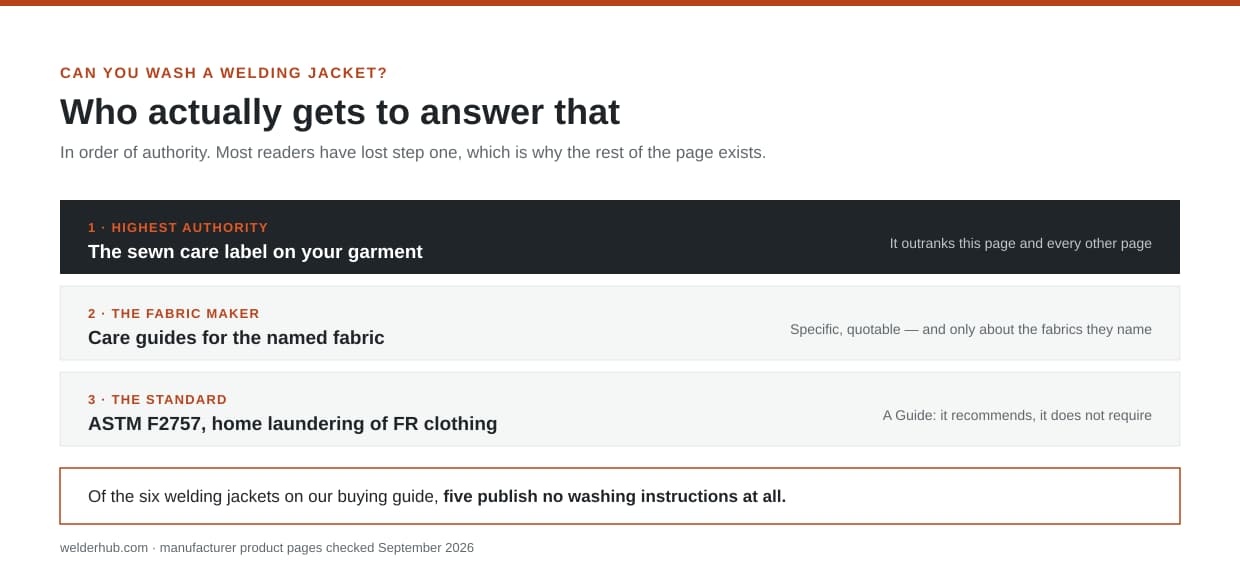
It is a fair question to ask, because the jacket is filthy, it cost real money, and nobody told you. We checked the manufacturer's own product page for all six welding jackets we recommend. Five of them publish no washing instructions at all. No care section, no laundering note, nothing. One of the six — Lincoln's K2989 — has a product page of about 1,400 characters that never uses the words care, wash, launder or clean.
So the honest answer is not a recipe. It is a method, and it sits inside the wider picture our guide to maintaining welding clothes at home covers: find out what your jacket is made of, find out what its own maker and its own fabric maker will commit to in writing, and refuse to accept a universal rule from anyone — including this article. Below is what can actually be sourced, and what cannot.
Start With the Label, Because the Standards Say So Too
There is a standard written for exactly your situation. ASTM F2757-20(2026), Standard Guide for Home Laundering Care and Maintenance of Flame Resistant or Arc Rated Clothing is active — shown as F2757-20(2026) — and was last updated on 11 May 2026. Its existence is itself the first useful fact: washing flame-resistant clothing at home is a recognised route, not a compromise you are getting away with.
Three things in that guide shape everything below. It tells you to follow all label care instructions. It requires that potentially flammable contaminants are removed during the wash, because contamination left in the fabric can compromise flame resistance — and it asks you to think about the soil your work actually produces and whether your wash is removing it. And it asks that the process and the materials you launder with are compatible with the FR material, which is a polite way of saying that the wrong detergent can undo what you paid for.
Notice what the standard does not do. It does not give you a temperature for your jacket, a detergent brand, or a verdict on your machine. It sends you back to the garment. That is not evasion — it is the only correct answer when FR fabrics differ from each other as much as they do.
Which of Three Jackets Do You Own?
Every welding jacket on the shelf is one of three things, and the washing answer is different for each. The six jackets on our welding jacket buying guide are exactly three all-cotton, one all-leather and two combination, so if yours is one of them the table below places it for you. Look at the sleeves and the body separately — that is where the difference usually hides.
The three kinds, and what our own six recommended jackets are
| Type | What it looks like | Machine washable? | Examples among the six |
|---|---|---|---|
| All FR cotton | Cotton throughout, body and sleeves, usually 9–11 oz, snaps down the front | Usually yes, if the label permits | Black Stallion FN9-30C, Miller Classic Cloth, YESWELDER ZRF02 |
| Combination | Cotton body with leather sleeves, or leather chest and sleeves with a cotton back | No — the leather decides | Black Stallion FRB9-30C, Lincoln K2989 |
| All leather | Split cowhide throughout, suede-textured rather than smooth | Never | Black Stallion JL1030 |
If any part of the jacket is leather, the whole jacket is limited by that leather. A combination jacket cannot go in the machine because half of it cannot. That is the single most common expensive mistake with welding jackets, and it is why the material question comes before the washing question.
Leather: What to Do Instead
A leather welding jacket does not go in a washing machine, and it does not get soaked in a sink either. Split cowhide is dried hide; a machine cycle drives water deep into the nap, agitation abrades it, and the jacket dries stiff, shrunken and misshapen. Nothing you add to the water fixes that.
Leather is cleaned at the surface rather than laundered, and the full method — soot and spatter residue, conditioning, drying, and what the makers do and do not warn you about — is its own article. If your jacket is leather or part leather, how to clean a leather welding jacket is the page you want — it covers why the chromium in split cowhide makes drying it in the sun the wrong move, and why the leather dressing everyone recommends has a flash point worth checking.
FR Cotton: What the Fabric Makers Will Actually Put in Writing
Here is where it gets useful, and where most pages on this subject start inventing. The garment makers are nearly silent, but the fabric makers are not. Westex is one of the larger producers of flame-resistant cotton and publishes care guidance for its own fabrics: a guide for UltraSoft, UltraSoft AC and Indura and a separate one for Westex DH. Both are quoted below from Westex's own file host rather than from a reseller's copy. They are specific, quotable, and they contain a number worth knowing.
Three documents on wash temperature, and where they disagree with themselves
| Source | What it says | What it covers |
|---|---|---|
| YESWELDER, product page for its FR cotton welding jacket | “Dry cleaning is recommended. If laundering is permitted by the sewn care label, do not exceed 165°F (74°C).” | That garment |
| Westex care guide — UltraSoft, UltraSoft AC, Indura | “UltraSoft, UltraSoft AC and Indura fabrics can be washed at temperatures up to 165°F (75°C)” — and, in a different section of the same guide, “the maximum wash temperature … is 165°F (74°C)” | Those three named fabrics |
| Westex DH care guide | “A maximum wash temperature of 165°F is recommended for best durability and appearance” — but the same guide also says “A 150°F maximum wash temperature is recommended for best durability, colorfastness and garment appearance” | Westex DH fabric |
165°F keeps reappearing as the ceiling — in a garment maker's own instruction and in two fabric care guides for different fabric families. Read the small print, though, and the convergence is looser than it first looks: the UltraSoft and Indura guide gives the Celsius equivalent as 75°C in one section and 74°C in another, and the DH guide recommends 165°F in one place and 150°F in another, for durability and colourfastness rather than for safety. We are printing that rather than tidying it away, because a page that reports one clean number is a page that has not read the documents. The practical point survives all of it: every figure here is above a domestic hot wash, so temperature is rarely what ruins an FR jacket at home. What you put in the water matters far more.
Chlorine bleach
This is the one place the language is unambiguous. Westex's guide states that chlorine bleach “must not be used on garments made with UltraSoft, UltraSoft AC and Indura fabrics”, because it can adversely affect flame resistance. Its DH guide says “do not use detergents containing chlorine bleach” — which also rules out ordinary supermarket detergents that include a bleaching agent, not just the bottle of bleach itself.
Fabric softener
Two strengths of wording, and it is worth reporting both rather than flattening them. The UltraSoft and Indura guide says “We do not recommend using a supplemental softener, except in unique circumstances” — and then, in its closing note, “do not launder with bleach or fabric softeners”. So the hedge and the instruction sit in the same document. The DH guide gives only the instruction: “Do not use starches, fabric softeners, or any other laundry additives”. Neither document gives you a reason to add softener to a garment you rely on.
Hard water and soap scum
This is the failure nobody expects, because the jacket comes out looking clean. Westex states that “an adequate supply of soft water is recommended for laundering garments” — recommended, not required, and we had it as the stronger word until we re-read the guide. It also warns that “Soap scums may be flammable and can adversely affect the thermal protection performance of the garment if they burn”. The DH guide says soap “is not recommended” and that the resulting “insoluble contaminants are difficult to rinse from fabrics”.
The Contradiction That Should Stop You Trusting Any Universal Rule
Including this one. Two care guides from the same fabric manufacturer disagree with each other about peroxide bleach.
Westex on peroxide bleach, in its own two documents
| Fabric | What Westex says |
|---|---|
| UltraSoft, UltraSoft AC, Indura | “Hydrogen peroxide (an oxygen bleach) must not be used separately or in detergents on garments” |
| Westex DH | “Only oxygen-based bleaches should be used on garments made with Westex® DH fabric” |
Westex's own guide calls hydrogen peroxide an oxygen bleach, in the very sentence forbidding it. So one Westex fabric family bans the thing that the other names as the only acceptable class. Both statements are correct for their own fabric. Neither is a rule about flame-resistant clothing in general.
That is the whole reason this article keeps sending you back to the label. If a single manufacturer's own two documents diverge on a basic chemical question, no third party — no blog, no forum thread, no buying guide — can hand you a rule that covers every FR jacket on the market. What they can do is tell you which questions to ask of your own garment, which is what the sections above are for.
Oil and Grease Are Not a Stain Problem
Every other section of this article is about keeping a jacket looking and lasting right. This one is about whether it still protects you.
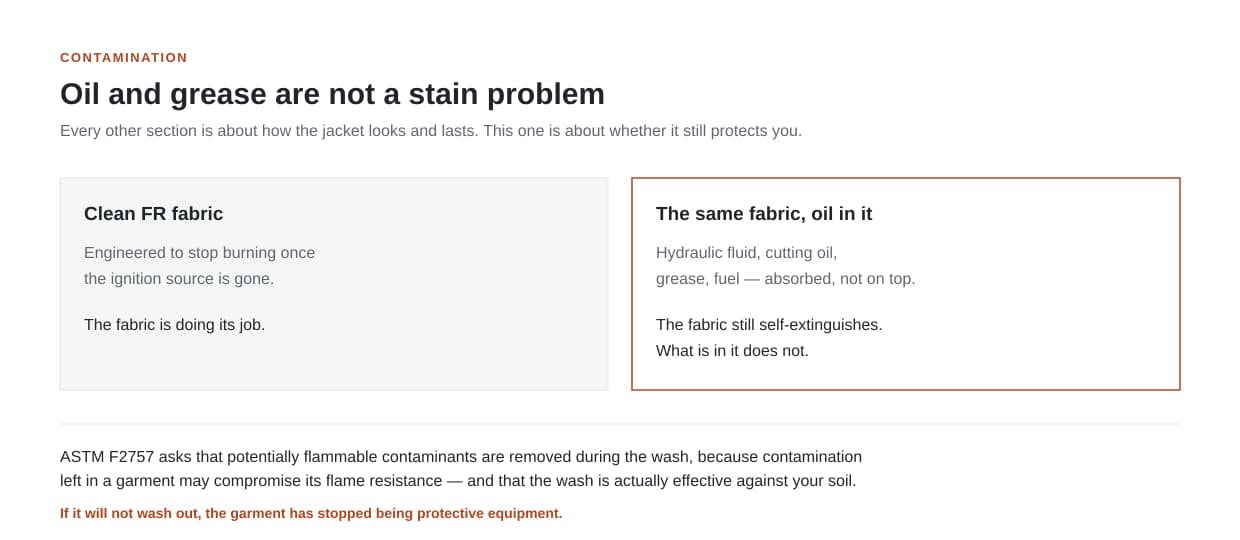
ASTM F2757 is explicit that potentially flammable contaminants have to come out of the garment during the wash, because contamination that stays behind can compromise the garment's flame resistance. It asks you to consider the soil your workplace actually produces and whether your wash procedure is removing it. In a welding context that means cutting oil, hydraulic fluid, penetrating oil, grease off a bench — the things that soak into cotton and stay there.
So the practical rule is simple and it is the opposite of how people treat work clothes: a jacket with oil or grease in it that will not wash out has stopped being ordinary laundry. F2757 points towards a different cleaning route when home laundering is not getting the contamination out — industrial laundering, or replacement. Washing it again at a higher temperature with more detergent is not the answer, and neither is wearing it because it looks clean.
Drying
There is less to say here than most pages pretend, because the makers publish less. Both Westex guides warn against the same thing and give no temperature: “Do not overdry fabrics, or excessive shrinkage will occur”, and “When drying, do not over dry the garment”. That is the sourced advice in full. Anyone quoting you a specific dryer setting for a jacket whose fabric they cannot name is making it up.
The reasoning behind it is ordinary textile behaviour rather than anything to do with flame resistance — heavy cotton shrinks when it is dried past dry, and a 30-inch jacket that shrinks is a jacket that no longer covers your waist when you reach up. Take it out while it still has a little moisture in it, or hang it.
What the Standards Do and Do Not Cover You For
Two standard numbers come up constantly in this subject and they are routinely swapped for each other, including by people selling you clothing.
The two NFPA numbers, and which is which
| Standard | What it is for |
|---|---|
| NFPA 2112 | Performance of the flame-resistant garment itself — the fabric and construction tests, including the instrumented manikin test |
| NFPA 2113 | Selection, care, use and maintenance of flame-resistant garments — the care standard |
If you read “NFPA 2112 says to wash it this way”, that page has the wrong document. 2112 is about whether the garment protects you — NFPA's own product page is the place to confirm which is which — and 2113 is the one about looking after it.
If the Label Is Gone
This is most people, eventually. Labels get cut out because they itch, or they fade past reading after a year in a hot shop. Work through it in this order.
- Look for leather anywhere on the garment. Sleeves, shoulders, chest panel, collar. If you find any, the machine is out and you are cleaning the surface instead.
- Find the maker and the model. It is usually stamped or embroidered somewhere even when the care label has gone. Search the model number rather than the brand — you may be one of the lucky ones whose maker publishes something.
- Look for a fabric name, not just a fibre. “88/12 cotton nylon” tells you the blend; “Indura” or “UltraSoft” tells you whose care guide applies. A named fabric is the difference between guidance and guesswork.
- If you find nothing, wash conservatively. Warm rather than hot, a plain detergent rather than a soap, no chlorine bleach, no softener, thorough rinse, and take it out of the dryer before it is bone dry. That is the intersection of everything the sourced guidance above agrees on.
- Deal with contamination separately. If oil or grease is not coming out, stop treating the jacket as laundry — see the section above.
Frequently Asked Questions
Can you wash a welding jacket in a washing machine?
An all-cotton FR welding jacket usually can be, if its sewn label permits it. A leather jacket never can, and a combination jacket with leather sleeves cannot either, because the leather decides for the whole garment. Check the label first: of the six welding jackets we recommend, five have manufacturers who publish no washing guidance at all, so the label in the collar may be the only instruction that exists for your jacket.
What temperature should I wash an FR welding jacket at?
No higher than the ceiling your fabric maker publishes. 165°F, about 74°C, is the figure that recurs — in YESWELDER's own jacket instruction and in both Westex fabric care guides. Be aware that the documents are not perfectly consistent with themselves: one gives 75°C and 74°C in different sections, and the Westex DH guide also recommends 150°F for best durability and colourfastness. Every one of those figures is hotter than a domestic hot wash, so temperature is rarely what damages an FR jacket at home. What you put in the water matters far more.
Can I use bleach on a welding jacket?
Not chlorine bleach. Westex states that chlorine bleach (sodium hypochlorite) must not be used on its garments, and its DH guide also rules out detergents that contain a chlorine bleaching agent. Peroxide bleach is more complicated: Westex forbids it on Indura and UltraSoft while naming oxygen bleaches as the only acceptable class for its DH fabric. That contradiction is exactly why the label, not a general rule, decides.
Does fabric softener damage flame-resistant clothing?
Westex advises against it, and the strength of the wording differs between its own two guides: one recommends against supplemental softener except in unique circumstances, the other says do not use fabric softeners or any other laundry additive. Both point the same way. ASTM F2757 also asks that laundering materials be compatible with the FR material, and a softener is an additive the fabric maker did not test with.
Does washing reduce a welding jacket's flame resistance?
Washing correctly is not the threat — ASTM F2757 exists specifically to describe home laundering of flame-resistant clothing, so it is a recognised route. The threats are the things that go wrong around it: chlorine bleach, additives the fabric maker did not test, insoluble soap deposits from hard water, and above all flammable contamination that the wash fails to remove.
What if oil or grease will not come out?
Then the jacket is no longer ordinary laundry. ASTM F2757 asks that potentially flammable contaminants be removed during the wash, because contamination left in the fabric can compromise flame resistance, and it asks you to judge whether your wash procedure is actually removing your workplace's soil. If it is not, the routes are industrial laundering or replacement — not another hot cycle.
How can I tell if my welding jacket is leather or cotton?
Look at the sleeves and the body separately, because combination jackets are common — two of the six we recommend have leather on a cotton body or a cotton back on a leather shell. Welding leather is split cowhide, which feels dry, matt and slightly napped rather than smooth. If any panel is leather, treat the whole jacket as leather when it comes to washing.
Is dry cleaning better for a welding jacket?
It is what one of the six makers recommends: YESWELDER's page says dry cleaning is recommended for its FR cotton jacket and gives home laundering as the alternative if the sewn label permits it. Note that ASTM F2757 covers home laundering specifically and excludes dry cleaning from its scope, so dry cleaning is a decision for you and the garment's maker rather than one that standard speaks to.
Sources
- ASTM F2757-20(2026), Standard Guide for Home Laundering Care and Maintenance of Flame Resistant or Arc Rated Clothing — active, designation F2757-20R26, last updated 11 May 2026. Covers home laundering of FR and arc-rated clothing. Published as a Guide, so it recommends rather than requires. Cited here for its designation, title and scope; the standard itself is paywalled and is not reproduced.
- NFPA 2112, Standard on Flame-Resistant Clothing for Protection of Industrial Personnel Against Short-Duration Thermal Exposures from Fire — garment performance, not care.
- NFPA 2113, Standard on Selection, Care, Use, and Maintenance of Flame-Resistant Garments… — the care standard; its scope covers industrial FR garments complying with NFPA 2112. Listed without a link because we have not read the clause text; what this page says about 2113 is limited to what it is.
- Westex care, maintenance and use guide — Indura, UltraSoft and UltraSoft AC — read from Westex's own file host, 1 November 2026. Source for the 165°F ceiling, the chlorine bleach prohibition, the hydrogen peroxide prohibition, the softener wording, soft water and soap scum, and overdrying. Covers those named fabrics only. No revision date appears in the document.
- Westex DH care and maintenance guide — also from Westex's own file host, 1 November 2026. Source for the chlorine-bleach detergent wording, the oxygen-bleach instruction, the additives instruction, soap and insoluble contaminants, and the 150°F recommendation. Covers Westex DH fabric only. Also undated.
- Manufacturer product pages for all six welding jackets on our buying guide — Black Stallion FRB9-30C, FN9-30C and JL1030, Miller Classic Cloth, YESWELDER ZRF02 and Lincoln Electric K2989 — checked 24 September 2026 for published care instructions and named standards. Five of the six publish none.
So, Can You Wash It?
Probably, if it is cotton and the label lets you — warm rather than hot, a detergent rather than a soap, no chlorine bleach, no softener, rinsed properly and taken out of the dryer before it is bone dry. Definitely not, if any part of it is leather. And regardless of material, the question that actually matters is not whether the jacket is clean but whether the oil has come out, because that is the part that decides whether it still does its job. Five of the six makers will not tell you any of this. The label in your collar and your fabric's maker will.