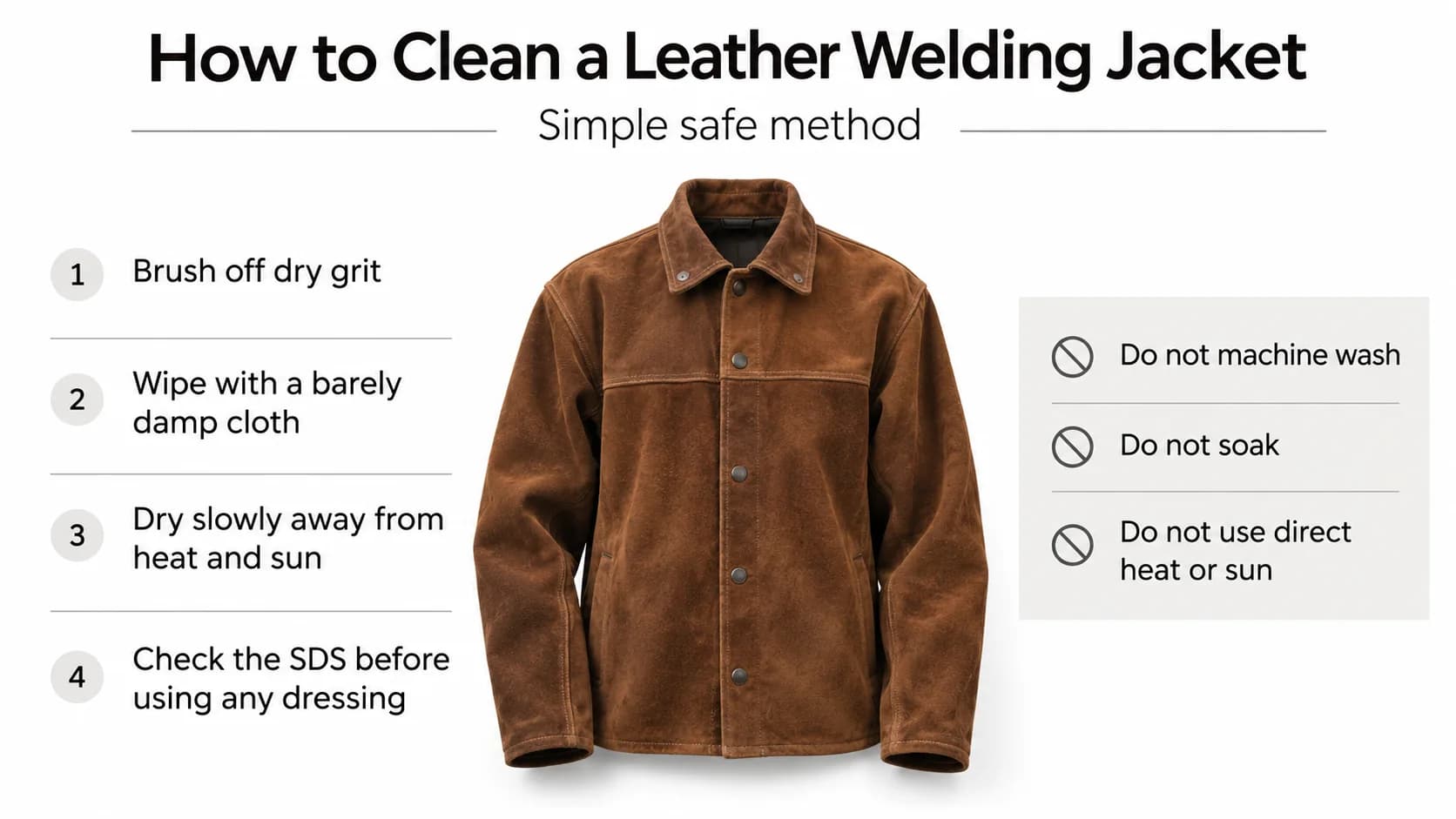
Practical steps, from common workshop practice and cautious reasoning from the sources below. They are not a manufacturer procedure:
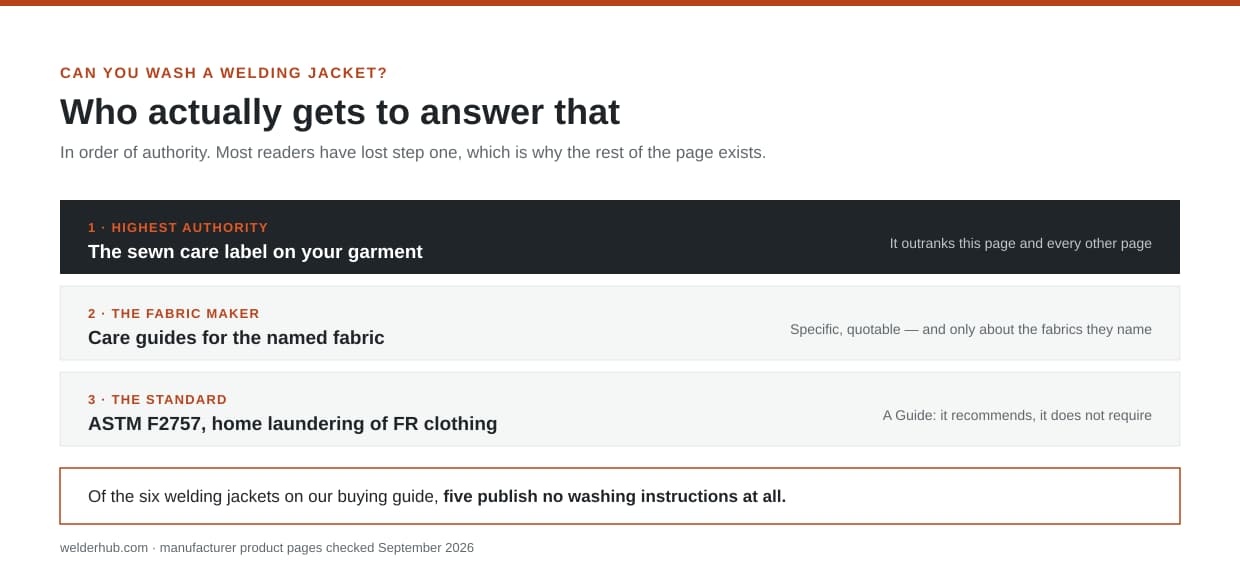
- Check for a care label. If your jacket still has one, follow it instead of anything on this page.
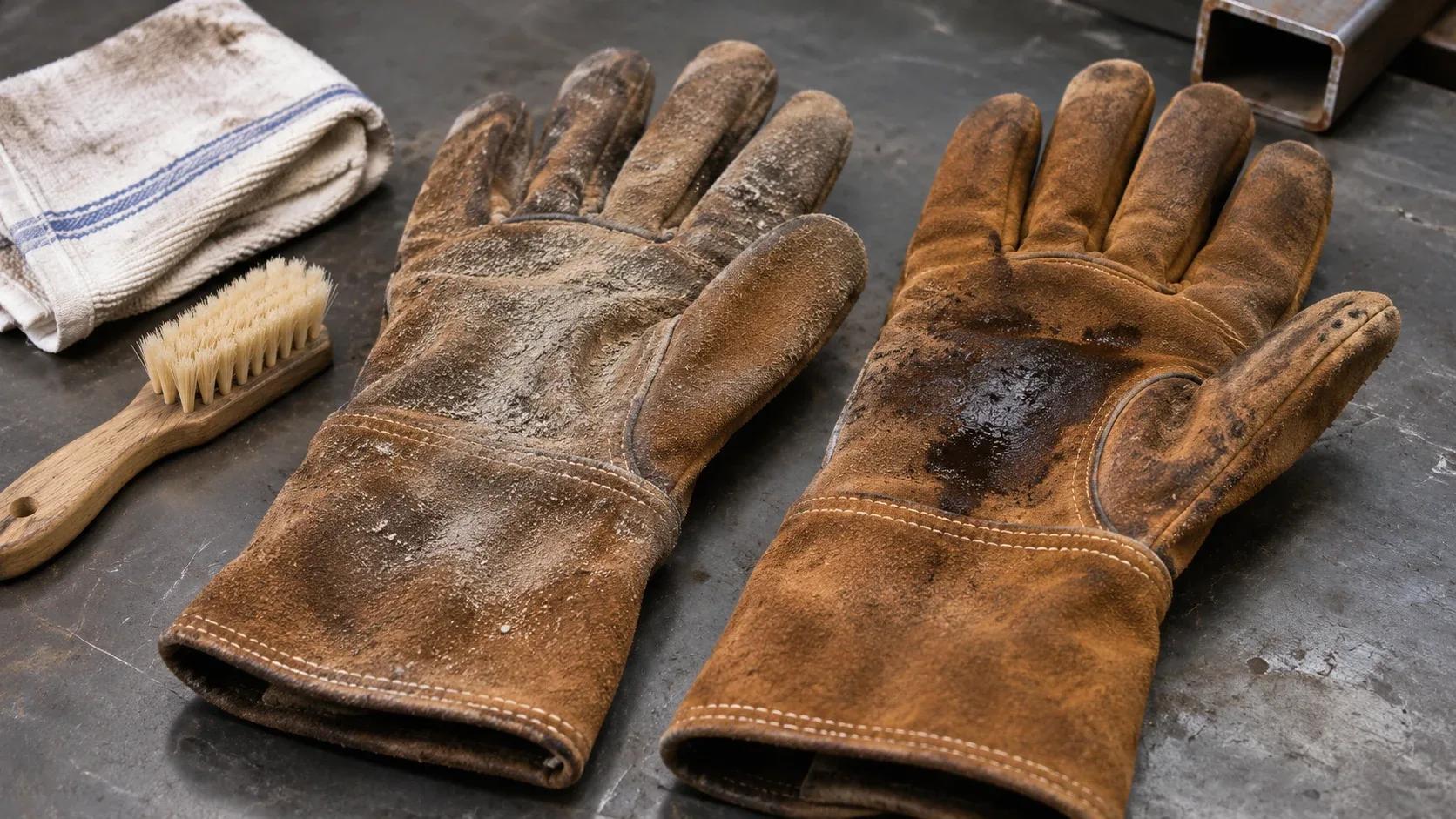
- Brush off dry grit and loose spatter with a stiff brush or a dry cloth before using any moisture.
- Wipe small areas with a cloth wrung out until it is barely damp. Do not soak the leather or pour water on it.
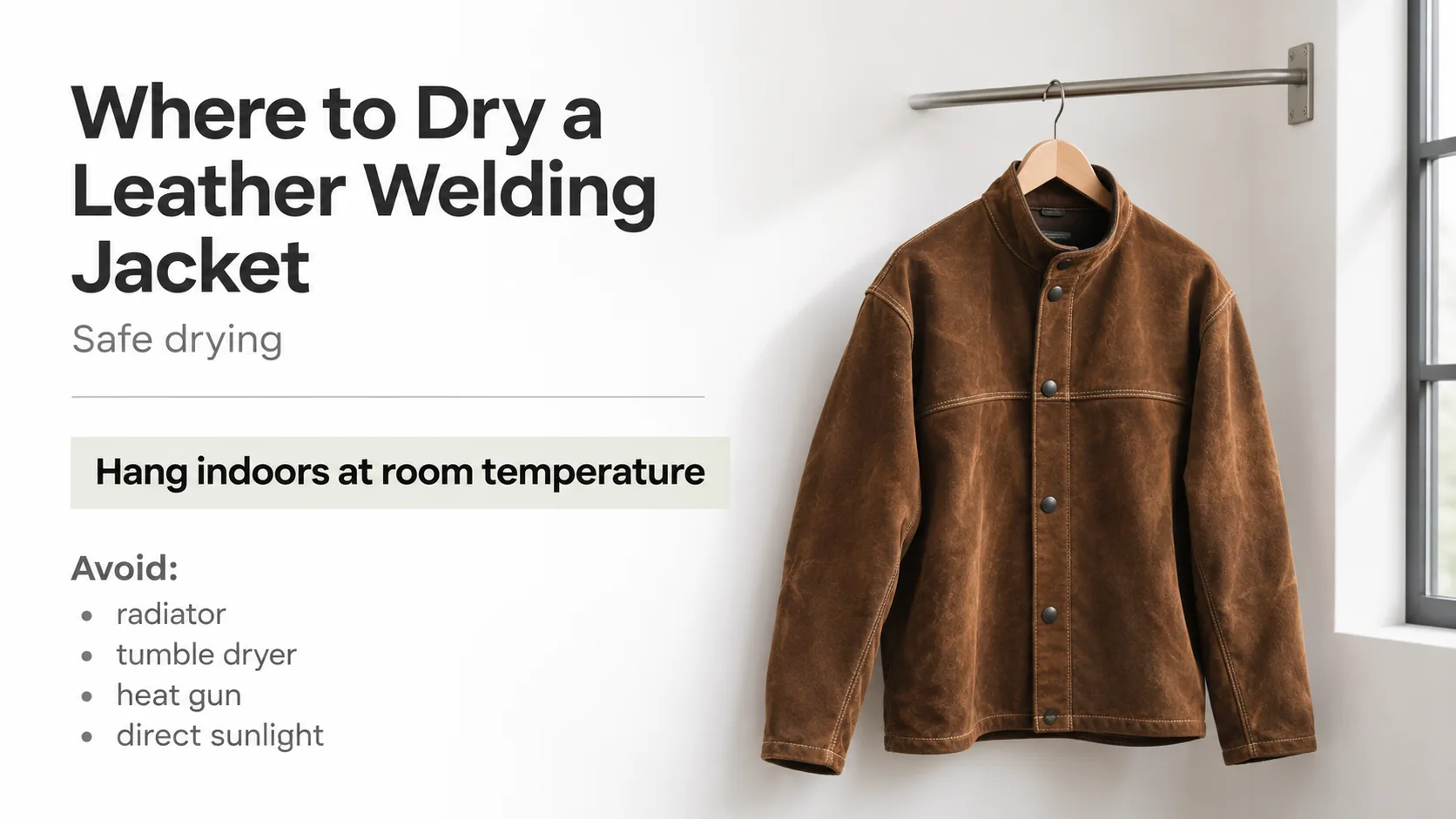
- Dry it slowly indoors on a hanger, away from heaters, radiators and direct sunlight.
- Before using any leather dressing, read its safety data sheet. A flash point alone does not show a product is suitable for protective clothing; the conditioning section below explains the limit.
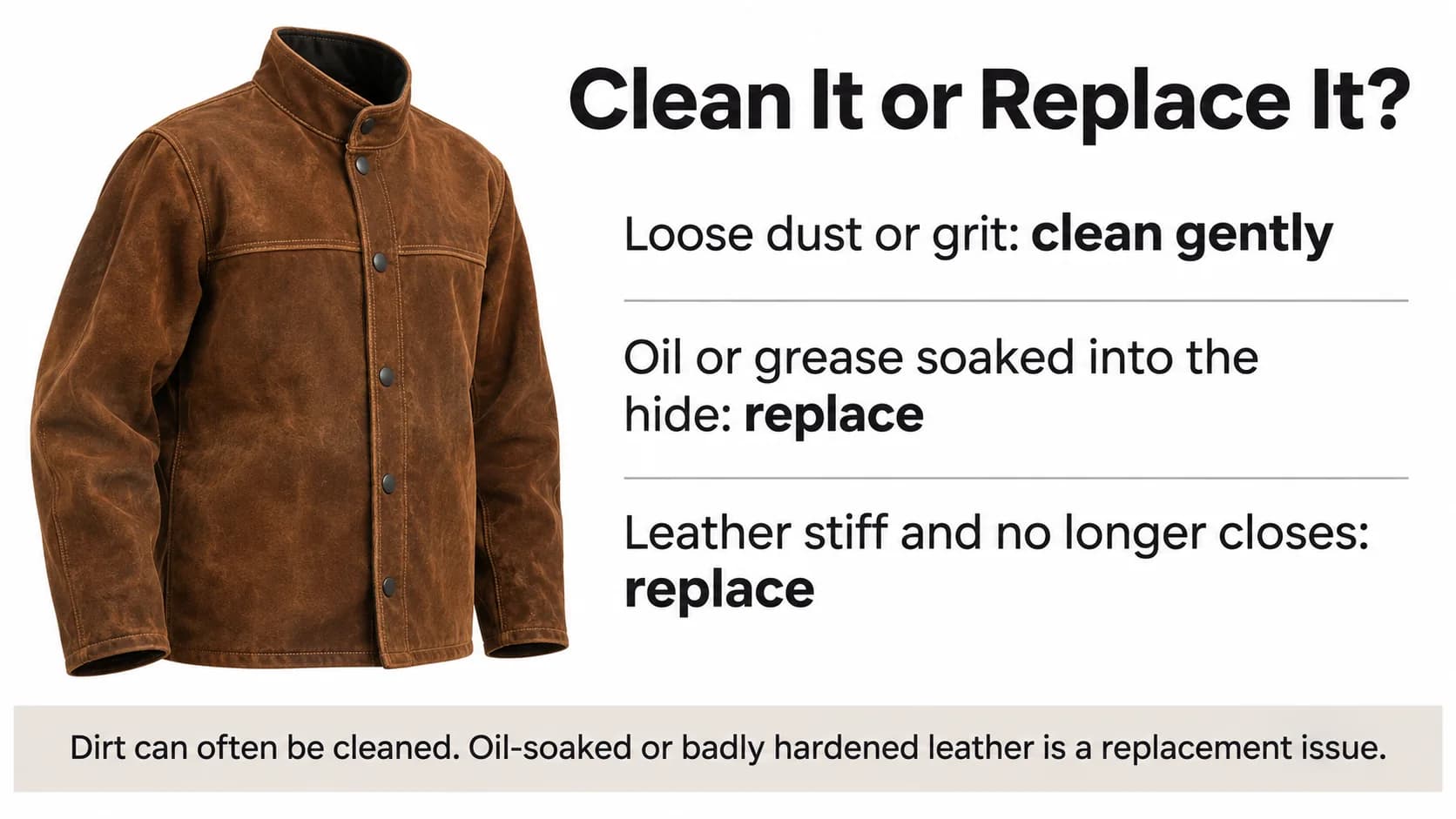
- If oil, grease or fuel has soaked in, or the leather has gone hard, this is no longer a cleaning question. See the section on when it stops being one.
That is an unsatisfying answer and it is the honest one. If you have come looking for how to clean a leather welding jacket, you will find a dozen pages that hand you a confident step-by-step routine. We went looking for where those routines come from. In the pages we checked, they do not come from the people who make the jackets, because those makers publish nothing on the subject on the product pages.
What follows is organised by how much weight each claim carries. Manufacturer documents first, then the standard that governs welding clothing, then peer-reviewed work on what chrome-tanned leather actually does. The things welders commonly do, which is most of what is written about this online, are at the end and labelled as exactly that.
Why Nobody Who Makes These Jackets Tells You How to Clean One
We opened the manufacturer's product page for five leather or part-leather welding jackets, from Steiner, Lincoln Electric and Black Stallion (three models), including three from our own buying guide, and looked for the words care, clean, wash, launder and condition. None of the five pages had them.
Leather welding jackets and their published care instructions
| Jacket | Material | Care instructions published? | Prop 65 chromium warning |
|---|---|---|---|
| Steiner 8215 Side Split Cowhide, 30 in | Side split cowhide | No — around 650 characters of description, none of it about care | Yes |
| Black Stallion JL1030-BB Color Block | Split cowhide | No | Yes |
| Black Stallion JL1030 | Split cowhide | No | Yes |
| Black Stallion FRB9-30C Hybrid | FR cotton body, split cowhide sleeves | No | Yes |
| Lincoln Electric K2989 | Split cowhide, FR cotton back | No | Not shown |
The closest thing to guidance from a major maker is a line in Miller's own article on choosing welding apparel, published on 4 April 2024: “Leather also becomes stiffer and less pliable over time.” That is the whole of what it says about leather ageing — it names the problem and, in what we read, offers no leather care or cleaning instruction. Miller's guidance article is otherwise about selection, not maintenance.
This matters more than it sounds. A sewn care label is the authority on any garment, and on a welding jacket it can wear away or burn off. When the label is gone and the maker's website is silent, there is no authority left to consult, which may be why so much of what is written about cleaning welding leather is somebody's workshop habit passed along until it sounds official.
What the Welding Clothing Standard Says — and Which One It Is Not
The standard that governs protective clothing for welding is ISO 11611, currently in its third edition, published June 2024 as ISO 11611:2024. Its public scope sets minimum safety requirements and test methods for clothing protecting the wearer against spatter, brief flame contact, radiant heat from the arc and harmful ultraviolet radiation. The scope does not address cleaning or care procedures, or leather specifically. Its one mention of soiling is that sweat, soiling or other contaminants can affect the level of protection against brief accidental contact with live electrical conductors.
The standard does deal with care, though, just not in the part that is public. The 2015 edition's publicly available sample pages show a contents list in which clause 8 is titled Information supplied by the manufacturer and its sub-clause 8.4 is titled Care and maintenance. We have not read that clause, which is behind a paywall, and we have not seen the 2024 edition's contents page, so we cannot say the clause carries the same number or wording there. This page tells you the 2015 clause exists and quotes nothing from it.
One standard that does not apply here is worth naming, because it is the obvious mistake. ASTM F2757 is the Standard Guide for Home Laundering Care and Maintenance of Flame Resistant or Arc Rated Clothing. It is the right document for a cotton FR jacket and the wrong one for leather: its subject is flame-resistant and arc-rated clothing in the laundry, not hide. The only part of it that carries over to a leather jacket is general — that flammable contaminants left in a garment can compromise its flame resistance, which is the oil and grease problem further down this page.
Why This Is Not Only a Laundry Question
Four of the five jacket pages we checked show a California Proposition 65 warning that names chromium; Lincoln Electric's page showed none. Black Stallion's, word for word: “WARNING: This product can expose you to chemicals including Chromium (hexavalent compounds), which is known to the State of California to cause cancer and birth defects or other reproductive harm.”
The warning names hexavalent chromium, Cr(VI). The review discussed below says chromium tanning is the most common tanning process in the world, and a chromium warning on a leather jacket is consistent with that, but none of the product pages we checked says how its leather was tanned, so we treat chrome tanning as likely rather than confirmed for these jackets. A natural assumption is that soaking such a jacket would wash chromium out onto your hands, so you should keep it dry. The research we found points in a different direction, and it changes what you should actually do.
A 2020 review in the Journal of Leather Science and Engineering by Yolanda Hedberg gathers the chemistry of chromium in leather as it relates to contact dermatitis. On when Cr(VI) appears, it reports that it is “formed on the surface of some, antioxidant-free, leathers at dry conditions (< 35% relative humidity)”. Among the risk factors it lists are exposure to UV irradiation and dry air, contact with alkaline media at pH 12 or higher (cement is its example), and the age and use of the leather, as well as how the leather was tanned and manufactured. It does not name wetting or high humidity as a promoter. The review is open access if you want to read it yourself. It is about leather in general, with work gloves as its closest example. It does not discuss welding jackets.
What moisture does drive is the total amount of chromium coming off the leather, which the same review says is primarily influenced by the amount of sweat, and so is highest in warm countries and in summer. For a welder inside a jacket in a hot shop, that is, by our reading, the relevant sentence, and it is about wearing the jacket rather than cleaning it.
There is one real connection between washing and chromium, and it needs its limits stated. The review notes reports that hexavalent chromium release from chrome-tanned leather increases with age and use, and attributes this to the antioxidants, acids and colours being washed out of the leather over its service life. Antioxidant-free leather is the kind the review says forms surface Cr(VI). That is a mechanism-level reason for caution about laundering chrome-tanned leather, not a tested prohibition, and it is about the person wearing the jacket rather than the jacket itself.
But the review studies leather in ordinary use. It does not test deliberately laundering a garment, and we found no study at all of washing a leather welding jacket. So the mechanism is published and the experiment is not. We are telling you what is known and where it stops.
One thing we are deliberately not claiming: that the ultraviolet from your arc promotes hexavalent chromium in the jacket you are wearing. The review's ultraviolet findings concern exposure before skin contact, in footwear and glove research. Welding arcs are intense ultraviolet sources and the question is an obvious one, but nobody appears to have asked it, and we are not going to answer it for them.
Work Out Which Leather You Have, Because They Do Not Behave Alike in Water
“Leather stiffens when it gets wet” is the standard line, and it is not true of all welding leather. Safety+Health, the National Safety Council's magazine, put the question to Joseph Solheid, a safety director at Fastenal, and the hides come out differently from each other:
Welding leathers and what this source says about water
| Hide | What the source says | What that means for cleaning |
|---|---|---|
| Cowhide | “the most common leather used in welding”; offers resistance to abrasion, sparks and spatter. No claim is made that it recovers from a soaking | The hide named on the jackets we checked (as split cowhide), and the one this source does not describe as water-tolerant |
| Elkskin | “It stays soft — even in hot and wet conditions”; described as the most heat-, flame- and abrasion-resistant | According to this source, more forgiving of moisture than cowhide |
| Pigskin | “stays soft, even after getting wet”, but “isn’t recommended for use where moisture levels are usually high” | According to this source, tolerates incidental wet; not for a damp environment |
| Deerskin | “one of the only leathers that can spring back to its original shape and softness after getting wet” | The exception that proves the rule is not universal |
| Split grain | “more water repellent because of the denseness of its fibers” | The source does not say how this relates to the split cowhide on the jackets we checked, so we do not rely on it |
| Top grain | “offers more durability and liquid resistance” | The source gives no jacket-specific information |
Read that table as a reason to be careful with a blanket rule rather than as permission. Note the provenance honestly too: a reputable publication and a named expert, but an expert who works for a distributor. It is a good secondary source, not a manufacturer's instruction for your garment.
If you are not sure what you own, the material is usually the easiest thing to identify about a welding jacket — split cowhide has a visible suede-like nap, and a combination jacket has cloth across the back where the leather stops. Our guide to welding jackets sets out what each of the recommended jackets is made from, which is a faster way to place yours than guessing from the feel.
What to Rule Out, and the Reason for Each
None of these is a manufacturer's prohibition, because no manufacturer published one. Each is a conclusion from the evidence above, and the reasoning is given so you can disagree with it.
- The washing machine. A drum full of water and detergent is the most thorough version of the washing-out that the chromium review links to rising Cr(VI) release with age and use. The review did not test it, and no maker states a rule. But we found no source recommending machine washing a leather welding jacket, and the cowhide named on the jackets we checked is not among the hides the Safety+Health source describes as recovering from a soaking.
- Soaking or submerging, including in a sink. Same reasoning, smaller scale. A barely damp cloth is a different thing from a wet one.
- The tumble dryer, a radiator, a heat gun, a hot car. Ordinary leather care is to avoid forcing leather dry with heat, which can leave it hard; this article does not source that. Separately, the chromium review associates dry conditions with surface Cr(VI) forming on some antioxidant-free leathers, so we would not add a heat source.
- Direct sunlight. The review names UV irradiation together with dry air among the conditions associated with Cr(VI) forming on some leathers. We found no study of sun-drying a welding jacket, so this is a precaution drawn from that finding, not a measured result.
- Dry cleaning, unless the cleaner agrees it suits this garment. None of the five product pages we checked mentions dry cleaning for leather either way.
- Bleach, solvent, degreaser, or saddle soap used on a guess. The review names contact with alkaline media at pH 12 or higher, with cement as its example, among the conditions associated with Cr(VI) forming on some leathers. We have not checked the pH of any cleaner, so read the product's own sheet before using it.
Conditioning a Welding Jacket: Read the Safety Data Sheet
The usual advice is to rub some oil or conditioner into dried-out leather. For a jacket whose job is to stop molten metal, that deserves one extra step. The two leather products we looked at each have a safety data sheet, and the sheets differ on flash point and flammability.
Two leather products, from their own safety data sheets
| Product | Flash point | Classified as flammable? | What its own SDS says about fire |
|---|---|---|---|
| Obenauf's Leather Oil (SDS v1.5, 17 July 2018) | 400 °F | No — “Not classified as a hazardous material by OSHA. Not a dangerous mixture according to Globally Harmonized System.” | Extinguish with sand, dry chemical, foam or CO₂; “Class K or B fire extinguisher”; “Do not use water jet as this may spread fire by dispersing oil”; “Container explosion may occur under fire conditions” |
| Chemical Guys SPI401 Leather Conditioner (SDS, last revised 14 April 2019; listed use: automotive detailing; water listed at up to 60% by weight) | None stated — the sheet gives “None” | No — the sheet states it is “Not flammable” | Not applicable |
Read that table carefully, in both directions. Obenauf's Leather Oil has a stated flash point of 400 °F, and welding spatter is molten metal at temperatures far above that. But Obenauf's own sheet also says the product is not classified as hazardous by OSHA or under GHS, and 400 °F is a high flash point. This is not a solvent, and we are not going to call it flammable when its manufacturer does not. The Chemical Guys sheet gives no flash point and states the product is not flammable, but it lists the product's use as automotive detailing, and it does not describe itself as made or tested for protective clothing.
If you do use a dressing, more is not safer. We found no source on how much is acceptable, and by our reasoning any excess would sit on the outside surface, which is the side facing the arc.
Oil and Grease Are a Different Problem From Dirt
A welding jacket picks up two unrelated kinds of filth. Spatter, grinding dust and shop grime are cosmetic and abrasive. Hydraulic fluid, cutting oil, grease and fuel are neither: they are combustible material sitting on the garment that is meant to stop ignition.
This is the one place ASTM F2757 carries over to a leather jacket. Its subject is flame-resistant clothing in a home laundry, but the principle it sets out is general: potentially flammable contaminants have to be removed, because contaminants left in a garment may compromise its flame resistance, and the standard asks that the soil conditions and the effectiveness of the cleaning process both be considered.
Put those two together and you get the uncomfortable conclusion. The cleaning processes available to you on leather are surface treatments — brushing and wiping. Brushing and wiping do not reach oil that has soaked into a hide. We found no published method for getting oil out of leather that has absorbed it. So for an oil-soaked leather welding jacket we have no sourced way to restore it, and whether it can still be relied on as protective clothing is a question for its maker or your employer's safety lead.
When It Stops Being a Cleaning Question
Miller's line that leather becomes stiffer and less pliable over time is the start of this. A welding jacket has a service life, and none of the five product pages we checked publishes a replacement interval, so the judgement falls to you or your employer's safety lead. These are the conditions we would treat as past cleaning. They are our judgement, not criteria published by a maker:
- Oil, grease or fuel soaked into the hide, for the reason in the section above.
- Burn-through, holes or splits, anywhere spatter could reach skin through the gap.
- Leather gone hard and board-like, so the jacket no longer closes properly or the sleeves no longer cover when you raise your arms. A jacket that does not stay shut is not protecting the part it is not covering.
- Charred or embrittled areas that crumble or flake when you flex them.
- Failed stitching at the seams, particularly under the arms and across the shoulders, where the panel edge is exposed.
How Welders Actually Clean a Leather Welding Jacket — and Why That Is at the Bottom of This Page
- Dry first, always. A stiff brush or a dry cloth takes off grinding dust and loose spatter. This is the one step nobody argues with and the one that does the most, because most of what makes a welding jacket look filthy is sitting on the surface.
- A barely damp cloth for the rest. Wrung out until it is not dripping, worked over small areas, and nothing poured on the garment.
- Saddle soap is the usual recommendation for ingrained grime. It is a leather product, not a welding product; no welding jacket maker endorses it for their garment, and we have not checked its pH, which the chromium review gives a reason to care about.
- Dry slowly, on a hanger, away from heat and sun. This is the one piece of common practice that the sourced material above independently supports.
- Spot test anywhere you are unsure — inside a cuff or under the collar — before doing a panel you have to look at.
If you want one more reason to treat this section as a lower tier than the rest: a practice often repeated, oiling dried-out leather, is the one the safety data sheets above give you a concrete reason to approach with a specific question rather than a habit.
This page covers leather only, because leather is the case where the usual advice does the most damage. For the wider picture — cotton FR garments, washing temperatures, flame-resistant fabrics and what the fabric makers themselves publish — our guide to maintaining welding clothes at home is the place to start.
How do you clean a leather welding jacket?
Brush off loose grit and spatter dry, then wipe the surface with a barely damp cloth and let it dry slowly on a hanger away from heat and sunlight. No manufacturer of a leather welding jacket we checked publishes a cleaning method, so that routine reflects common workshop practice and reasoning from the sources on this page rather than an official instruction.
Can you put a leather welding jacket in the washing machine?
We would not. The chromium review links rising hexavalent chromium release to antioxidants, acids and colours being washed out of leather over time, and a machine wash is the most thorough version of that. The review did not test machine washing and no maker states a rule, so this is a reason for caution, not a measured result. Cowhide, which is what the jackets we checked are described as, is also not among the hides the Safety+Health source describes as recovering from a soaking.
Should you oil or condition a leather welding jacket?
Check the product's safety data sheet first, and understand what it can and cannot tell you. Obenauf's Leather Oil has a stated flash point of 400 °F and its sheet calls for a Class B or K extinguisher; the Chemical Guys SPI401 sheet gives no flash point and states the product is not flammable, though its listed use is automotive detailing. A flash point alone does not show a product is suitable for protective welding clothing, and no jacket maker we checked publishes conditioning guidance, so we cannot recommend either product for a welding jacket.
Is it safe to dry a leather welding jacket in the sun?
We would avoid it. A 2020 review in the Journal of Leather Science and Engineering reports that hexavalent chromium forms on the surface of some antioxidant-free leathers in dry conditions below 35% relative humidity, and lists ultraviolet irradiation among the conditions that promote it. The review does not study welding jackets, so this is a precaution rather than a measured result. Dry it slowly indoors, away from heaters.
Does hexavalent chromium come out of the leather when it gets wet?
Not in the way people assume. The research associates Cr(VI) formation with dry air and ultraviolet rather than moisture. What moisture does increase is the total amount of chromium released, which is driven mainly by how much you sweat — so it is more a question about wearing the jacket in a hot shop than about cleaning it.
What should you do about oil or grease on a leather welding jacket?
Treat it as a safety question rather than a cleaning one. We found no published method for removing oil that has soaked into leather, and brushing or wiping does not reach it. ASTM F2757 sets out the general principle that flammable contaminants left in a garment can compromise its flame resistance. For an oil-soaked leather welding jacket we have no sourced way to restore it, so ask its maker or your employer's safety lead before relying on it again.
Do leather welding jacket makers publish care instructions?
None of the five leather welding jacket pages we checked did. Steiner, three Black Stallion models and Lincoln Electric published no care, cleaning or conditioning guidance on the product pages we read in September 2026. Care information may still come on a label or leaflet with the garment, which a product page does not show. The 2015 edition of ISO 11611 lists Care and maintenance under the information a manufacturer supplies.
So How Do You Clean It?
Brush it dry, wipe it with a barely damp cloth, and let it dry slowly indoors, out of the sun and away from any heater. Keep the machine, the sink and the radiator away from it. If you are thinking of a dressing, read its safety data sheet and ask the jacket's maker, because a flash point alone does not show a product is suitable for protective clothing. If oil has soaked into the hide, or the leather has gone hard enough that the jacket will not close, we would treat it as past cleaning and ask the maker or your safety lead about replacing it. If that sounds less certain than the other pages you have read on this question, it is because none of the five makers' pages we checked tells us what the right answer is.
Sources
- ISO 11611:2024, Protective clothing for use in welding and allied processes — ISO catalogue entry. Third edition, published June 2024. Used for the scope: the hazards covered, the fact that it does not address cleaning procedures, and its note that sweat, soiling or other contaminants can affect protection against brief accidental contact with live electrical conductors.
- ISO 11611:2015 (second edition), publicly available sample pages — an earlier edition. Used only for its contents list, which shows clause 8, Information supplied by the manufacturer, including 8.4, Care and maintenance. The clause text is not in the sample and was not read, and we have not seen the 2024 edition's contents page.
- Hedberg, Y.S. (2020), “Chromium and leather: a review on the chemistry of relevance for allergic contact dermatitis to chromium”, Journal of Leather Science and Engineering — peer-reviewed, open access. Used for the chromium findings on this page. It concerns leather in general and does not discuss welding jackets. Its risk-factor list does not name wetting as a promoter of Cr(VI) formation.
- “Choosing the right leather for welding”, Safety+Health Magazine (National Safety Council) — quoting Joseph Solheid, QSSP, of Fastenal. Used for how the different hides behave in water. A distributor's expert in a reputable publication: a secondary source, not a manufacturer instruction.
- Obenauf's Leather Oil, Safety Data Sheet, version 1.5, revised 17 July 2018 — manufacturer document, as hosted by a distributor. Flash point, classification statement and fire-fighting guidance. The maker's own link to its sheet returned a 404 when we checked on 2 November 2026, so this is the copy we could read; a newer version of the sheet may exist.
- Chemical Guys SPI401 Leather Conditioner, Safety Data Sheet, last revised 14 April 2019 — manufacturer document. Flash point and flammability statements, listed use (automotive detailing) and water content.
- Steiner 8215 side split cowhide welding jacket and Black Stallion JL1030-BB — manufacturer product pages, checked 27 September 2026, for the absence of care instructions and the Proposition 65 wording.
- “How to choose the proper welding apparel for safety”, Miller Electric, published 4 April 2024 — for the one manufacturer statement found on leather ageing.
- ASTM F2757, Standard Guide for Home Laundering Care and Maintenance of Flame Resistant or Arc Rated Clothing — ASTM store page. Used only for its general point that potentially flammable contaminants left in a garment can compromise flame resistance. It is about flame-resistant and arc-rated clothing, not leather. The page lists the 2020 edition as historical and F2757-20R26 as the active version.