WelderHub is reader-supported. When you buy through links on our site, we may earn an affiliate commission. As an Amazon Associate, we earn from qualifying purchases.
The best auto-darkening welding helmet for most people is the Lincoln VIKING 3350 with 4C lens technology: 1/1/1/1 optics, a 12.5 square inch window, a 5-13 shade range, and sensors Lincoln rates down to 2 amps on both AC and DC. If you ever weld at low amperage, that last number is the one that decides it.
At a glance
| Helmet | Optical class | Weld shade range | Viewing area | Lowest arc the sensors are rated for |
|---|---|---|---|---|
| Lincoln VIKING 3350 4C | 1/1/1/1 | 5-13 | 12.5 sq in (3.74 x 3.34 in) | DC > 2 A, AC > 2 A |
| Miller Digital Infinity ClearLight 4x | 1/1/1/2 | 8-13 (cut 5-8) | 13.4 sq in | "5 amps and below" |
| ESAB Sentinel A60 | 1/1/1/1 | 5-13 in 0.5 steps | 4.65 x 2.80 in | Not published |
| Hobart Inventor 770890 | Not published | 9-13 | 9.3 sq in (3.94 x 2.36 in) | Not published |
| Antra DP3-001X | 1/1/1/2 | 5-9 / 9-13 | 3.86 x 2.10 in | DC > 2 A |
| YESWELDER LYG-M800H | 1/1/1/1 (claimed) | 5-9 / 9-13 | 3.93 x 3.66 in | Not published |
The Lincoln is the clearest illustration of why a list price is not a price: Lincoln's own MSRP for the K3034-4 is $670.82, and the street price for that same part number sits well below it. Check the link rather than the MSRP.
The number that decides it: how little current the sensors can see
An auto-darkening filter is only dark while its sensors can see an arc. Above about a hundred amps, every helmet on this page darkens and none of this matters. The problem lives at the other end - DC TIG on thin sheet at fifteen or twenty amps, or the first half second of a tack - where a lens that flickers back to clear mid-bead is not a comfort problem. It is an arc flash.
Makers publish this as a TIG amp rating, and the striking thing is how few of them publish it at all. Lincoln prints it on the spec sheet for every VIKING. Miller prints it on the Digital Infinity sheet. Antra prints it on a seventy-dollar helmet. ESAB, Hobart and YESWELDER print no figure anywhere a buyer can read it.
What each maker publishes about low-current sensing
| Helmet | Published rating | Sensors | Source |
|---|---|---|---|
| Lincoln VIKING 3350 and 2450 | DC > 2 A, AC > 2 A | 4 | Lincoln VIKING series spec sheet |
| Lincoln VIKING 1840 | DC > 3 A, AC > 5 A | 2 | Lincoln 4C lens brochure |
| Miller Digital Infinity ClearLight 4x | "TIG rating 5 amps and below" | 4 | Miller spec sheet 296786 |
| Antra DP3 series | DC TIG amperage rating > 2 A | 4 | Antra DP3 product page |
| 3M Speedglas G5-01 | No figure; "low amp TIG" in words only | 4 | 3M technical datasheet |
| ESAB Sentinel A60 | No figure (ISO 16321 marking includes a TIG suffix) | 4 | ESAB product page |
| Hobart Inventor 770890 | No figure | 4 | Hobart Inventor series spec sheet |
| YESWELDER LYG-M800H | No figure | 4 | YESWELDER product page and Amazon listing |
Read those numbers carefully, because the two brands that publish most are not measuring the same thing. Lincoln states a floor - "DC > 2 Amp" means the sensors are rated to trigger on anything above two amps. Miller states it as a ceiling - "TIG rating 5 amps and below". Antra words it like Lincoln. No standard forces a common phrasing, so treat a published figure as evidence that the maker tested for low-current welding at all, rather than as a league table you can sort.
That is still more than most of the market gives you. The best-known budget helmet here, the YESWELDER, publishes no TIG rating on its own product page or on its listing. Neither does the Hobart, which is otherwise the best value on this page for stick and MIG.
What 1/1/1/1 actually means, and why it is not a ranking
The four digits come from EN 379, the European standard for automatic welding filters. They are four separate test results, not a score out of four, and each is graded 1, 2 or 3 with 1 the best. 3M states the order plainly in its Speedglas technical data: optical class, diffusion of light, variation in luminous transmittance, angle dependence.
The four digits, in order
| Digit | What it measures | What a poorer grade looks like at the bench |
|---|---|---|
| 1st - optical class | Refractive power: whether the filter bends what you see | Work appears slightly nearer or further than it is; eye strain by the end of a shift |
| 2nd - diffusion of light | Light scattered by imperfections in the filter | A faint haze over the puddle, worse once the cover lens is spattered |
| 3rd - variation in luminous transmittance | Whether the shade is even across the whole window | One corner visibly darker than the middle |
| 4th - angle dependence | Whether the shade changes when you look through the filter off-axis | The shade lightens as you tilt your head, which is most out-of-position welding |
Now the awkward part. The premium helmet on this page, Miller's Digital Infinity with ClearLight 4x, is rated 1/1/1/2. So is 3M's Speedglas 9100 filter. The budget YESWELDER is sold as 1/1/1/1 in its product title. Miller argues the point on its own product page, comparing its lens against "competitors with 1/1/1/1" and pointing instead at its light state of shade 2.5 against the usual 3 or 3.5 - how bright the helmet is when you are not welding, which is not one of the four digits at all.
So read the digits, and do not rank helmets by them. The fourth one, angle dependence, is the one you actually feel; a 2 there on a Miller or a 3M is not evidence of a worse helmet than an unverified 1 on a sixty-dollar one.
Shade range: the floor matters more than the ceiling
Every helmet here reaches shade 13, which is darker than any hand-held arc needs. All the difference is at the bottom. OSHA publishes minimum protective shades in 29 CFR 1910.133, Table I-5:
OSHA minimum protective shade numbers (Table I-5)
| Process | Arc current | Minimum shade |
|---|---|---|
| Shielded metal arc (stick) | Under 60 A | 7 |
| Shielded metal arc | 60-160 A | 8 |
| Shielded metal arc | 160-250 A | 10 |
| Shielded metal arc | 250-550 A | 11 |
| Gas metal arc (MIG) and flux-cored | Under 60 A | 7 |
| Gas metal arc and flux-cored | 60-160 A | 10 |
| Gas metal arc and flux-cored | 160-500 A | 10 |
| Gas tungsten arc (TIG) | Under 50 A | 8 |
| Gas tungsten arc | 50-150 A | 8 |
| Gas tungsten arc | 150-500 A | 10 |
| Plasma arc welding | Under 20 A | 6 |
| Plasma arc welding | 20-100 A | 8 |
| Plasma arc welding | 100-400 A | 10 |
| Plasma arc cutting | Under 300 A | 8 |
| Torch brazing | Any | 3 |
| Torch soldering | Any | 2 |
Those are minimums, and a darker shade is always compliant - which is why the shade floor is a question of what you can see rather than what is legal. The instruction printed under the table is to start with a shade too dark to see the weld zone, then move to a lighter shade that gives a sufficient view without going below the minimum. A helmet whose scale starts at 9 cannot follow that instruction anywhere the minimum is 7 or 8: stick or MIG under 60 amps, every current of TIG, plasma cutting, and plasma welding under 20 amps where the minimum is 6.
That is the case against the Hobart 770890 for anything outside its own job, and it is not a criticism of the helmet. It is shade 9-13 with no cut mode at all. For stick at 120 amps or MIG at 180 it is exactly right and it is the bargain on this page. For TIG at twenty amps you are locked one shade darker than the minimum, and for plasma or gas cutting it has no shade to offer. The Miller keeps the two apart: welding 8-13, cutting 5-8. The Lincoln, the ESAB, the Antra and the YESWELDER all take welding shades down to 5. If the machine is not settled yet either, our guide to the best TIG welders covers the amperage ranges these shades are for.
The six auto-darkening welding helmets, compared
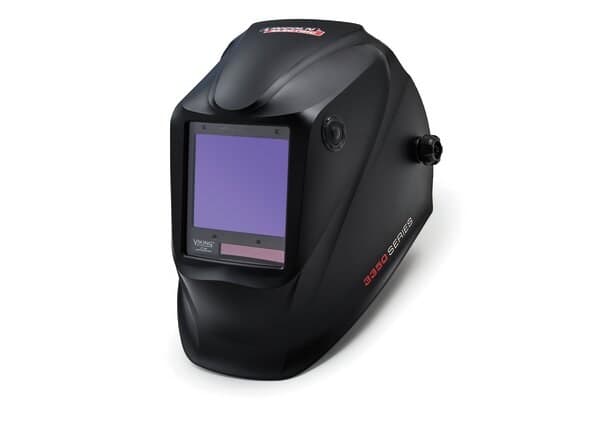
Lincoln Electric VIKING 3350 (K3034-4)
The one to buy if the money is there. It is the only helmet on this page that pairs a 5-13 shade range with a published sensor floor of 2 amps on both AC and DC, which covers twenty-amp TIG on sheet and 250-amp stick without owning a second hood.
Technical info
- Optical clarity: 1/1/1/1
- Viewing area: 12.5 sq in (3.74 x 3.34 in / 95 x 85 mm)
- Shade range: variable 5-13, internal control
- Grind mode: shade 3.5, external low-profile button
- Arc sensors: 4
- TIG amp rating: DC > 2 A, AC > 2 A
- Switching speed: 1/25,000 second
- Power: 1 x CR2450 replaceable battery (Lincoln lists no solar cell)
- Weight: 21 oz (595 g)
- Headgear: X6
- Lincoln MSRP: $670.82
- The lowest published sensor rating here - 2 amps on AC and on DC
- 5-13 shade range, so the low-amp TIG end of the scale is genuinely usable
- External grind button: you never reach inside a hood you are wearing
- 12.5 sq in window with a full 1/1/1/1 on all four EN 379 tests
- X6 headgear spreads the load, which a 21 oz helmet needs
- The most expensive helmet on this page
- Lincoln lists no solar cell, so a flat CR2450 ends your day
- 21 oz, heavier than everything here except the ESAB
- Lincoln's brochure lists a three-year warranty; Miller warrants its lens for four
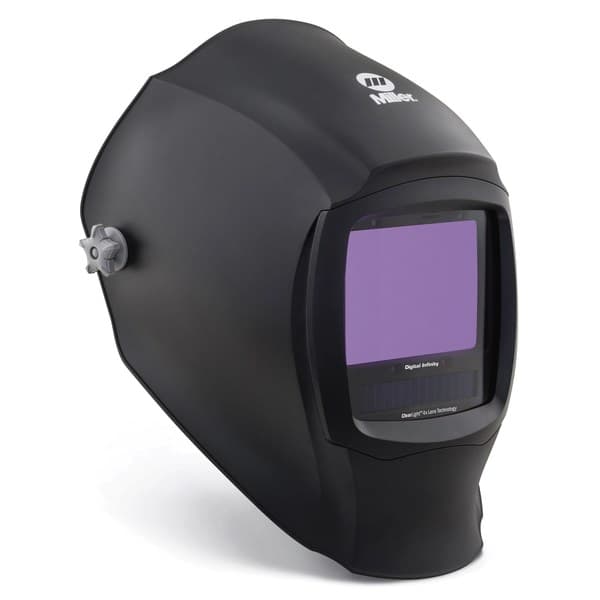
Miller Digital Infinity, ClearLight 4x (296786)
The largest window here and the brightest light state - shade 2.5 against everyone else's 3 or 3.5 - which is what you notice between welds rather than during them. Its welding scale starts at shade 8, with 5 to 8 held in a separate cut mode, so it is a production helmet rather than a light-work one.
Technical info
- Optical clarity (EN 379): 1/1/1/2
- Viewing area: 13.4 sq in (86.45 sq cm)
- Shade range: weld 8-13, cut 5-8, grind 2.5
- Light state: shade 2.5
- Arc sensors: 4
- TIG rating: 5 amps and below (Miller's own wording)
- Switching speed: 1/25,000 second
- Certifications: ANSI Z87.1+, CSA
- Weight: 21.4 oz (606 g)
- Warranty: auto-darkening lens warranted four years
- Extras: X-Mode, AutoSense, InfoTrack 2.0, two memory presets
- 13.4 sq in - the largest viewing area on this page
- Light state shade 2.5, the brightest here, so the hood can stay down between welds
- X-Mode senses the arc electromagnetically and holds the lens dark when the sensors are shadowed
- Four-year warranty on the lens itself
- AutoSense sets the sensitivity for you, which is the control people most often get wrong
- Weld mode starts at shade 8, with 5 to 8 kept in a separate cut mode - so for stick or MIG under 60 amps, where the minimum is 7, the lightest welding shade you can dial is 8
- 1/1/1/2: the shade shifts slightly when you look through it off-axis
- 21.4 oz, the heaviest lens and shell combination here
- Costs seven times the YESWELDER, and its published low-current rating is worded so differently from Lincoln's that the two cannot be compared
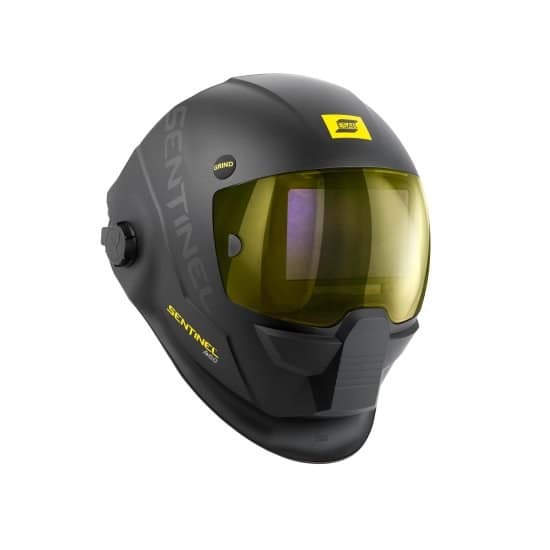
ESAB Sentinel A60
The most thoroughly certified helmet here, a hundred dollars under the Lincoln. Half-shade steps across 5-13, solar assist on top of two lithium cells, a colour touch screen, and the longest standards list on this page.
Technical info
- Optical class: 1/1/1/1
- Viewing area: 118 x 71 mm (4.65 x 2.80 in)
- Shade range: DIN 3 / 5-13, adjustable in 0.5 increments
- Light state: shade 3 in passive mode
- Arc sensors: 4
- Switching time: 0.04 ms light to dark; 0.1-0.9 s dark to light
- Power: 2 x CR2450 lithium plus solar cell assist
- Standards: ANSI Z87.1+, CSA Z94.3, EN 175, EN 379, EN 166, AS/NZS 1338.1, ISO 16321 +TIG, UKCA
- Weight: 644 g (1.4 lb)
- Controls: colour touch screen; external grind button with an internal warning LED
- Half-shade steps, so you can sit at 9.5 instead of choosing between 9 and 10
- The longest standards list here, including ANSI Z87.1+ and ISO 16321
- Solar assist plus two cells - it does not stop dead when one battery goes
- A warning LED inside the hood so you cannot forget the lens is in grind mode
- Settings on a touch screen rather than buttons hidden under the shell
- ESAB publishes no TIG amperage rating for it
- 644 g, the heaviest helmet on this page
- A touch screen is one more thing that can fail, and it is not user-replaceable
- The older Sentinel A50 is still sold alongside it and is only 1/1/1/2 with a smaller window - check the model number before you buy
Hobart Inventor Series 770890
The value pick for stick and MIG, and the wrong helmet for TIG. Four sensors, a 9.3 square inch window, ANSI Z87.1-2015 printed on the spec sheet and a two-year warranty - but it stops at shade 9.
Technical info
- Viewing area: 9.3 sq in (3.94 x 2.36 in / 100 x 60 mm)
- Shade range: 9-13 dark; light state shade 3
- Modes: weld and grind
- Arc sensors: 4
- Switching speed: 1/25,000 second
- Lens: PureColor (optical class not published)
- Standards: ANSI Z87.1-2015, CSA, CE EN 379
- Weight: 19.7 oz (560 g)
- Warranty: 2 years
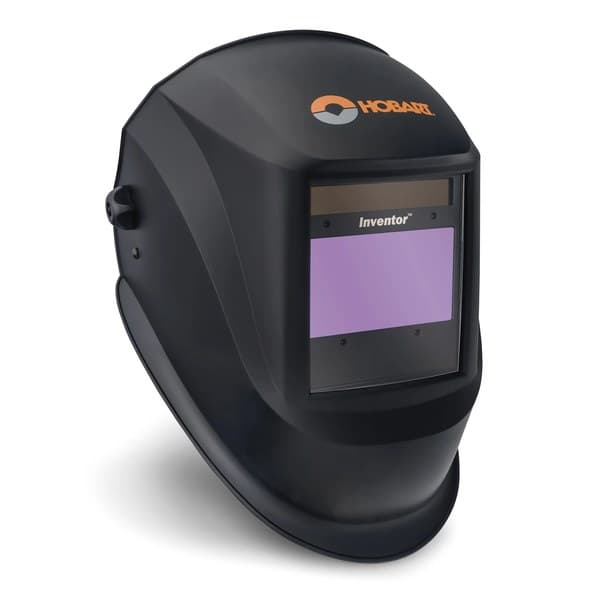
- Names its standards on the spec sheet - ANSI Z87.1-2015, CSA and EN 379 - which neither cheap helmet here does
- Four independent arc sensors, which is unusual at this end of the market
- 19.7 oz, the lightest of the branded helmets
- Two-year warranty, and Hobart sits inside the same group as Miller, so parts and service exist
- Shade 9-13 only, and no cut mode: at low-amp TIG you sit one shade darker than the minimum, and plasma or gas cutting is out
- No optical class published, so it cannot be compared on the four EN 379 digits
- No TIG amperage rating published
- 9.3 sq in is the smallest window of the branded helmets here, against 12.5 for the Lincoln and 13.4 for the Miller
Antra DP3-001X
Ten dollars more than the YESWELDER, a much smaller window, and the thing that matters at this price: Antra publishes its numbers. Optical class 1/1/1/2, ANSI Z87 and CSA Z94.3, and a DC TIG rating of more than 2 amps on a seventy-dollar helmet.
Technical info
- Optical class: 1/1/1/2
- Viewing area: 98 x 53 mm (3.86 x 2.10 in)
- Shade range: light DIN 3; dark DIN 5-9 / 9-13, shade lock 5-13
- DC TIG amperage rating: > 2 A
- Arc sensors: 4 infrared
- Switching time: 1/25,000 second
- Modes: weld, cut and tack presets; quick grind button at shade 3; two-step delay
- Power: solar cell plus 1 x CR2450 replaceable
- Standards: ANSI Z87, CSA Z94.3
- Weight: 17 oz
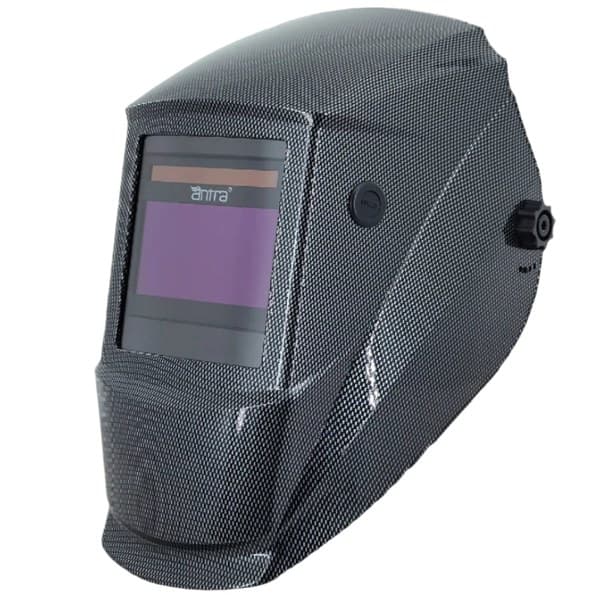
- The only budget helmet here that publishes a DC TIG rating - more than 2 A
- States ANSI Z87 and CSA Z94.3 on the maker's own page
- 17 oz, the lightest helmet on this page by some way
- Tack mode with a two-step delay, a feature normally found several hundred dollars higher
- States its optical class honestly as 1/1/1/2 rather than claiming 1/1/1/1
- 98 x 53 mm - a little over half the window area of the YESWELDER, and you feel it out of position
- Antra publishes a DC TIG rating and no AC figure
- The AH6-660 that most helmet guides still recommend has been superseded; the DP3 is the current model
YESWELDER LYG-M800H
The volume seller, and the one that needs the most care. With a 3.93 by 3.66 inch window it is unarguable value on paper. But YESWELDER states no ANSI Z87.1 compliance and no TIG amperage rating - not on its own product page, and not on the Amazon listing.
Technical info
- Claimed optical clarity: 1/1/1/1 (stated in the product title, not against a named standard)
- Viewing area: 3.93 x 3.66 in (100 x 93 mm)
- Shade range: dark DIN 5-9 / 9-13
- Light state: DIN 4 on YESWELDER's page; DIN 3 in the Amazon title
- Arc sensors: 4
- Response time: under 1/30,000 second
- UV/IR protection: stated as up to DIN 16
- Power: solar cell plus replaceable CR2450
- Weight: about 600 g (1.32 lb) per the Amazon listing
- Standards stated by the maker: none
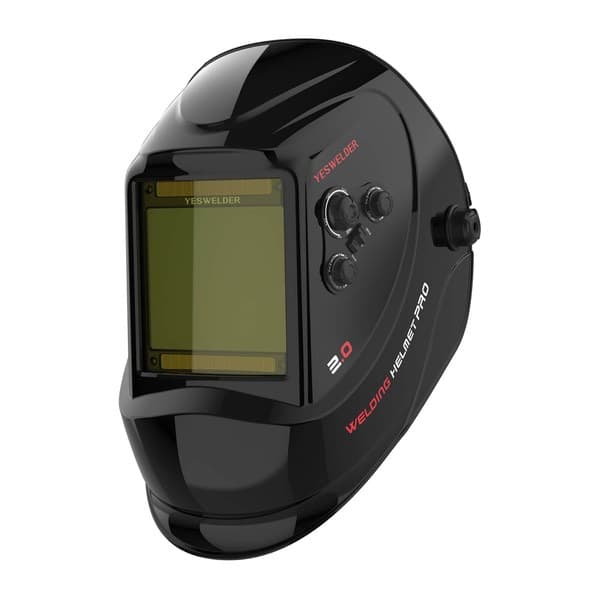
- The largest viewing area on this page, for a twelfth of the Miller's price
- Solar plus battery, so a flat cell does not end the day
- Reaches shade 5, so the low-amp end of the scale is at least available
- Four sensors and a built-in filter self-check
- 8,106 Amazon ratings at 4.4 - a great many people are using these without complaint
- No ANSI Z87.1, EN 379 or CSA claim on the maker's page or the Amazon listing
- No TIG amperage rating published, so low-current performance is unknown
- The maker says light state DIN 4 and the Amazon title says DIN 3 - the same helmet described two ways
- The 1/1/1/1 figure appears in the product title rather than against a stated test
What a welding helmet does not protect
A welding helmet is a filter and a face shield, and AWS Z49.1, Safety in Welding, Cutting, and Allied Processes, is clear that it is not the only eye protection you wear. Clause 4.2.1.1 requires safety spectacles with side shields, goggles or equivalent to be worn underneath it. The explanatory clause E4.2.1.1 adds the reason plainly: helmets are not designed to protect against severe impact.
OSHA says the same thing in 29 CFR 1910.133(a)(2): where flying objects are a hazard, the eye protection must have side protection. The practical version is that you lift the hood to chip slag or look at what you have just done, and that is the moment something hits you. A pair of Z87+ spectacles costs less than a packet of cover lenses.
On markings: ANSI/ISEA Z87.1 is the American standard for eye and face protection and the current edition is Z87.1-2025. "Z87" on a product means it met the basic requirements; "Z87+" means it also passed the high-impact tests. Hobart states ANSI Z87.1-2015, CSA and CE EN 379. Miller states ANSI Z87.1+ and CSA. ESAB lists ANSI Z87.1+, CSA Z94.3, EN 175, EN 379, EN 166, AS/NZS 1338.1 and UKCA. Antra states ANSI Z87 and CSA Z94.3. YESWELDER states none of these, in either place a buyer would look.
That is not the same as saying the YESWELDER fails the standard, and it may well pass it. It means the claim is not made anywhere you can read it, on a product whose job is to stop your retina being burned. On a sixty-dollar helmet with eight thousand ratings behind it, that is the one thing worth knowing before you click.
Sensitivity and delay: the two settings people get wrong
Two controls decide whether a helmet feels good or feels broken, and neither is on the box. Sensitivity is how strong an arc has to be before the lens darkens: turn it up and the filter triggers on a neighbour's arc, on sunlight through a roller door, sometimes on a halogen lamp; turn it down and it misses the start of a low-amp TIG arc. Delay is how long the lens stays dark after the arc stops. Short delay for tacking, so you can see between tacks. Long delay for heavy welding, where the puddle is still glowing brightly enough to hurt after the arc has gone out.
Set it in that order. Start at maximum delay and mid sensitivity, then bring the delay down until the lens clears at the moment you want to see the weld. If it flickers, raise the sensitivity before you blame the helmet; if it darkens when you are not welding, lower it. Miller's own demonstration walks through both controls on a digital hood:
What to check before you buy, in order
Work down this list and most of the market eliminates itself before you have looked at a single review.
- The lowest current you will ever weld at. Under about 30 amps DC TIG, you need a helmet whose maker publishes a sensor rating and whose shade range reaches 5. That rules out most of the market, including several good helmets
- The shade floor, not the ceiling. Everything reaches 13. What separates these six is whether they reach 5, 8 or 9
- Whether the maker names a standard at all - ANSI Z87.1 in the United States, CSA Z94.3 in Canada, EN 175, EN 379 and EN 166 in Europe. A product page that names none is asking to be trusted on nothing
- The four EN 379 digits, read as four separate results rather than a score. The fourth, angle dependence, is the one you feel out of position
- How many sensors, and whether anything will shadow them. Two is a pipe-welding problem waiting to happen; four is standard once you leave the cheapest shelf
- Grind mode, and whether its control is on the outside of the shell. Reaching inside a hood you are wearing is how people end up grinding in shade 10
- Power. Solar-assisted helmets top up while you weld; pure-battery helmets stop when the cell does. Both types here use a CR2450, so buy a pack of them
- Weight, last, once everything else is settled. 17 oz against 21 oz is a real difference by mid-afternoon
Frequently asked questions
What shade should I use for MIG welding?
OSHA's Table I-5 sets a minimum of shade 10 for gas metal arc welding from 60 amps up to 500, and shade 7 below 60 amps. The instruction under the table is to start with a shade too dark to see the weld zone and then move lighter until you can see it, without going under the minimum. Most MIG on steel between 100 and 250 amps settles at shade 10 or 11.
Why does my helmet stay clear when I TIG at low amperage?
Because the sensors cannot see the arc. Every auto-darkening filter has a current below which it will not trigger reliably, and the makers who publish it call it a TIG amp rating. Lincoln rates the VIKING 3350 at more than 2 amps on AC and DC; the cheaper VIKING 1840, with two sensors instead of four, is rated at more than 3 amps DC and more than 5 amps AC. Raise the sensitivity first, change the battery second, and check that nothing is shadowing the sensors. If it still fails at fifteen or twenty amps, the helmet is not rated for the work.
Are cheap auto-darkening welding helmets safe?
The ultraviolet and infrared filtering in an auto-darkening lens is passive and permanent rather than switched: YESWELDER states UV/IR protection up to DIN 16 for the M800H, and Antra describes its filters as full-time passive UV/IR behind the LCD shutter. That is why a shutter which fails to darken is a painful flash rather than an instant injury. What you lose at sixty dollars is verification. If the maker does not state ANSI Z87.1 anywhere you can read it, nobody is telling you the helmet was tested.
Do I still need safety glasses under a welding helmet?
Yes. AWS Z49.1 clause 4.2.1.1 requires spectacles with side shields, goggles or equivalent under the helmet, and its explanatory clause notes that helmets are not designed to protect against severe impact. OSHA 1910.133(a)(2) requires side protection wherever flying objects are a hazard. You lift the hood to chip and to inspect, and that is when you get hit.
Does 1/1/1/1 mean a helmet is better than 1/1/1/2?
Not on its own. The digits are four separate EN 379 test results - optical class, diffusion of light, variation in luminous transmittance and angle dependence - each graded 1 to 3 with 1 best. Miller's Digital Infinity and 3M's Speedglas 9100 filter are both 1/1/1/2 and both cost several times a sixty-dollar helmet sold as 1/1/1/1. The fourth digit is the one worth caring about, and none of the four tells you anything about the shell, the headgear, the sensors, or whether the helmet was ever tested to ANSI Z87.1.
Solar or battery - does it matter?
Not for safety. Solar-assisted helmets top up the cell while you weld, so they go longer between changes; pure-battery helmets, including the Lincoln VIKING 3350, stop when the CR2450 does. Every helmet on this page uses a CR2450, so carry a spare whichever you choose.
Sources
- Lincoln Electric - VIKING 3350 Black (K3034-4) product page and MSRP
- Lincoln Electric - VIKING 3350 series specification sheet (PDF)
- Lincoln Electric - 4C lens brochure, with the 1840, 2450 and 3350 TIG amp ratings (PDF)
- Miller - Digital Infinity ClearLight 4x product page
- Miller - Digital Infinity specification sheet, optical clarity and TIG rating (PDF)
- ESAB - Sentinel A60 specifications and standards list
- Hobart - Inventor Series specification sheet (PDF)
- Antra - DP3 series specifications, including the DC TIG amperage rating
- YESWELDER - LYG-M800H product page
- 3M - Speedglas technical data, with the EN 379 four-digit classification explained (PDF)
- 3M - Speedglas G5-01 filter datasheet (PDF)
- OSHA - 29 CFR 1910.133, eye and face protection, including Table I-5
- AWS - ANSI Z49.1:2021, Safety in Welding, Cutting, and Allied Processes (free PDF)
- AWS Welding Digest - complete welding lens shade chart
- ANSI - what ANSI/ISEA Z87.1-2025 covers, and the Z87 versus Z87+ marking
Which one
If you weld TIG at low amperage, buy the Lincoln VIKING 3350: it is the only helmet here with both a 5-13 shade range and a published 2 amp sensor rating on AC and DC. If you weld production MIG and stick and want the biggest, brightest window, the Miller Digital Infinity earns its price; its welding scale simply starts at shade 8, with 5 to 8 kept in a cut mode. If you want the most standards for the least money, the ESAB Sentinel A60 is the value buy of the three premium helmets. If the budget is tight and the work is stick and MIG, take the Hobart 770890 and do not use it for fine TIG. And if the budget is tighter still, take the Antra DP3-001X over the better-reviewed YESWELDER, because Antra tells you what its helmet was tested to and how little current its sensors can see, and YESWELDER tells you neither.