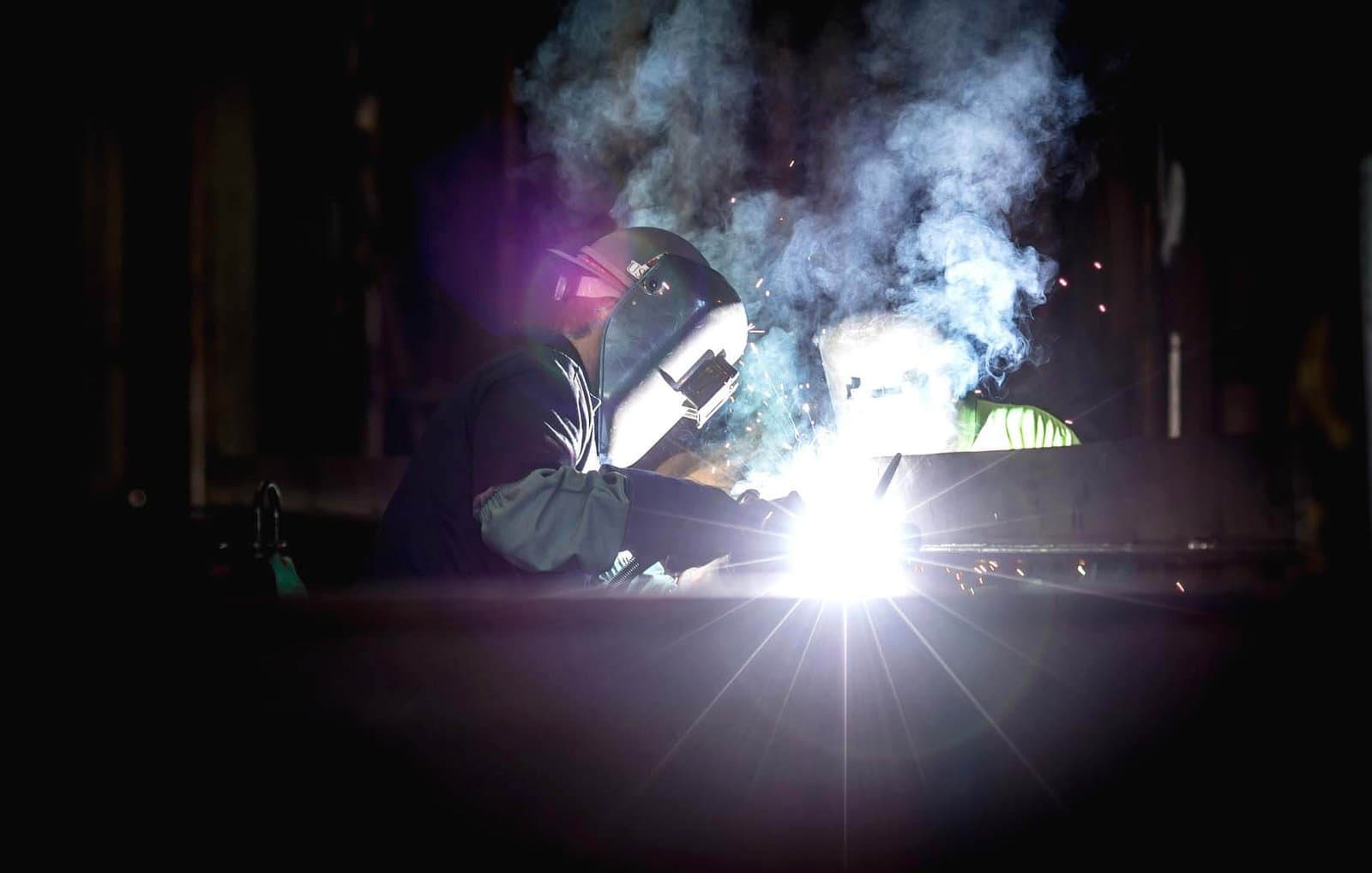
The difference between MIG and TIG welding is who feeds the filler. MIG drives a consumable wire through the torch automatically, so one hand welds and the machine keeps up. TIG holds a tungsten electrode that is never consumed, and your other hand feeds a rod into the puddle. That one difference produces every other difference between them.
MIG and TIG compared
| MIG (GMAW) | TIG (GTAW) | |
|---|---|---|
| Electrode | Consumable wire, fed continuously | Tungsten, not consumed |
| Filler | The wire itself | A separate rod, fed by your other hand |
| Shielding gas | Argon and CO2 mixes, or CO2 on steel | Pure argon, or argon with helium |
| Current control | Trigger, on or off | Usually a foot pedal, continuously variable |
| Speed | Fast. High deposition rate | Slow. TWI note the deposition rate is low |
| Thin material | Burns through easily | The process of choice |
| Aluminium | Possible, with a spool gun | Yes, on AC |
| Appearance | Good, some spatter | No spatter, and the stacked-dime bead people photograph |
| Outdoors | No. Wind removes the gas shield | No. Same problem |
| Learning curve | Days | Weeks |
How MIG works
A motor feeds bare wire from a spool, through a liner, out of a contact tip. The wire is both the electrode and the filler, and gas flows around it from the same nozzle. TWI give the usual wire range as 0.6 to 1.6 mm; a home machine runs 0.6 or 0.8 mm on thin steel. Setting wire speed against voltage is the skill, and there is only one right pair for a given thickness.
What the wire does when it crosses the arc has a name, and it changes with voltage. TWI describe the modes and give figures for 1.2 mm wire: in dip transfer, at 17 to 22 volts and 100 to 200 amps, the molten tip of the wire physically dips into the pool and short-circuits, hundreds of times a second. In spray transfer, at 27 to 35 volts and 250 to 400 amps, the metal crosses as a fine spray of droplets without touching.
That is why a MIG machine sounds like frying bacon when it is set correctly for thin steel: you are listening to dip transfer. Spray transfer sounds like a hiss, needs argon rather than CO2, and is for thick plate in the flat position.
How TIG works
The arc runs between a pointed tungsten electrode and the work. TWI note that because the electrode is not consumed, the welder does not have to balance the heat of the arc against metal being deposited from the electrode - the heat and the filler are two separate controls, which is exactly why TIG is both precise and slow. Setting one up and striking the first arc is a different job from MIG, and if you are buying, our TIG machine comparison explains which numbers on a spec sheet matter.
TIG normally runs direct current with the electrode negative. TWI explain why: arc heat divides roughly one third at the negative pole and two thirds at the positive, so the electrode is kept negative to stop it overheating and melting. Aluminium is the exception. On AC, part of each cycle puts the workpiece at the negative pole, and TWI describe the effect plainly - the surface is cleaned of oxide contamination. Without that, the oxide skin on aluminium never lifts.
The differences that actually decide it
TWI's own comparison is blunt about the trade. MIG welders, they write, typically provide faster welding speeds in a production setting, because the filler feeds automatically and the arc is rounder and broader. TIG welds, they write, are stronger, more precise and more aesthetically pleasing, with very little or no spatter.
It is worth being careful about the word stronger. A sound weld in either process is normally stronger than the metal around it, because the filler over-matches. What TIG actually delivers is fewer defects and less contamination for the same operator effort - there is no spatter to clean, no wire stubbing, and you can see the puddle because the arc is not hidden behind a wire.
Where each one loses
| Situation | MIG | TIG |
|---|---|---|
| Thin sheet under 1.5 mm | Blows through unless settings are exact | The right tool |
| Plate over 6 mm | The right tool | Deposition rate too low to be practical |
| Aluminium | Needs a spool gun; the soft wire birdnests in a standard liner | AC TIG, and the standard answer |
| A long production run | Fast, and mechanises easily | Slow and expensive in labour |
| Rusty or painted steel | Poor | Worse. TIG needs bright, clean metal |
| Learning it in a weekend | Achievable | It will not happen |
Which should you choose?
Watch the two run before you spend anything. TimWelds compares them from a hobbyist's point of view rather than a production one, which is the comparison most people actually need.
Choose by the first line that matches
In the order that most people arrive at the question.
- You want to build things out of steel and you want to start now
- MIG
- You want to weld aluminium properly
- TIG, on a machine that says AC/DC. A DC-only TIG will not do it
- Exhaust tube, bike frames, stainless, anything thin
- TIG
- Trailers, gates, brackets, thick steel
- MIG, or stick if you are working outdoors
- You want one machine for both
- a multiprocess inverter does MIG and DC TIG. Check whether it offers AC TIG before assuming it does aluminium
What they share
Both are gas-shielded, and that is their common weakness: neither works outdoors. A light breeze pulls the shield off the puddle and fills the weld with porosity that will not be visible until it fails. That is what stick and self-shielded flux-cored are for, and the wider comparison of welding processes sets out where each one belongs. Both also need the right bottle: which gas for which job matters more on MIG than most people expect.
Both also throw the same ultraviolet. A MIG arc and a TIG arc will burn skin through a thin shirt in minutes - our guide to flame-resistant welding shirts covers what the labels certify and what they do not.
Frequently asked questions
Is TIG welding stronger than MIG?
TWI describe TIG welds as stronger, more precise and more aesthetically pleasing than MIG welds. In practice a sound weld from either process is stronger than the parent metal, because filler is chosen to over-match it. What TIG really buys is control and cleanliness: no spatter, a visible puddle, and separate control of heat and filler.
Can you weld aluminium with a MIG welder?
Yes, but not well with a standard setup. Aluminium wire is soft and jams in a normal liner, so it needs a spool gun or a push-pull torch, plus pure argon. For anything thin or visible, AC TIG is the standard answer, because only alternating current strips the oxide skin off the surface.
Which is easier to learn, MIG or TIG?
MIG, by a wide margin. One trigger, one hand, and the machine feeds the filler. TIG asks two hands and a foot to do three different jobs at once, and most people are poor at it for the first couple of weeks. Days against weeks is a fair summary.
Do MIG and TIG use the same gas?
No. MIG on steel usually runs an argon and CO2 mix - TWI list CO2, argon with 2 to 5 per cent oxygen, and argon with 5 to 25 per cent CO2. TIG runs pure argon, because tungsten is sensitive to reactive gases such as oxygen and CO2, which would erode the electrode.
Can I use one machine for both?
A multiprocess inverter will do MIG and DC TIG, and usually stick as well. The gap is AC TIG, which is what aluminium needs, so check the specification says AC/DC rather than assuming. A combination machine is cheaper than two and slightly worse at each.
Sources
- TWI - MIG vs TIG welding: what is the difference between them
- TWI - MIG welding: transfer modes, voltages, wire sizes and shielding gases
- TWI - Tungsten inert gas (TIG/GTA) welding: polarity, and why aluminium needs AC
- TWI - What is gas metal arc welding (MIG / MAG)
- American Welding Society - What is GTA welding
- TimWelds - TIG vs MIG welding for hobbyists
In short
MIG feeds the filler for you and TIG makes you do it, and everything else follows: MIG is faster, cheaper and easier, TIG is cleaner, more controllable and the only sensible way to weld thin aluminium. Neither works outdoors. If you are buying one machine and you weld steel, buy MIG; if you weld aluminium or anything that will be looked at, buy AC/DC TIG and accept the fortnight.