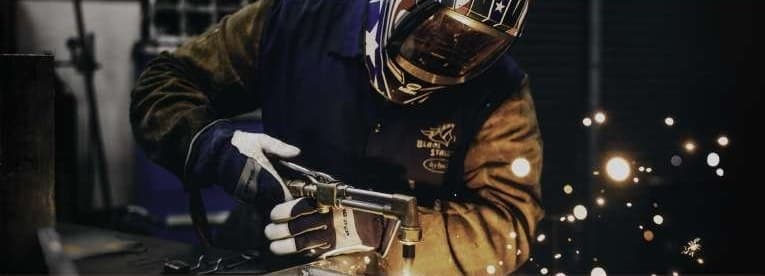
Most explanations of welding start by listing processes. That is the wrong end. The processes differ only in where the heat comes from; what happens in the metal is the same in all of them, and once you have that, the rest follows.
What Actually Happens in a Weld
Bring the edges of two pieces of metal up to their melting point and they form a shared pool of liquid metal — the weld pool. Move the heat along and the pool moves with it, melting new metal at the front and freezing behind. What solidifies is a single crystal structure spanning what used to be a joint. There is no longer a boundary there.
Most of the time a filler metal is added, melting into the same pool to fill the gap and build up the joint. It is not always needed: a weld made without filler, by simply fusing the two edges together, is called autogenous, and thin sheet is often joined that way.
The reason this is harder than it sounds is that molten steel is chemically greedy. At welding temperature it will pull oxygen and nitrogen straight out of the air, and the weld cools porous and brittle. Every arc process therefore has to keep the atmosphere off the pool — with a shielding gas, with flux that burns to make its own gas, or with both.
Welding, Brazing and Soldering Are Not the Same Thing
These get used interchangeably and they describe genuinely different mechanisms. TWI draws the line in one sentence: welding “involves melting of the base materials to create a consolidated joint”, while brazing and soldering “melt the filler metal (braze or solder) only, not the base materials”.
Three ways to join metal
| Process | Does the base metal melt? | Filler melts at |
|---|---|---|
| Welding | Yes — that is the definition | Around the same temperature as the base metal |
| Brazing | No | Above 450°C |
| Soldering | No | Below 450°C |
Which is better depends entirely on the job. Welding gives the strongest joint, because the joint is the parent metal. Brazing joins dissimilar metals and thin or heat-sensitive parts that welding would destroy. Soldering is for electronics and plumbing, where the heat has to stay low. Calling one of them “the best” is how you end up using the wrong one — we compared all three directly.
Why Welds Often Fail Beside the Weld, Not in It
Around every weld is a band of metal that never melted but got hot enough to change — the heat-affected zone. TWI defines it as “a non-melted area of metal that has undergone changes in material properties as a result of being exposed to high temperatures”.
Those changes are not cosmetic. Toughness drops, hardness shifts, and corrosion resistance can fall away — in stainless steel, chromium carbides forming at the grain boundaries can pull the local chromium below the level that makes it stainless at all. In carbon steel, hydrogen trapped during cooling migrates into the highly stressed metal at the edge of the weld and cracks it, sometimes days later.
The Main Families of Welding
The processes differ in where the heat comes from and how the pool is protected. There are dozens; they group into four, and our guide to the types of welding processes goes through them individually.
Four families, and where the heat comes from
| Family | Heat source | Typical processes and uses |
|---|---|---|
| Arc welding | An electric arc between an electrode and the work | SMAW (stick) for construction and pipe, GMAW (MIG) for fabrication and repair, GTAW (TIG) for aerospace and thin or precise work |
| Resistance welding | The work's own resistance to a heavy current, plus pressure | Spot and seam welding — car bodies, sheet metal, tube |
| Energy beam welding | A focused laser or a beam of electrons | Deep, narrow, very precise welds in medical, electronics and aerospace parts |
| Gas welding | A fuel gas burned with oxygen | Oxy-acetylene, for repair work and cutting where there is no power |
Arc welding covers most of what a person is likely to do or see, and the differences between its processes are mostly about how the filler is delivered and how the pool is shielded. If you are starting, MIG is the usual first process.
Welding as a Job
Some numbers, because most pages on this subject quote figures with no source. The US Bureau of Labor Statistics counts 437,700 people employed as welders, cutters, solderers and brazers in 2025, with median pay of $53,750 a year and a typical entry requirement of a high school diploma. Employment is projected to grow 2% between 2025 and 2035 — slower than the average across all occupations.
That is a flatter picture than the trade press usually paints, and it is worth knowing before anyone signs up for a course. The demand that does exist is concentrated in specialisms — pipe, pressure vessel, underwater, aerospace — where certification is the thing that pays, not the welding itself.
What Makes It Dangerous
Three hazards at once, and they are unrelated to each other: the arc emits ultraviolet strong enough to burn the surface of the eye within seconds, the fume carries metal oxides into the lungs, and the sparks start fires in whatever is lying around. The welding safety standard, ANSI/AWS Z49.1, covers all three, and none of them is optional to think about.
Frequently Asked Questions
How does welding actually join two pieces of metal?
By melting both of them. The heat creates a shared pool of liquid metal across the joint; as the heat moves on, that pool solidifies as one continuous piece of metal. The join is not a layer of something else holding two parts together — after a sound weld there is no boundary there at all.
What is the difference between welding and brazing?
In welding the base metals melt. In brazing they do not — only the filler melts, above 450°C, and it flows into the joint and bonds to the surfaces. Soldering is the same idea below 450°C. Brazing is the right choice for dissimilar metals and for thin or heat-sensitive parts that welding would ruin.
Why does welding need a shielding gas?
Because molten metal absorbs oxygen and nitrogen from the air, and a weld that cools having done so is porous and brittle. Shielding gas pushes the atmosphere away from the weld pool until it has solidified. Stick and flux-cored wire do the same job with a flux that burns to produce its own shielding.
What is the heat-affected zone?
The band of metal beside the weld that did not melt but got hot enough for its properties to change — toughness, hardness and corrosion resistance can all shift. It is frequently where a welded structure fails in service, which is why preheat, controlled cooling and post-weld heat treatment exist.
Is welding a good career?
It pays a median of $53,750 a year in the US and needs no degree, but the Bureau of Labor Statistics projects only 2% employment growth from 2025 to 2035, slower than average. The money is in certified specialisms — pipe, pressure vessel, underwater — rather than in general fabrication.
Sources
- TWI, welding, brazing and soldering — which processes melt the base material, and the 450°C line between brazing and soldering
- TWI, the heat-affected zone — definition, the property changes in it, and why failures happen there
- US Bureau of Labor Statistics, Welders, Cutters, Solderers and Brazers — 2025 employment, median pay and the 2025–2035 projection
- ANSI/AWS Z49.1:2021, Safety in Welding, Cutting, and Allied Processes — the hazards and the controls for them
The Short Answer
Welding works by melting the two pieces themselves so they freeze as one. The filler fills the gap, the shielding keeps the air out of the molten metal, and the heat source is the only thing that really differs between processes. The part worth remembering afterwards is the heat-affected zone: the metal just outside the weld changed too, and that is usually where things break.