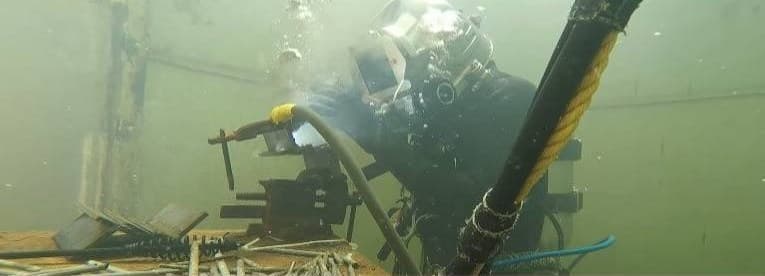
Underwater welding looks impossible the first time you see it. An electric arc, several hundred amps, burning in seawater — and the diver holding it is fine. The trick is that the arc is never really touching the water.
This guide covers both methods — how each one works, why the dry method produces a far better weld, how deep each can go, the code that governs the work, and the gear a welder-diver actually wears.
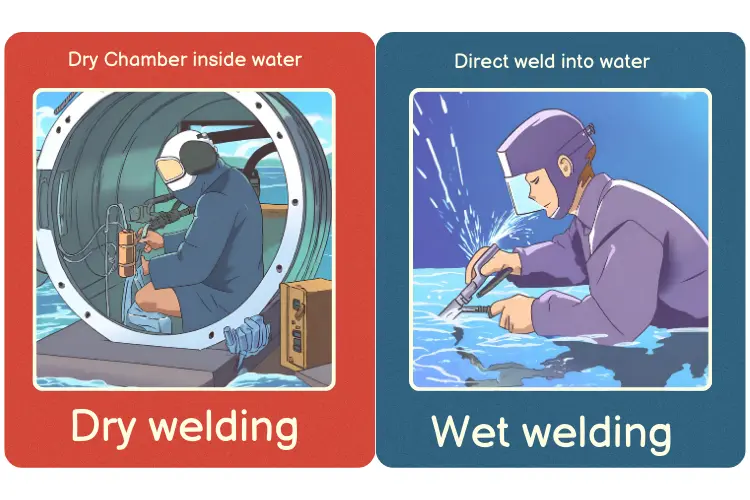
What Is the Difference Between Dry and Wet Underwater Welding?
Everything else on this page follows from this one distinction: whether there is water touching the weld pool.
Wet welding vs dry hyperbaric welding
| Wet welding | Dry (hyperbaric) welding | |
|---|---|---|
| Where the welder is | In the water, at the joint | Inside a sealed, gas-filled habitat |
| What shields the arc | The arc's own gas bubble | Dry gas at the surrounding water pressure |
| Weld quality | Lower — rapid cooling and absorbed hydrogen | Comparable to surface welding |
| Typical depth | The first tens of metres | Several hundred metres, using closed-bell and saturation diving |
| Setup time | Hours — the diver goes in and works | Days — the habitat has to be built, positioned and sealed |
| Cost | Low | High: habitat, positioning, gas and pressure management |
| Used for | Repairs to sheet piling, harbour structures, temporary fixes | Pipelines and critical structures where the weld must be certified |
If you take one thing away: wet welding buys speed, dry welding buys quality. Which one a job gets is almost always decided by whether the finished weld has to carry a certified load.
How Does Dry Hyperbaric Welding Work?
Dry welding is not a different way of welding so much as a way of removing the water first. The welding itself is close to ordinary topside practice.
The habitat
A sealed chamber — the habitat — is lowered and fitted around the joint. Gas is fed in until the water is pushed out through an open bottom, leaving a dry pocket with the workpiece inside it. The welder-diver then enters and works in air, or in a breathing mixture, with the weld in front of them and the sea held back by pressure alone (Hyperbaric Welding Center: wet vs dry).
Habitats range from a small box clamped around a single pipe joint to a chamber a welder can stand up in. The larger it is, the more it costs to build, position, seal and keep supplied with gas and power for the length of the job.
Why the pressure has to match the depth
The gas inside the habitat has to be held at the pressure of the water outside it. If it were lower, water would come back in; the dry pocket only exists because the gas is pushing back just as hard as the sea is pushing.
That pressure rises quickly. Seawater adds roughly one atmosphere — about 14.7 psi — for every 10 metres (33 feet) of depth. At 30 metres the habitat is holding about four atmospheres; at 100 metres, about eleven. This is why deep dry welding needs saturation diving and a decompression schedule rather than a diver who simply swims down.
Why dry welds come out stronger
Two things ruin a wet weld, and the habitat removes both.
- Cooling rate. Water pulls heat out of the joint far faster than air does. A weld that quenches that quickly forms hard, brittle microstructure in the heat-affected zone.
- Hydrogen. The arc splits water into its elements, and hydrogen dissolves into the molten metal. As the weld cools, that hydrogen drives cold cracking — cracks that can appear hours after the welder has finished.
Inside a habitat the weld cools at something like a normal rate, in a gas that is not made of hydrogen and oxygen. That is the whole reason dry welds can reach a quality comparable to conventional surface welding and be certified for pipelines, while wet welds usually cannot (Hyperbaric Welding Center).
How deep can dry welding go?
Far deeper than wet welding. Closed-bell and saturation diving techniques put hyperbaric welding several hundred metres down, and the limit is a diving and logistics problem rather than a welding one — the arc does not care about depth, the human being does.
How Does Wet Underwater Welding Work?
In wet welding the diver welds directly into the sea, using shielded metal arc welding with a waterproofed electrode — see our guide to types of welding rods for how electrode coatings work. Nothing separates the arc from the water except the arc itself.
The bubble that makes it possible
When the arc strikes, the heat vaporises the flux coating and breaks down the surrounding water. The gas this produces — largely hydrogen, along with carbon monoxide and metal vapour — forms a bubble around the arc that keeps liquid water off the weld pool for the moment it matters. The melted flux then covers the bead as slag while it cools.
It works, but only just. The bubble is unstable, it boils away constantly, and the stream of bubbles rising past the welder's faceplate is one of the reasons visibility at the joint is so poor.
Why wet welds are weaker
Both problems from the previous section apply at full strength: the water quenches the joint almost instantly, and hydrogen from the dissociated water goes straight into the weld metal. The result is a joint that is more prone to hydrogen-induced cold cracking and harder to inspect, which is why wet welding is used for structural repair work rather than for anything that has to be certified to surface standards.
When wet welding is the right choice
Often. Not every weld underwater needs to be a certified pipeline joint. Sheet piling, harbour structures, barges, temporary repairs and anything where getting a diver in the water this afternoon matters more than a metallurgically perfect bead — that is wet welding's territory, and building a habitat for such a job would be absurd.
What Standard Governs Underwater Welding?
Underwater welding is not improvised. In the United States the governing document is AWS D3.6M, the Underwater Welding Code, which covers both dry and wet work and sets out how a weld is qualified, examined and classified.
Weld classes under AWS D3.6M:2017
| Class | What it means |
|---|---|
| Class A | Comparable to above-water welding — the most stringent class, for critical applications |
| Class B | For less critical applications, where some discontinuities are acceptable |
| Class O | Must meet the requirements of another designated code or specification |
If someone tells you a weld was done underwater, the useful follow-up question is which class it was qualified to (summary of AWS D3.6M:2017). In Europe the equivalent framework is ISO: EN ISO 15618-1 and ISO 15614-9 for wet welding, EN ISO 15618-2 and ISO 15614-10 for dry.
Why Is Underwater Welding Dangerous?
The welding is rarely the thing that hurts people. The diving is.
Add the ordinary risks of commercial diving — differential pressure from a nearby intake, entanglement, cold, near-zero visibility — and the reason the job pays what it does becomes clear (hazard overview). If the career interests you, we cover how to become an underwater welder and what the work pays separately.
What Gear Does a Welder-Diver Use?
Three groups: what keeps the diver alive, what keeps the electricity where it belongs, and what does the welding.
Life support and diving equipment
- Diving helmet — surface-supplied, with a welding lens fitted to the faceplate and communications to the topside crew
- Umbilical — the line carrying breathing gas, communications, and often hot water for the suit; the diver's connection to the surface in every sense
- Bailout gas — an independent cylinder carried on the back, enough to reach the surface or the bell if the umbilical fails
- Suit and harness — a drysuit or hot-water suit against cold, on a harness rated to lift the diver out
- Diving knife — for entanglement, not for welding
Electrical safety
This is the part that has no topside equivalent, because on land the water is not part of the circuit.
- Knife switch — a lever at the surface that isolates the welding current. It stays open at all times except the moment the diver is actually welding, and the diver asks for it to be closed and opened by voice. This single piece of discipline is what keeps wet welding survivable
- Insulated stinger — the electrode holder is fully insulated; any bare metal in the diver's hand is a path to earth
- DC, never AC — direct current with the electrode negative is used throughout. Alternating current is not used underwater: it reverses continually, which makes it far more dangerous to a body in a conducting medium and gives a less stable arc
Electrodes and the welding machine
- Waterproofed electrodes — the flux is coated or sealed so it does not disintegrate before it reaches the joint
- A high duty cycle machine — underwater work runs long, continuous arcs rather than short bursts
- Stable DC output — a drooping-characteristic DC source, with the polarity set and checked topside before the diver goes in
The surface welding kit itself is ordinary enough — much of the technique carries over from stick welding on land, and the flame-resistant clothing a diver wears topside between dives is the same gear covered in our welding shirt guide.
Frequently Asked Questions
What is dry underwater welding?
Dry underwater welding, also called hyperbaric welding, is done inside a sealed habitat placed around the joint. Gas at the surrounding water pressure pushes the water out, so the welder works in a dry pocket and the weld never touches water. It produces welds comparable in quality to surface welding, which is why it is used on pipelines and other critical structures.
How deep can underwater welding be done?
Wet welding is generally limited to the first tens of metres. Dry hyperbaric welding reaches several hundred metres using closed-bell and saturation diving. The constraint is the diver's physiology and the logistics of supporting them at depth, not the welding process itself.
Why are wet welds weaker than dry welds?
Two reasons, both caused by the water. It pulls heat out of the joint very fast, which leaves hard, brittle structure in the heat-affected zone; and the arc splits water into hydrogen and oxygen, so hydrogen dissolves into the weld metal and later causes cold cracking. A habitat removes the water and therefore both problems.
What standard covers underwater welding?
AWS D3.6M, the Underwater Welding Code, covers both wet and dry work in the United States. It defines three weld classes: Class A, comparable to above-water welding; Class B, for less critical applications; and Class O, which must meet another designated code. In Europe the equivalent standards are EN ISO 15618-1 and ISO 15614-9 for wet welding and EN ISO 15618-2 and ISO 15614-10 for dry.
Is underwater welding dangerous?
Yes, though the greatest risks come from the diving rather than the welding. The specific hazards are electric shock in a conducting medium, explosive pockets of hydrogen and oxygen produced by the arc, and decompression sickness. Commercial diving hazards such as differential pressure and entanglement apply on top of those.
Sources
Checked against the following. Any job carried out for real is governed by the contract specification and the diving contractor's procedures, not by a web page.
- AWS D3.6M:2017, Underwater Welding Code — weld classes and scope, from AWS
- ANSI: AWS D3.6M:2017 explained — what the code covers
- Hyperbaric Welding Center — wet vs dry welding — depth ranges, weld quality, ISO standards
- Weld Guru — underwater welding — hazards, including explosive gas accumulation
The Short Answer
Wet welding puts the diver and the arc in the water and accepts a weaker joint in exchange for speed and low cost. Dry hyperbaric welding builds a pressurised room around the joint, removes the water, and gets surface-quality welds at far greater expense and depth. Which one a job uses comes down to a single question: does the finished weld have to be certified?